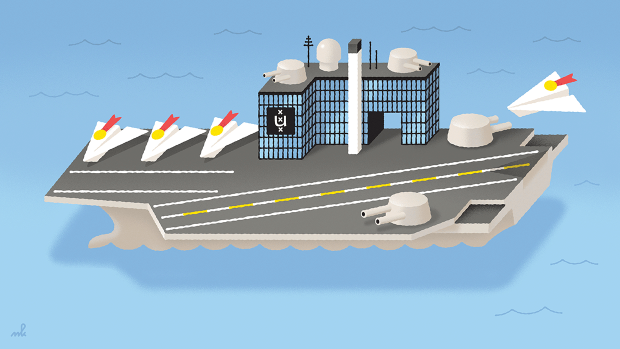
How should we deal with technologies that can both help and destroy us?

Satellites enable us to check the weather in the morning, but also to carry out a precision bombing. So-called dual-use technologies can be applied to both civilian and military ends and are therefore subject to extensive legislation. Universities must take that into account as well, explains professor Machiko Kanetake, who delivers an inaugural lecture about dual-use this Friday.
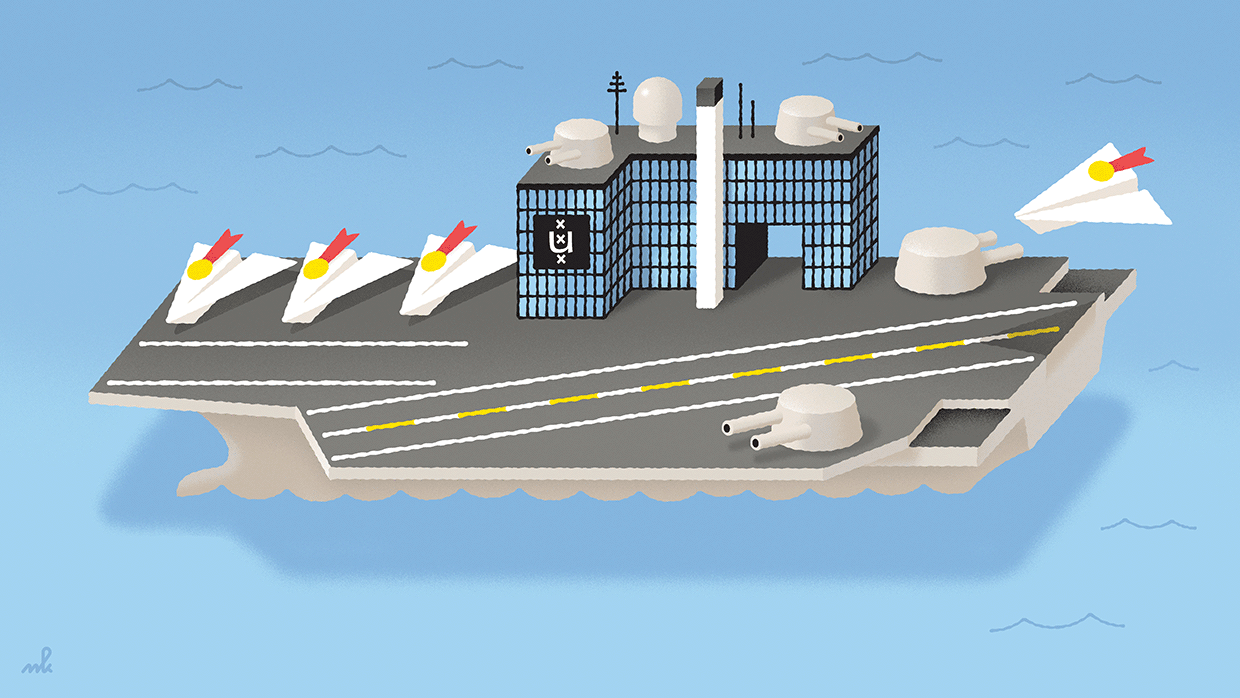
The potential collaboration between the UvA and the defence sector is a thorny issue among many students, teachers and employees. One of the concerns is that UvA contributes to the development of technologies that can be used for both civilian and military purposes, so-called “dual-use technologies”. Machiko Kanetake, professor of International Law and Security Governance since July 2025, will give her inaugural lecture about these technologies at the Lutherse Kerk tomorrow. She explains what benefits and risks they can bring.
When are technologies considered to be of “dual-use”?
“Dual use is a very broad concept: some people say any goods can be dual use. At its core it is an item used in our daily lives that has a potential for being used for military purposes.”
“The example I usually give is that of a satellite in space. Satellites are essential for our daily communications and, for example, tracking climate change. In that sense, they are critical infrastructure for our civilian lives and science. At the same time, they are essential for military operations, to track the movement of military vehicles or other military targets. Without them it is impossible to run any modern military operation.”

Is it possible to govern these technologies?
“One of the primary legal instruments is called dual use export control, which is essentially a way to restrict the international movement of sensitive goods. Its goal is that technology with a military application does not end up falling in the wrong hands.”
“Let's say an EU-based company that develops satellite components and wants to sell them to non-EU countries. Then a company must check if their product is on the list of controlled items, a list of hundreds of pages, containing for example space technologies. If that is the case, they need to, depending on the destination, apply for a licence.”
Does the EU differentiate between destinations that can be trusted and those that cannot with dual-use technologies?
“There are ten non-EU countries that are covered by most comprehensive general licenses, which means exporters can export sensitive goods without seeking authorization before every export: The United States, Australia, New Zealand, Canada, Iceland, Japan, United Kingdom, Norway, Switzerland and Liechtenstein.”
“In the absence of general licenses, exporters may need to seek licenses for every export. So, export control divides the world into safe and 'sensitive' destinations. To me that’s both interesting and worrisome.”
How do these regulations impact research European at universities, like the UvA?
“The instrument of export control is usually used for physical transfer of goods, but it is also applicable to intangible transfer. When a Dutch university wants to set up an international research project in artificial intelligence, quantum computing or some other cutting-edge technology, export control can be applicable if it shares a prototype or idea with non-EU partners.”
Could that also have consequences for the hiring of academic staff? For example in denying researchers from “sensitive countries”?
“If a Dutch laboratory in the Netherlands for instance wishes to hire a postdoctoral researcher with a non-EU nationality on a research project concerning controlled dual-use items, yes, export control can be applicable.”
“Yet this is usually not the main issue. Main problems are that researchers do not apply, or recruiters hesitate taking some researchers, depending on their backgrounds, beyond what is required by export control regulations. There is a very good NPO podcast series about this called Vriend of Vijand (friend or foe).”
A recent letter of intent between the Ministry of Defence and the Universities of the Netherlands expressed a willingness to increase collaboration between the two, in response to the current geopolitical climate. Have the wars in Ukraine, Gaza and Iran influenced regulations of dual use?
“Dual use export control was always there, but recently it became more discussed due to intensifying geopolitical tensions and rivalries, especially with Russia and China. The EU has been more active in encouraging states to be more aware about the applicability of export controls to research institutions, including universities. The EU has done this as part of its ‘economic security’ policies.”
“The same policy has new meaning against the background of geopolitical competitions. There has been greater investment in defence technologies, which has the side effect that many of the technologies that were previously not considered for defence purposes are now being considered for them. In other words: dual use is not about the technology itself, but primarily about the political context in which the purposes of technologies are defined.”
Machiko Kanetake gives her inaugural lecture "Governance van dual-use-technologieën" this Friday at 16:30 in main auditorium of the UvA.