
Opening Academic Year | Social relevance, deliver us, O Lord!
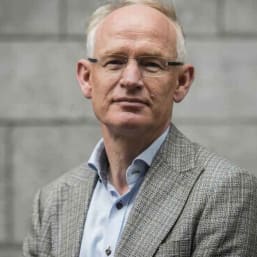
The rationale set out in the new UvA Institutional Plan is that society pays us less attention and values us less, and that universities must therefore reach out to society more. Fred Weerman, Professor Emeritus of Dutch Linguistics, believes there is quite a lot to be said against this.

No one can fail to notice that a church is used as the UvA’s Aula, but at the same time, during a Dies or an Opening of the Academic Year, there is usually little to remind one of a church service. Strikingly enough, I did get that feeling this year in the Old Lutheran Church. Not because the opening ceremony on 31 August reminded visitors of the Protestant tedium of the interminable sermons of yesteryear, but rather because the service took the form of modern variations on that theme.
With a lively and cheerful gospel choir, soul music, a short speech by the minister and positive testimonies, the new UvA Institutional Plan was launched. The key word is: Together! We’re going to get to work together. With one another, with Amsterdam, with society, with the world. The audience sang and clapped along, some seated and some standing. Perhaps not quite as in sync as the choir just yet, but the enthusiasm and goodwill were certainly there.
Sourness
It’s easy to be cynical about this (‘together for our own sake’, to quote Koot and Bie), but to be fair: after all the sourness of meetings disrupted by protests in recent years, this did have a certain charm. Rather than seeing it as an outrage that Amsterdam partners such as the council believe we are inward-looking, we are, for the moment at least, also willing to remove the beam from our own eye and get to work together.
Yet there is an increasing sense of unease regarding the ethos of the institutional plan, which had already become apparent in the new educational vision. In short, the reasoning is that society pays us less attention and values us less, and that we must therefore reach out to society more. I think there is quite a lot to be said against this.
Yes, it is true that not everyone holds science in equal esteem, certainly not in politics, and certainly not the UvA. It is more complicated to answer the question of whether things really were that different in the past. In any case, this view is now being expressed more vocally. Incidentally, this attitude applies to all institutions.
Universities are still getting off relatively lightly. The fact that this is a generic problem affecting all institutions makes one hesitate as to whether a one-way approach for a single institution (‘universities must engage more with society’) would work.
This becomes even clearer if we focus more on who is primarily displaying this lack of trust. If we try to interpret this in social and political terms, that mistrust is found primarily amongst those who have not received a theoretical education and who are situated on the (far) right of the political spectrum. It is this group that refuses to accept scientifically substantiated arguments regarding, for example, climate change, nitrogen emissions and migration.
Mona and Geert
Could it really be the case that this would change if the UvA moved closer to society? Will we ever see Mona and Geert become supporters of the UvA? It seems to me no wild guess that, in this instance, their view of the university would, at best, only change if scientific research were to confirm right-wing views after all. However, I cannot imagine that this outcome is the intended aim of the institutional plan. If the thinking is that greater trust will emerge if more people are given a theoretical education, then the status quo is sufficient. After all, mistrust is actually much lower amongst those with a practical education.
Even if the solution does not work, one could still argue: if it does no good, it does no harm; at any rate, we are doing something that is undeniably the prevailing trend, and indeed has been for years. I fear, however, that moving further towards society will actually be counterproductive. After all, the university’s strength has always been its independence from society. That it offers a sanctuary for reflection and research for those who wish to try to understand the world.
Intruders on the scene
Of course, that does not mean there is no connection whatsoever with society. Students, lecturers and researchers do not come from Mars. They bring their questions and their commitment with them. It is crucial, however, that they remain free and are not further constrained by externally imposed questions. There are already far too many intruders seeking to hijack science for their own ends. The university should be the foremost defender of this sanctuary.
Is it only scientists who think this way? I don’t think so. It is precisely the fact that science scores relatively well compared with other institutions that points to appreciation and trust. Seen in this light, it is exactly the opposite. Those who dance to society’s tune will squander this credibility (further). As long as you agree with the underlying interest, you may well be enthusiastic, but there are, after all, multiple interests at play. I believe that the frustrations felt here and there regarding the role universities play have therefore arisen more from an excess of social orientation than from a lack of it. At the next service in the Old Lutheran Church, I would therefore like to call for a change of course: ‘From social relevance, deliver us, O Lord!’
Fred Weerman is a Dutch language and literature specialist, former dean of the Faculty of Humanities and former director of the University Library.