After the UvA, the campaign group ‘UvA Staff 4 Palestine’ is turning its focus to Europe

The campaign for an academic boycott of Israel does not stop at the UvA’s gates. With the new action group Universities for Justice, UvA staff (among others) are setting their sights on Europe. Their aim: to mobilise universities across Europe to sever academic ties with Israel.

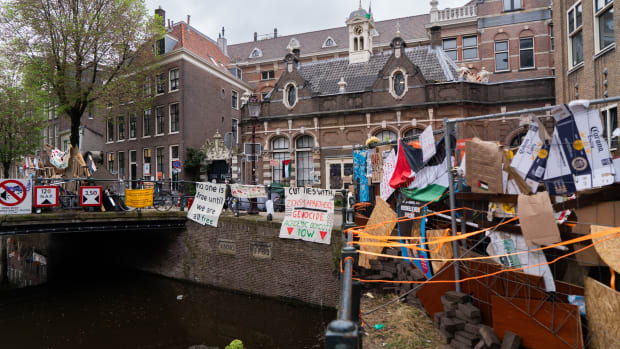
More than two years ago, the UvA community took to the streets in the now famous demonstrations on campus. Now, UvA Staff 4 Palestine is taking a broader approach and addressing all universities in Europe. According to them, complicity in Israel’s human rights violations is a ‘universal problem’. And so, at the end of October, in collaboration with PACBI and Dutch Scholars for Palestine, they launched Universities for Justice.
The new action group aims to mobilise universities across Europe to end collaboration with Israeli universities, according to UvA staff members Miriam Heipertz and Arjen Noordhof, who are involved in the initiative.
On 5 October last year, the whole city turned red during the first Red Line protest in Amsterdam. More than a quarter of a million people called on the Dutch government to take action against the human rights violations and genocide in Gaza. “Since the last Red Line protest, the government has already imposed a ban on products from the occupied Palestinian territories,” writes Amnesty International. “But more is needed.”
That is why another Red Line protest will be held on Sunday, 8 November. At 1 pm, the procession of people dressed in red will set off from the Museumplein. Various organisations are supporting this action and calling on people to join the march, including Dutch Scholars for Palestine and the Algemene Onderwijsbond (AOb).
Heipertz and Noordhof will be taking part on Sunday on behalf of Universities for Justice and hope to use the occasion to encourage their colleagues the following day to sign the open letter.
Open letter
Here’s how it works: students, staff and alumni can sign an open letter on the Universities for Justice website to call on the top brass of their universities to take action with them. One of the aims is to sever ties with Israel within the Horizon projects. In addition, the letter calls on universities to sever other institutional ties with Israeli organisations, to protect academic freedom and to support Palestinian academics. Heipertz emphasises that this concerns the suspension of institutional collaborations, not the exclusion of individual academics.
University boards are then asked to endorse an instituional appeal. This is subsequently submitted to the European Union, with the aim of completely suspending Israel from Horizon. This move capitalises on the ongoing negotiations regarding the 2028–2034 Horizon programme.
In October 2025, the UvA announced that it would not enter into any new collaborations with Israel and would investigate whether existing collaborations could be terminated. In doing so, the UvA did not opt for a full boycott. Due to the structure of European projects, it can be complicated to withdraw from ongoing collaborations, says Heipertz. For the university, this entails risks and potential costs. Exactly what the considerations are remains unclear. They are currently discussing this with the Executive Board.
Political reluctance
Following the Russian invasion of Ukraine, Russia was immediately excluded from collaborations with European universities and also from the Horizon programme, notes Heipertz. According to her, this shows that complete exclusion is indeed possible, but that what is lacking above all is “political will” rather than legal options. European legislation is clear, argues Heipertz, who is also a PhD candidate specialising in European and international law. “The EU already has the legal instruments to suspend cooperation with Israel. The cooperation agreement with Israel contains a human rights violation clause. The European Commission has determined that Israel is in breach of this clause.” However, according to Heipertz, the political will to act on this is lacking. A year ago, the European Commission put forward a proposal to suspend Israel from Horizon, but failed to secure sufficient support for it.

Anti-boycott lobby
One of the biggest obstacles, according to Heipertz, is Israel’s extremely powerful lobby, who is determined to remain involved in these collaborative projects. The investigative journalism consortium Investigate Europe recently documented this anti-boycott campaign. “They work with a great deal of money, and we are fighting against them,” says Heipertz.
“Changes are needed to the framework of Horizon,” argues Heipertz. Universities must be able to withdraw from ongoing programmes more easily. Universities should be able to withdraw from ongoing programmes more easily. The campaign calls for Israel to be completely excluded as long as it continues to violate human rights. Simply taking that first step requires considerable courage on the part of institutions (and individuals), says Heipertz. “That is why we realise we need a European movement.”
Will it really work? Heipertz and Noordhof are optimistic. Noordhof believes the University of Amsterdam has already made “great strides” since the barricades. Now it’s Europe’s turn. Noordhof: “I’m feeling hopeful today. I think many university boards are sympathetic to the cause, but real action takes time. We must keep pushing for it.”