Kind-hearted dissident Mikhail Kasyanov is trying to bring Putin to his knees from abroad
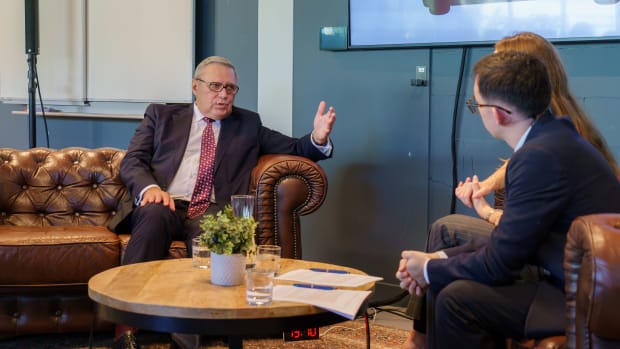
Mikhail Kasyanov, Prime Minister of Russia from 2000 to 2004, was a guest today on the debate platform ‘Room for Discussion’. Kasyanov advocates a tough stance towards Moscow, with EU membership for Ukraine and far-reaching economic sanctions against Russia. We need not fear Putin, he says: ‘He understands that he would be destroyed in a nuclear war.’
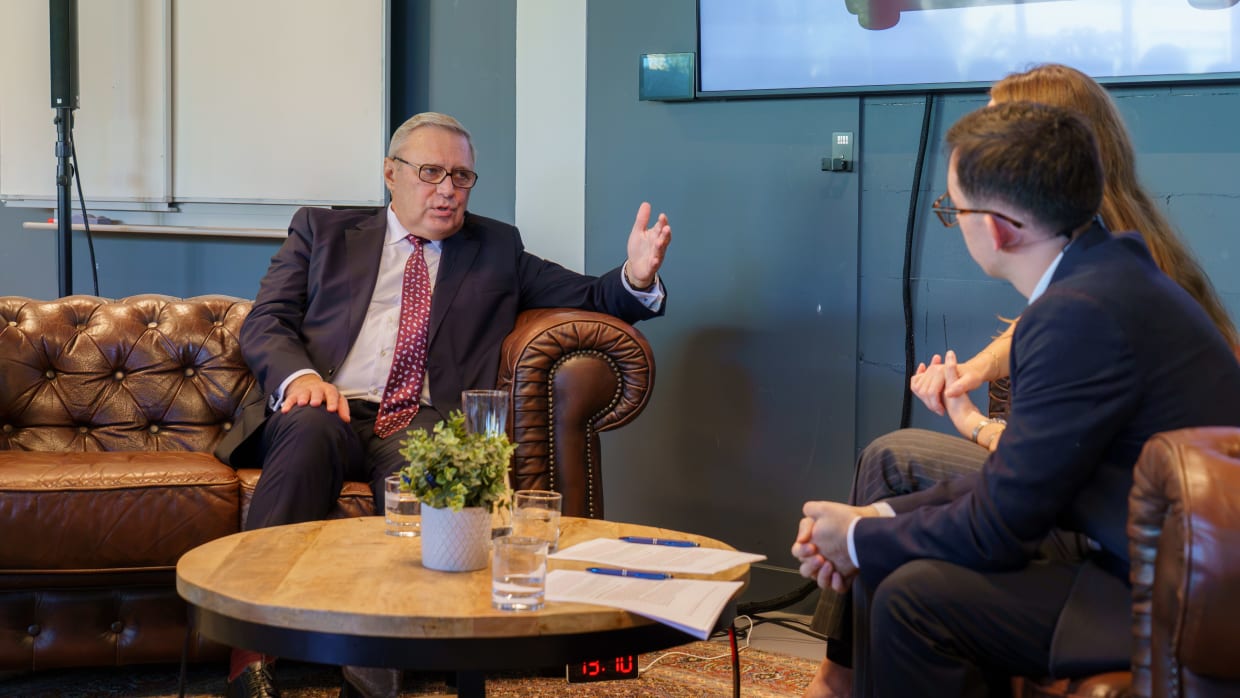
Anyone walking past REC Impact today must have noticed the crowd of burly security guards patrolling the normally rather nondescript space in the J/K building. They were there for Mikhail Kasyanov, the former Prime Minister of Russia and now a Putin critic in exile, who was a guest at the debate platform Room for Discussion. The discussion, which was dominated by the war in Ukraine and the deplorable state of Russian democracy, was at times somewhat predictable, but it did offer the unique insights of someone who has been so closely involved with the Russian political establishment. Kasyanov’s key message: ‘Don’t give up on Russia!’
After Kasyanov and his cabinet were dismissed by Putin – who was already president at the time – in 2004, just before the elections, he emerged as a leading figure in the Russian opposition. Following the invasion of Ukraine, he has continued these activities from abroad. Kasyanov has been receiving threats from the Putin camp for decades, and since last year has been on the Kremlin’s list of ‘extremists and terrorists’ – hence the tight security.
A sense of humour
This ‘extremist’ – or ‘terrorist’, for that matter – stood out above all for his sense of humour and friendly demeanour. For example, he teasingly replied to a question about Putin’s military plans with, ‘You all study political science? Then you know the predictive models’.
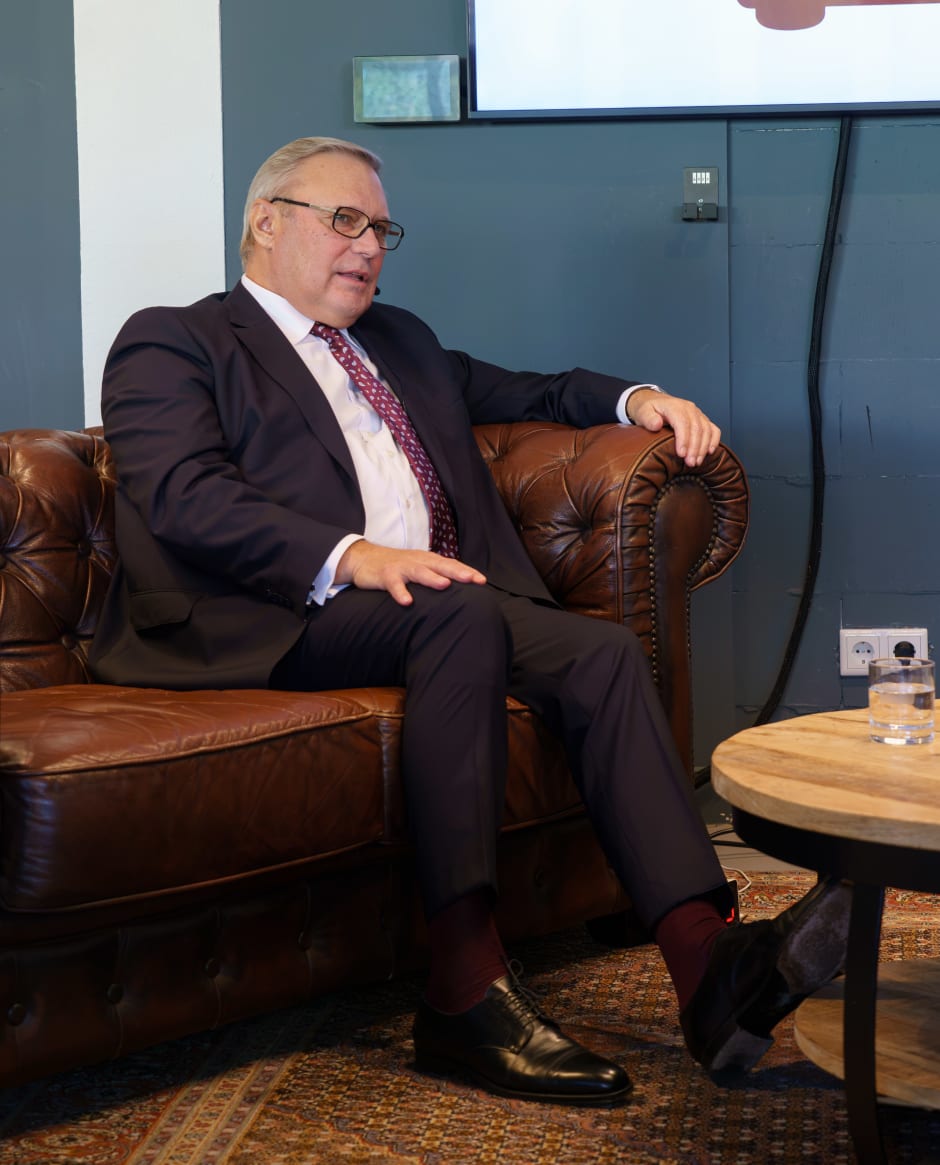
That light-heartedness did not detract from the seriousness of his argument. From the comfort of his Chesterfield sofa, he left no doubt that nothing remains of the Russian democracy he once helped to build. And Putin is the problem, Kasyanov made clear to his audience.
No responsibility whatsoever
During the interview, Kasyanov acknowledged the uncomfortable reality that he had worked closely with Putin when he was Prime Minister from 2000 to 2004 and Putin was President. Putin is said to have misled him during those years by pretending to be democratically minded. The scales fell from Kasyanov’s eyes when he was dismissed in 2004, and in December of that year he severed ties with Putin. Kasyanov stated at the time that he ‘bears no for the Putin now’.
Nevertheless, Kasyanov reacted uneasily when the interviewer asked whether Putin had learnt lessons during the Second Chechen War (1999–2009) that he had applied in Ukraine. ‘No, there is no connection between those wars,’ he replied curtly, and did not elaborate further. It may have been a factor here that Kasyanov was Prime Minister of Russia for part of that war.
Kasyanov’s message of hope
Kasyanov, however, used the platform primarily to call for further sanctions against Russia, arguing that this would be the best way to bring Putin to his knees. ‘Money is everything in Russia,’ he stated, and Europe and the US ‘must create a situation in which Putin runs out of money’.
Such sanctions would also enable Europe to take a firmer stance towards Moscow. According to Kasyanov, Europe’s response was too weak when Russia invaded Georgia and annexed South Ossetia in 2008. The lack of a firm response taught Putin that he had room for manoeuvre, which made the occupation of Crimea six years later ‘predictable’, according to Kasyanov. He therefore called for Ukraine to be offered EU membership – ‘grab Ukraine!’ – as the best guarantee against future invasions.
Kasyanov also conveyed the good news that Europe need not fear a nuclear escalation if it were to take a tougher stance. ‘Putin understands what nuclear warfare comes down to. He would be destroyed,’ said Kasyanov. In his view, Putin’s threats are nothing but hot air.
Putin’s psyche
Kasyanov offered further insights into Putin’s psyche. According to Kasyanov, the Russian president is said to have harboured a pathological desire to be respected as a leader from the very beginning, but lacked the patience to earn that respect. According to him, Putin therefore decided, after trying his hand at democratic governance for a few years, that he wanted to be respected ‘simply for existing and having a nuclear button’. This lust for power is said to be a remnant of Putin’s KGB past.
Russian propaganda
On the whole, the discussion was cordial – at times a little too cordial to be called a debate. The affable Kasyanov generally had no critical questions to fear from interviewers or the audience. The exception was a question from the audience about alleged Ukrainian war crimes against the Russian-speaking population of eastern Ukraine, a question that echoed Putin’s justification for his war in Ukraine (the protection of Russian minorities).
Kashanov reacted with a mixture of dismay and astonishment. He recognised Putin’s propaganda in the question, which he ‘completely denied’. It was one of the few moments when his otherwise unbeatable smile faltered.