Thijs Bol spent 15 years researching inequality: ’‘We have come to believe that success can be shaped at will”

Success is a choice, and so is failure. Over the past few decades, we have increasingly come to believe that success is within one’s control, research by Thijs Bol shows. In his new book, The Myth of Meritocracy (De maakbaarheidsmythe), the UvA Professor of Sociology seeks to offer an antidote to this way of thinking. “Chance plays a much bigger role than we think.”
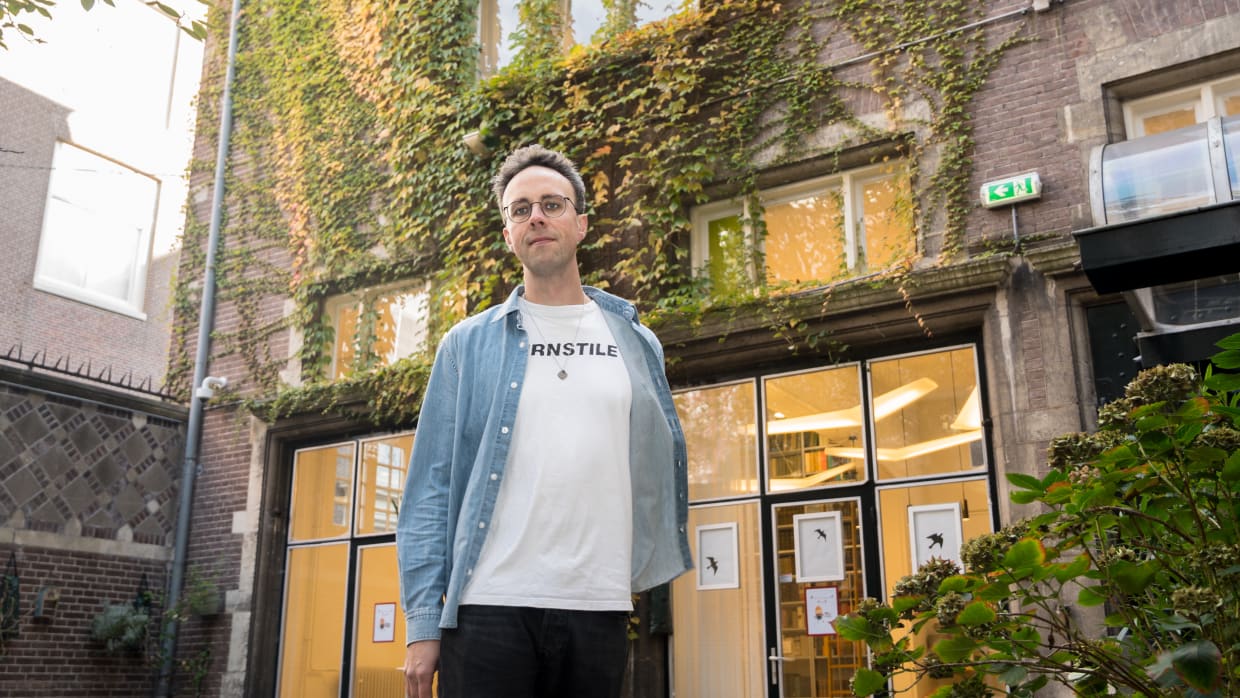
“I’m not really a fan of having my picture taken.” It is Wednesday morning, and sociologist Thijs Bol is standing in the deserted courtyard of the Spinhuis. “Television is fine, because at least you have something to do. I never know what to do with my face in photographs. Just put me somewhere.”
The photographer positions him in front of the glass wall where the Common Room once stood, the former home of the UvA’s sociology and anthropology departments. As a third-year sociology student, Bol used to work behind the bar there. “It was a very cosy, slightly makeshift place, with African art on the walls and Kitsch Kitchen tablecloths. We sold sandwiches and coffee for next to nothing. Lecturers and professors came in too. On Thursday evenings, there was dancing.”
Thijs Bol (1985) was born on the island of Texel and completed his master’s degree in sociology at the University of Amsterdam in 2008. After obtaining his PhD from the same university in 2013, he began working as a lecturer. In 2023, he was appointed professor of sociology.
It was there that Bol, coffee pot still in hand, was asked to lead a seminar after a lecturer had called in sick. The rest is history. Thijs Bol is now a professor of sociology at the University of Amsterdam, a position he attained at the age of 38.
Colleagues congratulated him, telling him he had done well and that his success was well deserved. Bol sees things differently. Chance plays a much bigger role in success than we think, says the sociologist, who has spent the past fifteen years researching inequality of opportunity. He has written a book about it, De maakbaarheidsmythe, published by Das Mag on 10 November.
Thijs, may I congratulate you on your new book?
“Absolutely. Although it is a slightly complicated feeling. Whether this book becomes a success will depend partly on the book I have written, but to a much greater extent on things over which I have no control. Whether people pick it up, whether lots of other books on the same subject happen to be published at the same time – those factors will have a much greater influence.”
Yet, as you describe in your book, we are constantly congratulating one another on these kinds of ‘successes’ on platforms such as LinkedIn. Should we stop doing that?
“I don’t think so, although I wouldn’t mind seeing a few fewer congratulations on LinkedIn. The whole point of LinkedIn is that people make these supposedly humble announcements about their achievements and others congratulate them. You have to wonder how sincere any of it really is. Personally, I find the whole thing incredibly tedious.”
“I don’t think there’s anything wrong with genuinely congratulating someone when they achieve something. It’s not that successful people haven’t worked hard or lack talent. But it is very often the case that people with just as much talent who have worked just as hard never end up in the same position. That’s where the injustice lies.”
“What I find much harder to accept are the implications we attach to congratulations, such as ‘You really deserve this’ or ‘Only you could have done this so well’. Why? Does that mean someone else didn’t deserve it? That’s what makes me uneasy. We need to stop describing every achievement as well deserved. Research shows that chance plays a much bigger role in success than our own actions.”
You have made this argument before in the national media. Why write a book about it now?
“Those interviews focused mainly on the role of chance in success. In this book, I turn my attention to the idea that success is something we can shape and control. How have we come to believe so strongly that success is within our own power? And what is the alternative?”
“When I walk into the Bruna bookshop at the station, the shelves are dominated by self-help books explaining how to steer your life in a different direction. With a simple step-by-step plan, you can achieve a toned body or a tidy home in no time. More than 300,000 copies of a book such as Master Your Mindset have been sold.”
“Half of the people in my father’s generation, born in the 1940s, believed that success was the result of hard work and ambition. In my generation, that figure is 75 per cent.”
“I notice it with my two boys as well. My eldest son, Ezra, has just started secondary school and is exposed to this mindset of self-determination much more than I was at his age. Mobile phones were only just being introduced back then. You were exposed to some of it, but it was nowhere near as intense as it is now with TikTok and Instagram. This message that we can shape every aspect of our lives is getting louder and louder. I hope my book can make even the smallest dent in that narrative.”
Is a book the right way to reach young people?
“If you look at ideas that have had a lasting influence, there is often a book behind them. Our thinking about wealth taxes versus taxes on labour, for example, has been shaped by Thomas Piketty’s Capital in the Twenty-First Century (which shows that, over the long term, the value of assets grows faster than the economy and wages – ed.). Nobody has actually read that book, but everyone seems to have a copy on their bookshelf. So I do believe in the value of books as a benchmark for an alternative narrative, even if not everyone reads them.”
“I actually think younger generations are once again developing a greater appetite for sitting down and reading something long-form, as a reaction to the constant rush of everything. Last month, students at Harvard were queuing to get into a course on the classics. What were they going to do? Read, think and write. In a society where everything can be produced artificially quickly, I think young people have a growing need to delve deeper into things and learn more about how the world works.”
What is the problem with believing that success is within our control?
“When we believe that success can be engineered, success becomes a choice and failure becomes your own responsibility. It also changes the way we look at people who have ended up on the wrong side of the divide.”
“Yet very often, those people have ended up there through sheer bad luck. They were born into the wrong family, or things happened in their lives by chance that were beyond their control. That matters, because hopefully it will also lead us to look at this group differently.”
“This belief that we can shape our own destiny also creates enormous pressure on young people who are trying to build their lives. They are expected to have a good relationship, a fulfilling and well-paid job, maintain friendships and look good too. The pressure is immense.”
What is the alternative to believing that success is within our control?
“In the book, I joke that it would be nice to have a step-by-step plan for that too. But there isn't one. What I do offer is a direction to move in. For a start, the message that life is not quite as controllable as we think can take some of the pressure off. Although the solution does not lie with the individual.”
“Ultimately, this is a question of distribution. There is inequality: some people earn very little because other people earn a great deal. So, at the moment, it makes an enormous difference whether or not you get that house or that job, because it widens the gap between people.”
So should we introduce a cap on wealth?
“For example. Measures like that can ultimately only be enforced through collective political action. To give a very concrete example, wealth taxation in the Netherlands has still not been properly reformed. The reason for that stems from the belief that success is something we make ourselves: people with substantial wealth think, ‘We earned this.’”
“Yet we know that isn’t true: money generates more money. You could impose additional taxes on large fortunes, which are partly ‘undeserved’, and invest the proceeds in public services that benefit everyone. That way, someone born into a less privileged family still has the opportunity to make something of their life. And if things don’t work out, there is a social safety net to fall back on. That sounds a little activist, doesn’t it?”
Well, it is a left-wing argument.
“Yes, I always find that a slightly irritating point. If you had been sitting here with a climate scientist who said that the Earth is warming because of fossil fuels and that we need to do something about it, you wouldn’t have said: ‘What a left-wing argument.’ You would have said: ‘You’ve done your research and adjusted your views accordingly.’ I see my own research in exactly the same way. I’ve spent fifteen years researching this subject, together with many others, and this is the logical conclusion of that research.”
Will inequality remain your subject for the rest of your career?
“Yes, I think so. I’ve still got almost thirty years to go. Horrible. Don’t put that in. Lovely! But sometimes I do wonder what else I’m going to do. Still, I think I’ll always be fascinated by the very fundamental question: why do some people have so much while others have so little? How do we view that, and how do we justify it? But ask me again in ten years’ time. Perhaps I’ll be studying aeroplanes by then.”