Farewell rector Peter-Paul Verbeek: ‘The key is to calmly stay the course’
After four turbulent years as rector magnificus, Peter-Paul Verbeek will leave the UvA next week to join the Royal Netherlands Academy of Arts and Sciences (KNAW). He looks back on a period marked by intense student protests, changes in the university’s leadership, and the search for a new direction for the university in society.
After four eventful years, Peter-Paul Verbeek’s time at the UvA is coming to an end. Next week, the rector magnificus will bid farewell to the university. He will trade his office on the sixth floor of the D building at the Roeterseiland campus for the monumental Trippenhuis of the Royal Netherlands Academy of Arts and Sciences (KNAW), where he will become president on 1 September.
Verbeek guided the UvA through an exceptionally turbulent period. In his first year, he was already confronted with heated debates over ties with the fossil fuel industry and the controversy surrounding UvA lecturer Laurens Buijs. Ultimately, however, it was the deep divisions over collaboration with Israeli universities – and the demonstrations and occupations that followed in the spring of 2024 – that left the biggest mark on his tenure. It forced the philosopher of technology into a role he had not anticipated: that of crisis manager at the centre of a national storm.
How do you look back now – more than two years later – on those demonstrations and occupations?
“I mainly remember it as a very intense period. It was certainly not easy; the images were unbelievable and reminiscent of scenes from a war zone. I think it was a traumatic period for many people at the UvA, in all sorts of ways. It was also a time when we saw the polarisation present in wider society enter the university very directly.”
What was that period like for you personally?
“Well, pretty tough, of course. That comes with the job; if you take on a leadership role, you don’t do it to sit back and relax. I also always drew motivation from the thought that this was a historic period. But it obviously had its difficult sides: in a debate like that, moments are quickly taken out of context. Before long, it becomes about “that woke university” and “that weak rector”. You are immediately drawn into the polarisation. The response to that shouldn’t be to join in, but precisely to calmly stay the course: I stand up for my students, I stand up for the university, I stand up for society. That’s what we tried to do.”
During the occupations, you told Nieuwsuur that the students and staff you were negotiating with were wearing masks, meaning you didn’t know exactly who you were talking to. That image is likely to stick with many people.
“To me, that moment shows exactly how you deal with such a polarised situation. What you want to do in my position at that moment is keep talking to your own students – people who don’t organise an occupation for no reason – while at the same time showing society that we are running our university responsibly.”
“In the aftermath, partly because of how things were portrayed on social media, all sorts of things happened that flattened the story considerably. Because of course we did have that conversation, but the occupation was followed by an evacuation shortly afterwards. It wasn’t as though we thought, ‘Let them stay there’. But I did think it was very important to show that I wanted to hear those students’ voices.”
Are there things you would have handled differently in hindsight?
“I think the most telling thing is that, even in the media, you sometimes see two opposing narratives in a single news report about that period. When the news broke that I was going to the KNAW, the same NRC article said that I was under fire for talking to masked protesters, while also reporting that consultancy firm Berenschot had concluded that we had shown too little empathy towards our own students and staff. Those two things cannot both be true. I think that shows how difficult it is to continue reaching the large groups in the middle. Should we have done something differently? I wouldn’t know.”
Has the UvA fully recovered from that turbulent period by now?
“We came through it fairly well, but there are still wounds. At the same time, we really did gain something valuable from it: a very fundamental discussion about how you can connect academic freedom with academic responsibility. We have since developed an ethical framework for collaboration with external parties, for example, and together with the university’s representative bodies we have drawn up new house rules that enshrine the right to protest much more clearly. We have come to realise that we need to approach this as an ethical issue, not a political choice. As a university, you don’t want to take a political position, but you do want to exercise your freedom in an ethically responsible way.”
“The most important lesson we have learned is that, for a highly socially engaged university like the UvA, it is crucial to create space for dialogue. When you stand very firmly by your ideals, it can sometimes be difficult to truly listen to the other side. The paradox of science is that you search for the truth precisely by continuing to doubt and ask questions. The moment you shut down the debate because you believe you have absolute right on your side, things go wrong.”
How does that translate to the lecture halls?
“We are placing much more emphasis in our new education vision on what we call ‘academic citizenship’. We have linked this to the UvA’s three core values: curiosity, engagement and independent-mindedness. The idea is that we don’t just train students to become researchers, but to become academically educated people who will play a responsible role in society. That requires the ability to engage with one another in an academic way: listening, being open to other perspectives, and not simply shouting that you are the only one who knows how things really are.”
More broadly, how is the UvA doing compared with when you arrived four years ago?
“We have obviously made progress. The new strategy in particular shows that we have entered a new phase in the university’s development. I think, for example, that we have started thinking much more in terms of ‘one UvA’. We still have seven autonomous faculties, of course, but there is a strong sense that we are one university together.”
That new strategy, drawn up in the year when you were also chair of the Executive Board, also says that the UvA should become less inward-looking. What should we make of that?
“Actively seeking out partnerships, above all. We gathered extensive feedback from all kinds of societal partners and peer universities, and they all said roughly the same thing: the UvA is very inward-looking. Arrogant. That may be the flipside of our success. We are, for example, extremely good at securing individual grants. But if you start looking more for grants that you apply for as part of a consortium—in collaboration with universities in other countries—you immediately start thinking much more in terms of societal challenges that you can contribute to together.”
‘Society’ seems to be the magic word here.
“I think that is so important because you can see that trust in and support for science have declined so much. We want to show that universities have a crucial role to play in society and democracy. Just look at Amsterdam: we are in a fantastic city that we can collaborate with much more. In all kinds of areas, from energy and housing to quality of life and health. It is our ambition to show the city why our presence matters. To demonstrate that we can genuinely contribute, and that we are not here solely for the sake of science.”
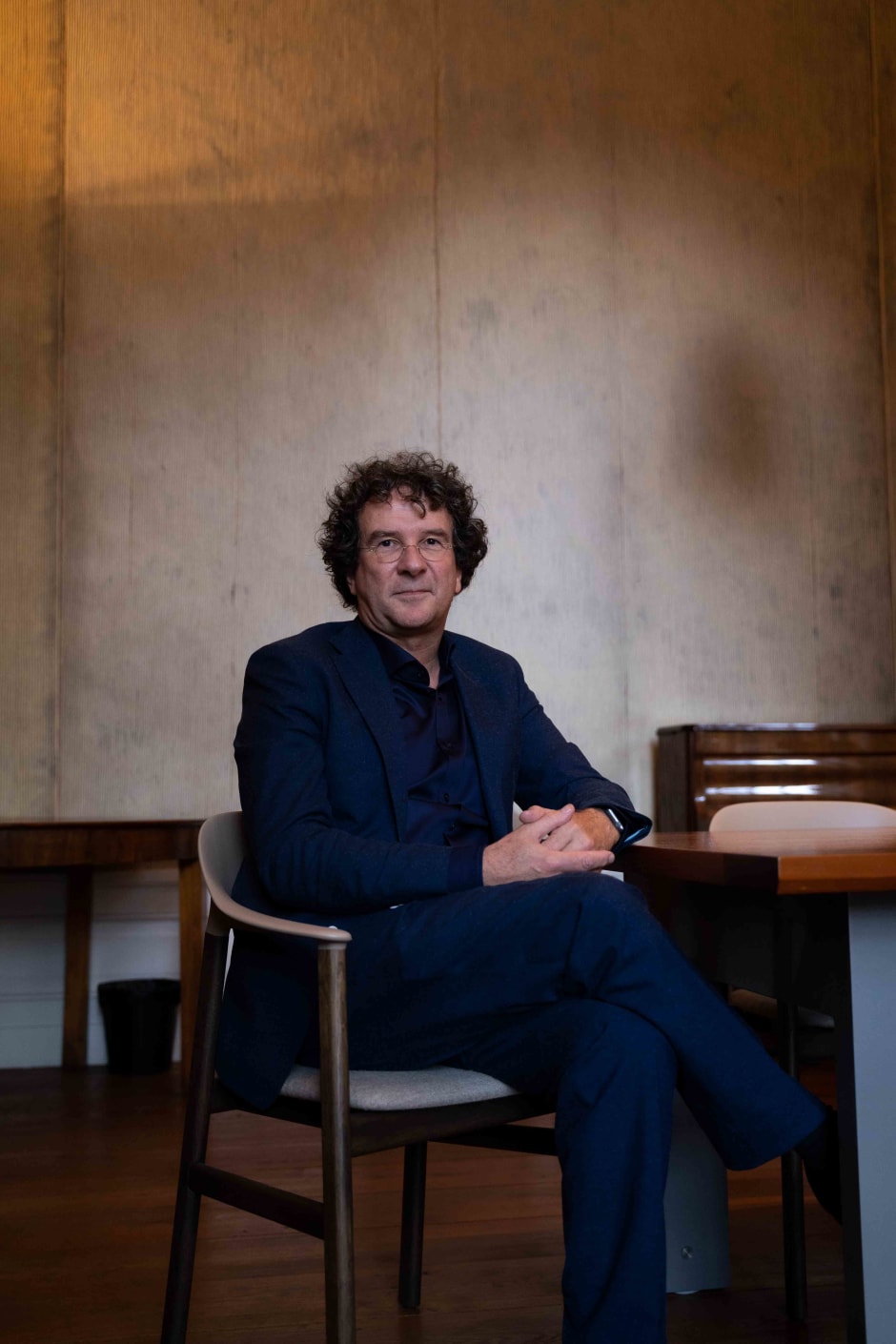
You have experienced quite a few changes in the Executive Board over the past few years, and you also served as interim president of the board for a while. At one point, it seemed as though the Executive Board consisted only of Peter and Paul.
“Well, we did still have André Nollkaemper as a kind of part-time interim member of the Executive Board. But that period certainly felt very unusual. It also allowed me to get to know the UvA very intensively and very well. It felt like an enormous responsibility to be able to do this; to be given the trust to have, basically, the entire UvA in your hands on your own. During that period, I started taking much better care of myself: I exercised more and lost weight. I’m very glad I had the opportunity to do it.”
What has changed now that, following the arrival of Vinod Subramaniam as the new president of the Executive Board, there is again three of you?
“On his first day, I suddenly felt: oh, I can now devote my full time to my work as rector again. That’s when I really realised the cost of having such a dual role. Over the past few months, I’ve really felt what it’s like to be rector again. That’s been nice; I had missed it. Ultimately, that’s why I came here. I’m not a born Executive Board president. I genuinely enjoyed doing it; I never did it reluctantly. But I hadn’t applied for that role. I had applied for the rector position. I’m really a scientist who went into university leadership out of a passion for science. Not an administrator who also happens to enjoy working at a university.”
With what feeling will you close the door behind you?
“With a sense of melancholy. I’ve been feeling nostalgic for quite some time. It was a difficult decision to leave the UvA for the KNAW, but when this train came along, I thought: I have to jump on it. I hope to use the lessons I’ve learned so intensively here over the past few years to help restore public support for science at the national level. We need to develop a new, shared story about what science contributes to society and democracy.”