UvA lecturers learn to teach using Lego bricks

Although Lego is primarily known as a children’s toy, the colourful building bricks are now also being used as an experimental teaching method. Several times a year, UvA lecturers can sign up for a Lego workshop.
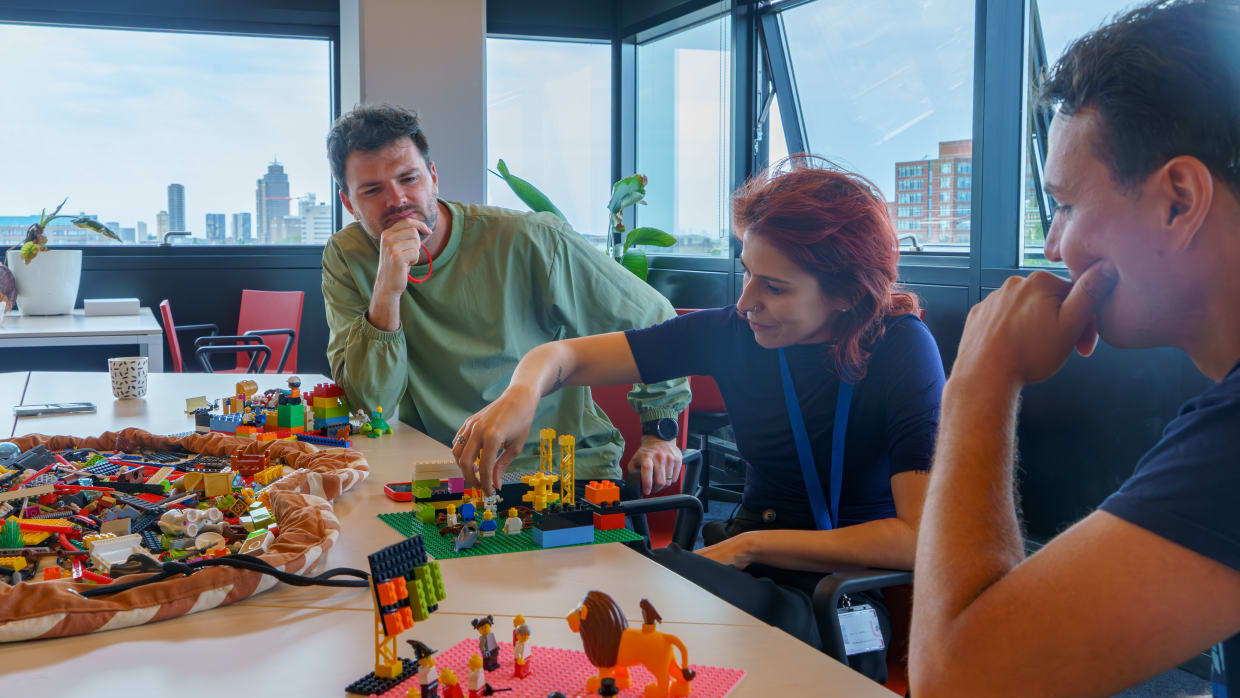
“There must be well over three thousand of them,” says Imber van Dijk, gazing thoughtfully at the enormous pile of Lego bricks in the middle of the long table in front of him. Together with colleague Tom Slöetjes, the educational adviser has been running the Lego Serious Play workshop for several years now: a teaching method that was initially introduced in the corporate world, but has since found its way into education as well.
Anyone who still thinks Lego is used solely as a children’s toy is therefore quite mistaken. Several times a year, UvA lecturers can sign up for an actual Lego workshop – which, according to those involved, is in no way sponsored by the Danish toy manufacturer itself – where they learn how to use the bricks during seminars to make abstract concepts understandable. For example, by visualising complex cellular processes.
Building
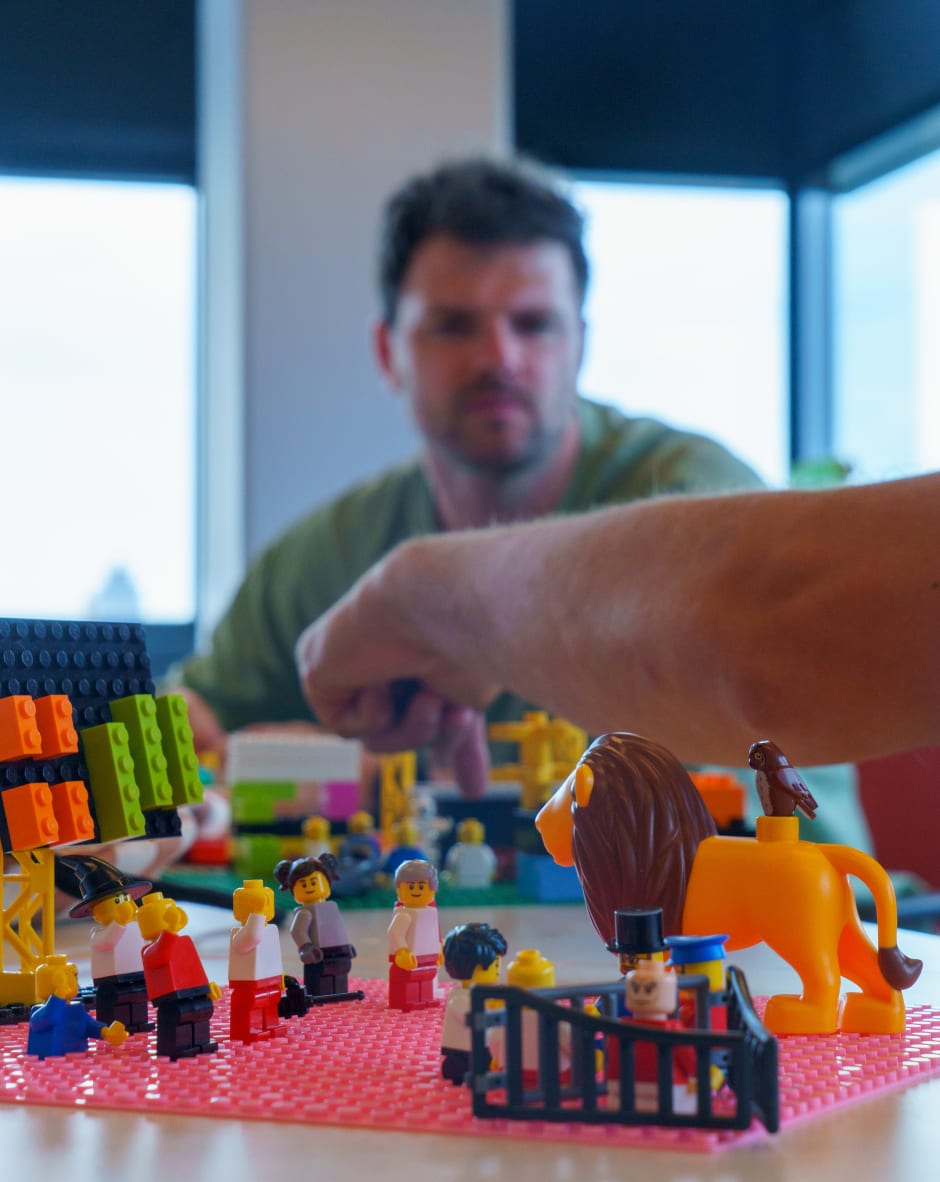
Although there is also plenty of building going on during today’s session, it is not only traditional bricks that are laid out; the table is scattered with at least as many Lego figures in the shape of animals, people, wheels, ladders, plants and much more. It is this great variety that, according to the lecturers, forms the strength of the workshop.
“All the Lego bricks in this set have been individually selected to serve as metaphors,” says Van Dijk. “By associating certain concepts and then building something out of Lego, you are encouraged to look beyond the surface. That leads to a deeper understanding. The power lies in the metaphor of what you build.”
Towers
Because this may still sound somewhat vague, the lecturers decide to skip the standard introductory round at the start of the session and immediately throw the participants in at the deep end. “You have two minutes to build the tallest tower you can,” is the instruction. It sounds simple, but once the constructions are standing, the twist follows: participants must introduce themselves to the rest of the group using their improvised towers. “How is that tower a metaphor for your teaching style? Be creative,” the lecturers encourage them.
While one participant believes that the variety of colours she has used in her construction represents diversity and the absence of hierarchy in her teaching, another suspects he placed a giraffe on top of his tower because he is someone who “likes to stick his neck out”. The point of the exercise: behind what appears to be a simple Lego structure, an entire narrative can exist on a symbolic level.
And that is precisely the core of this workshop, as becomes clear during the rest of the session. The aim is for participants to give concrete form to abstract concepts from their own field – ideas that in everyday language risk becoming vague catch-all terms – using Lego. Slöetjes: “Through this method, you learn to share ideas and assumptions about concepts, and then enter into dialogue about them. Your hands get to work with the Lego on intuition, based on the knowledge you have about a particular subject.”
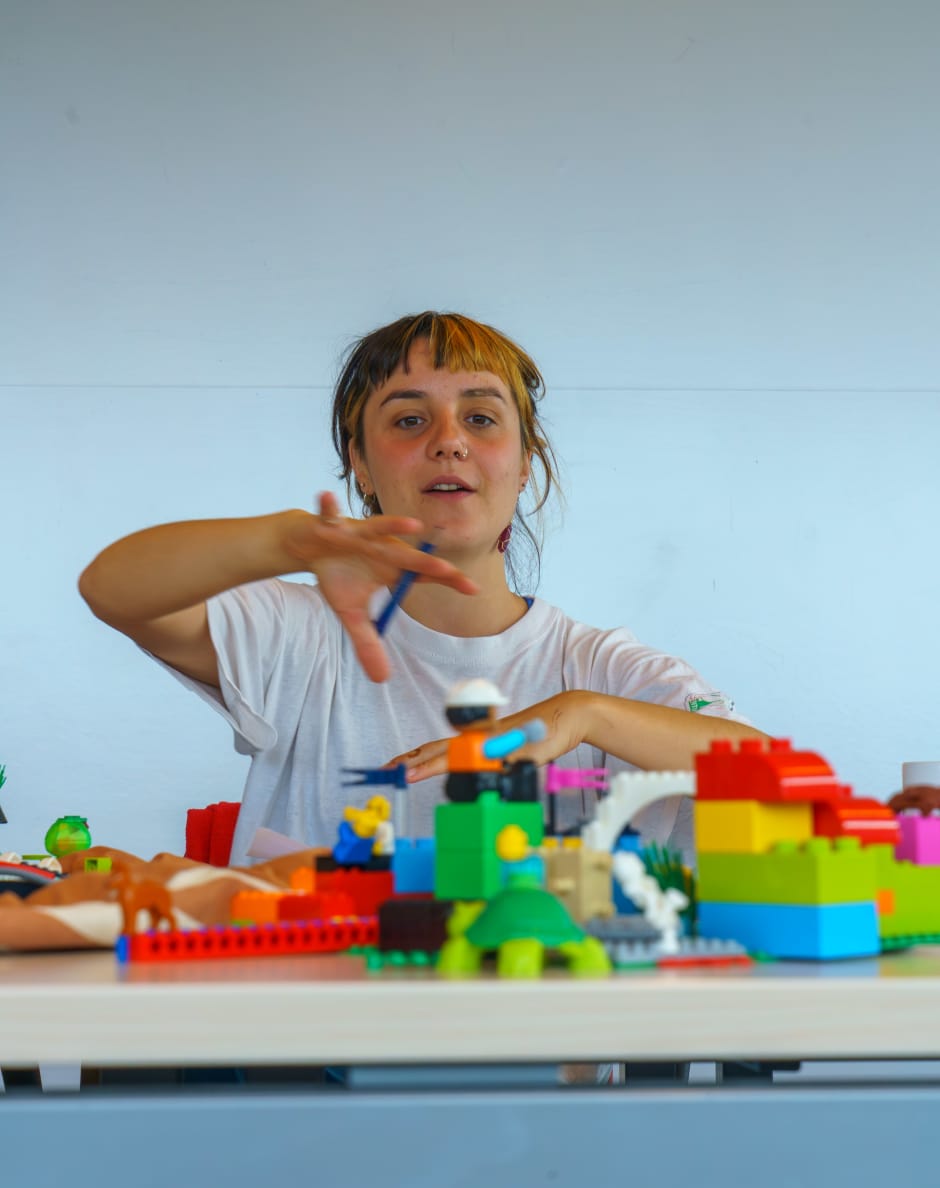
And so a political science lecturer works with the concept of “democracy” by placing a diverse group of Lego figures in a circle, surrounded by a few larger structures meant to represent democratic institutions, while someone else focuses on the concept of “personal development” by building a dangerously winding path leading towards a treasure chest. “By giving a concrete form to an abstract concept such as democracy or personal development, you are forced to really think about its meaning, thereby adding depth to the concept,” Van Dijk explains.
Icebreaker
Meanwhile, Chiara Croccolo, a career orientation lecturer, is busily taking notes. “I’ve never actually played with Lego myself, so I am quite surprised by what I’m managing to build,” she says enthusiastically during the break. “Apparently there is something in your subconscious that makes you intuitively feel what you want to create. At the same time, it is also very interesting to see what others are doing. I notice that people really think in completely different ways and look at certain concepts differently than I do. I find that inspiring.”
After three hours of association, building and discussion, one question remains: what exactly is the concrete application of this workshop afterwards? “In the classroom, this is an icebreaker,” Slöetjes explains. “Lego is a light-hearted way of learning; adults in particular benefit from it, because they often no longer play. It forces you to communicate in a different way, which involves a lot of reflection and creativity.”