Magazine | “Standing on the Malieveld is the most restrained way to protest”

Over the coming weeks, Folia will be dedicating a special print magazine to the theme of ‘democracy’. Activist Martijn Dekker still sees room for improvement in terms of democracy at the UvA. “It sometimes feels as if participation is something the UvA is required to have, rather than something it actually wants to have.”
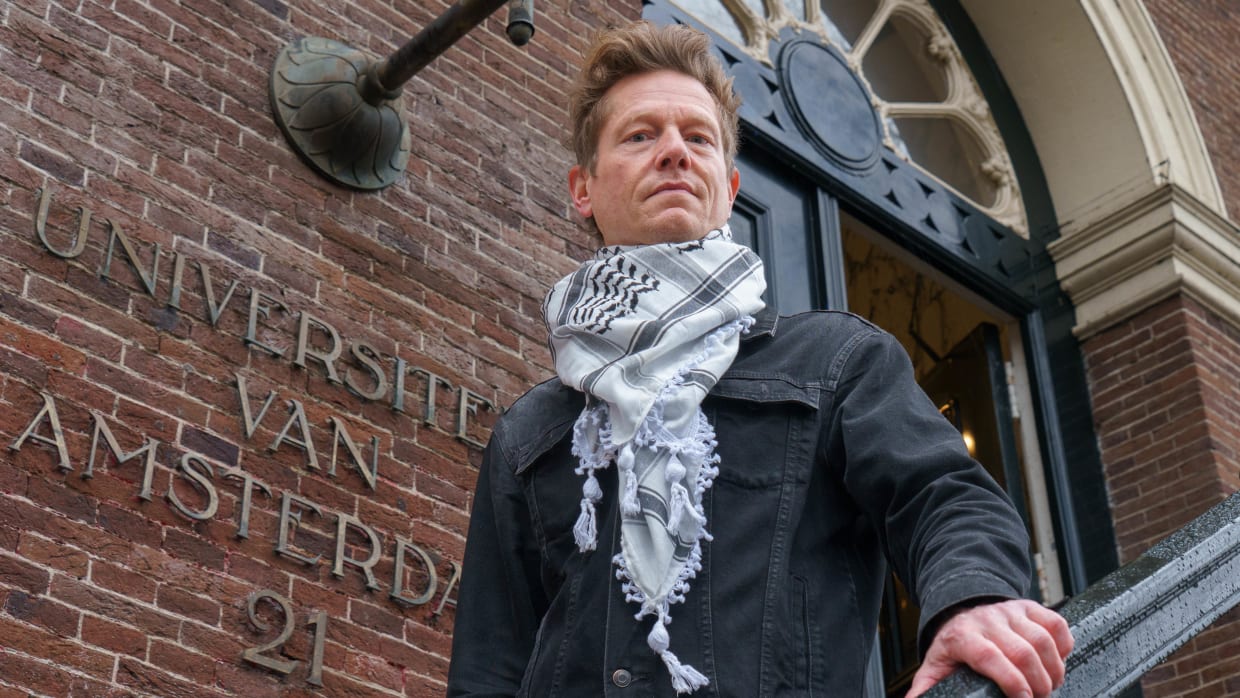
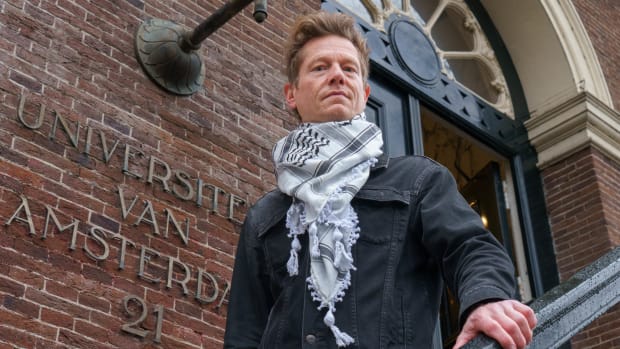
On the day of the 2015 Maagdenhuis occupation, anthropologist Martijn Dekker put a note on his office door: the lecture had been moved to the Maagdenhuis. If students wanted to attend, they could come there.
More than ten years later, Dekker is once again on the barricades. This time he is affiliated with Dutch Scholars for Palestine, who want their university to sever ties with Israeli institutions. After more than two years of protests, the UvA ultimately decided to do so.
During the 2015 Maagdenhuis occupation, the demand was for more democracy at the UvA. Do you think this has now been properly secured?
(Thinks for a long time): “On paper, yes. There is participation, both from students and staff, for example. But if you look at the appointment of the new Chair of the Executive Board, which is largely decided without the community, I still find it very top-down. It sometimes feels as if participation is something the university has to have, rather than something it actually wants. It often comes down to: we hear what you’re saying, rather than actually doing something with it.”
“When the protests began in 2024, a sense of crisis emerged and the UvA essentially shut itself off. The Executive Board, together with the communications departments and the ‘triangle’ determined the course. I notice a lack of connection between the administrative elite and the rest of the university. The board mainly talks to other administrators: other members of the UvA Executive Board, boards of other universities, and the minister. When it comes to accountability and decision-making, it feels like a fairly inward-looking layer.”
You could also argue that the Executive Board is there for all students—not just the protesting students and their demands.
“That’s a fair point. But in a democracy, simply doing what ‘the people’ want is not enough. As activists, we repeatedly asked the UvA to speak out about what is happening in Gaza, but we were told time and again that it was ‘political’ and therefore not something they engaged in. I think that as a leader, you can sometimes show moral leadership – and in some cases, you even should.”
That also carries the risk of alienating other students and staff. That’s quite a precarious position for a university.
“Yes, that’s always tricky in a democracy. You have to consider minorities, even if you don’t fully agree with them as a leader. Still, I have the impression that over the past two and a half years, the board has been more concerned with public perception and with the feelings of people holding pro-Israeli views than with the actual genocide in Gaza and the UvA’s cooperation with complicit institutions and companies. Then it quickly starts to feel populist.”
“I’ve always said: as an Executive Board, you can explain such a boycott perfectly well. At the UvA we have plenty of expertise—for example in international law or the functioning of boycotts—to explain why you would make such a decision. That’s precisely why we are a university. But at the time, they were too wary of backlash, of accusations of antisemitism.”
In the end, the UvA did decide to suspend collaborations and stop exchange programs. How do you look back on that?
“It’s a mix of complex feelings. Better late than never, certainly. And the goal has been achieved. An earlier decision would not have changed the course of the war, we as activists are realistic about that. But still – if even one university, especially a prominent one like this, had decided to implement a boycott, it could have had a real impact. Israel positions itself as a knowledge-based society driven by technology. An academic boycott hits precisely at that point. And that was, of course, our goal as demonstrators.”
How do you balance your work as a scholar with your role as an activist?
“For me, teaching is already a major form of activism. Because I try to bring about positive change. That also lies in helping young people figure out what they want and what they can do. But that’s a bit of a predictable answer. Students know that I have practical experience in the subjects I teach. That I know what it’s like to organize an action or to break through a police line – that does add something.”
The right to protest is under political pressure. Does that discourage you as an activist?
“It concerns me, but it doesn’t stop me. If anything, it makes me more determined. I have the same criticism of politicians as I do of the Executive Board: leaders listen too much to sentiments expressed in the media, rather than to arguments based on facts. The WODC, the knowledge institute for the rule of law, has stated that the right to protest is already adequate as it stands. There are sufficient tools for mayors to maintain order. There is no need to tamper with it.”
“In general, aside from elections, there aren’t many ways to make your voice heard. As Martin Luther King said, ‘a riot is the language of the unheard’. For people who are not heard or do not feel heard, voting once every few years is not enough. Then you have to make your voice heard in other ways. And that is why the right to protest is so important. Not everyone has the social, economic, or cultural capital to influence political decisions. What remains then? Standing on the Malieveld is the most conventional, restrained way to protest. And sometimes that is no longer enough. That’s when more disruptive forms of protest emerge. For example, every Thursday we held a sit-in here at the UvA. A senior administrator walked by and later told me it was such a ‘beautiful and dignified way of protesting’. He had no idea we had been doing this for six months. I told him that and said: ‘This is why we sometimes escalate. Otherwise no one notices us. And then we – and our message – can very easily be ignored.’”
And what if that ‘escalation’ involves damage?
“To be honest, morally I don’t really have an opinion on that. I mainly find it unfortunate that this is what the conversation always turns to. It’s the eternal dilemma: you want to disrupt, you want to create friction. But how do you ensure that it’s not only the friction that gets attention, but also the message? It’s difficult to find the right balance. I think the movement at the UvA has tried to do that. Sometimes more successfully than at other times.”
From 28 April, a new edition of Folia will once again be available in purple distribution racks. The free print magazine will be disposable on all campuses from that date onwards, featuring democracy as its central theme.