Amsterdam votes | Whole crates of free beer at the Amsterdam student debate

The Amsterdam Student Debate, which was organised at the VU on Monday evening in the run-up to the municipal elections on 18 March, became an engaging exchange between students and politicians. “Students need to fall flat on their faces so that they learn to stand on their own two feet.”
It was set to be a typically student-style evening, as became clear short before the start of the Amsterdam Student Debate held on Monday in the VU auditorium, when GroenLinks condoms bearing the slogan “Big Links (Left) Energy” were placed on all the (then still) empty seats. That was bound to get the students excited, someone must have thought.
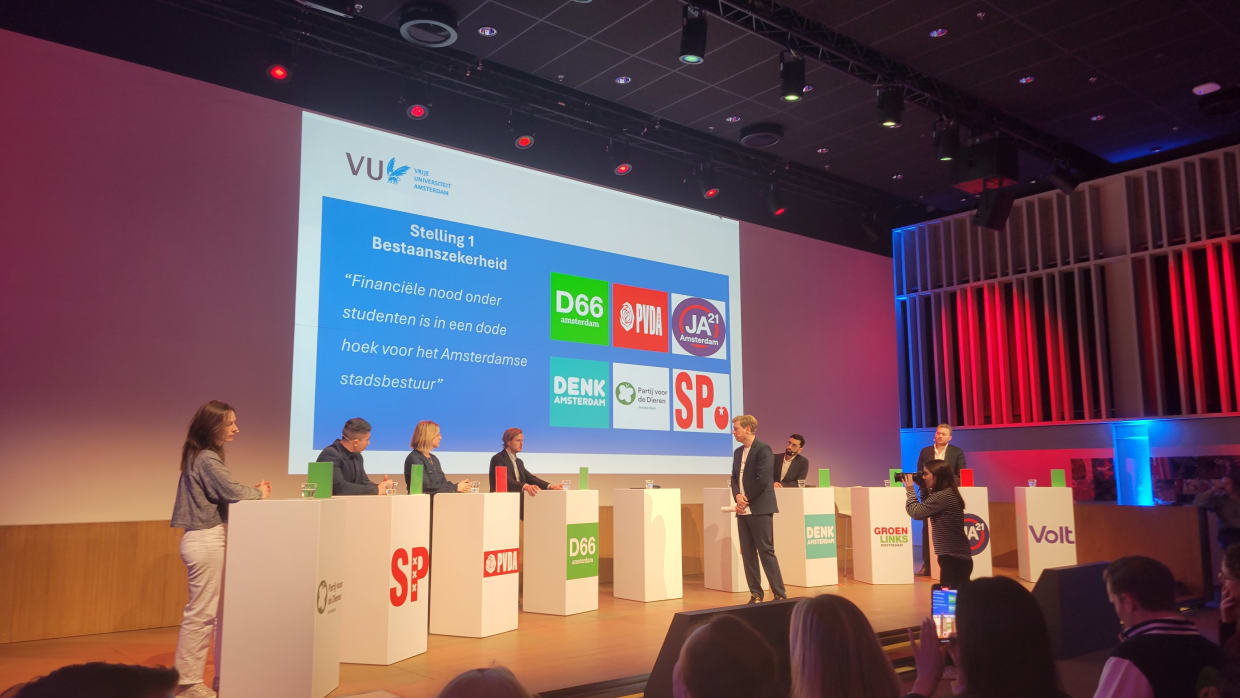
When the debate – chaired by Parool journalist Tim Wagemakers and co-organised by educational institutions such as the VU, the UvA, the HvA and ROC Amsterdam – got started shortly afterwards, the politicians took to the stage. Virtually all parties represented on the city council were present. Only the CDA, the BIJ1 splinter groups De Vonk and Partij voor Morgen, and Forum voor Democratie – boycotted by a large number of the other Amsterdam parties – were absent. The nine parties that did take part in the debate, GroenLinks, PvdA, VVD, PvdD, JA21, D66, Volt, SP and DENK, were each represented by their respective lead candidate or group leader.
Hammock
The first topic, financial security, was introduced by Asva chair Sahand Mozdbar and SRVU chair Jelle Gnoth, who argued that financial insecurity among students is a blind spot for Amsterdam’s city council. “On campus you pay a tenner for half a plate of food,” said Gnoth. The debate that followed focused on financial support schemes, free school lunches and making the city pass available to students.
With the VVD on the substitutes’ bench – six of the nine parties took part in each round of the debate – the right-wing counterpoint in this segment largely came from JA21. “The safety net must not become a hammock,” said JA21 lead candidate Sytze Rijpkema. “There is a basic grant, you can take out a loan and there are plenty of jobs. Student life is, after all, a formative phase in which you sometimes have to fall flat on your face in order to learn to stand on your own two feet.” His remarks prompted a number of agitated responses. “Just because you may have lounged in a hammock as a student does not mean others do,” D66 group leader Rob Hofland snapped back.
When the discussion later turned to housing, perhaps the hottest issue among student concerns, tempers flared once again. The proposition was: should students be given priority for affordable rental housing? Juliet Broersen of Volt answered with an unequivocal yes. “Amsterdam has the dubious honour of being the most expensive student city in Europe, so of course students should be given priority. As a city, you must invest in your future generation.”
Free beer
Zita Pels, GroenLinks’ lead candidate, raised her red card and described it as a “free beer” proposition. VVD representative Daan Wijnants retorted: “Refreshing. We tend to know GroenLinks as the party that is rather fond of handing out free beer.” For anyone who had not yet gotten tired of the beer metaphor – it had already been used at least five times during the debate – DENK’s Sheher Khan took it a step further: “Whole crates of beer are being handed out for free here.” Perhaps a little flippant, but the audience could not suppress a chuckle.
It was above all the VVD that was frequently singled out as the culprit behind the housing shortage. “If it were up to the VVD, no affordable homes would be built at all to allocate,” said SP representative Angelo Delsen. Several parties advocated house-sharing as a solution, though Zita Pels of GroenLinks added a caveat: “We cannot turn everything into shared accommodation, because we also need homes for families.”
Between the debate rounds, questions were taken from the audience, and at one point an awkward moment arose. An indignant woman, who turned out to be a list-pusher for BIJ1, argued that not only FvD but also JA21 should have been boycotted. It took a while before debate chair Wagemakers was able to make clear to her why this format had been chosen and she relinquished the microphone.
Bodyguard
During the final debate of the evening, which focused on safety, there was relatively broad agreement. Anke Bakker, lead candidate for the PvdD, stressed that men should call each other out over macho behaviour. “The problem does not lie with the victims or a broken lamppost, but with the perpetrators.” Volt’s Broersen added: “One in ten students has at some point been raped. Those are deeply painful figures, so we need to act much more swiftly when reports are made.”
Rijpkema of JA21 and Wijnants of the VVD – the only men on stage during this delicate debate, and seemingly reluctant to set themselves too firmly against their female counterparts – argued for a greater police presence on the streets. “That is an illusion of safety. We cannot provide every Amsterdam resident with a bodyguard,” responded PvdD candidate Bakker. According to Wijnants, she was thereby “doing our police officers a real disservice”. The other left-wing parties likewise rejected Rijpkema’s proposal to deploy decoy officers.
When, at the end of the debate, a member of the audience called for a cultural shift and argued that men in particular should challenge one another more robustly over inappropriate behaviour, the applause was thunderous. The loudest ovation of the evening went not to a politician, but to a student.