Central Works Council does not agree with revised UvA house rules

The new UvA house rules presented in December have not been well received by the Central Works Council, which finds the rules too vague and not very positive. “The idea is that people are made aware of the importance of the house rules, which will make them trust them more and see their logic.”
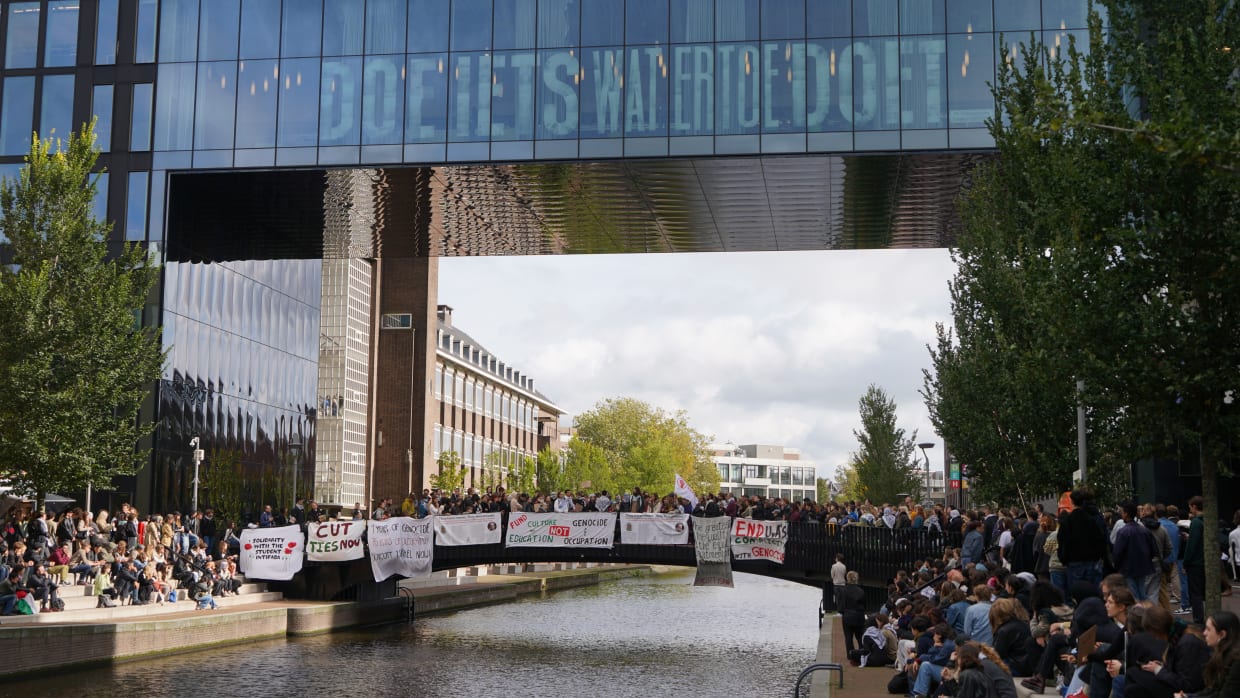
Unworkable and unenforceable is how Gerwin van der Pol, chairman of the Central Works Council (COR), summarises the UvA´s revised house rules. The UvA revised the rules in the wake of disagreement at the university surrounding last year´s pro-Palestinian demonstrations. The UvA hopes that the new draft house rules will “clearly anchor the right to demonstrate and guarantee a safe study and work environment”, as stated on the website. The draft has been sent to both the Central Works Council and the Central Student Council (CSR) for approval. Both representative advisory bodies have the right of approval, so nothing is finalised yet before they approve the new regulations.
The CSR cannot yet respond to the content of the new draft house rules, but the COR appears dissatisfied. There is a need for more clearly defined demonstration frameworks, but according to Van der Pol, the new house rules currently raise more questions than they answer. “We are asking for a reformulation, in more positive terms.”
Fundamental right
Charlotte Hille, vice-chair of the Central Works Council, agrees: “Of course there are certain rules, but they can be formulated in different ways.” The draft house rules still read too much like a long list of prohibitions, while the employee representation body is actually arguing for a positive approach, emphasising the right to demonstrate. “The idea is to make people aware of the importance of the house rules, so that they gain confidence in them and recognise their logic. In essence, demonstrating is a fundamental right, unless certain criteria are not met. It is important that this is also how it is presented.”
The COR also believes that the UvA´s revised draft house rules have not yet been drawn up carefully enough, leaving room for misinterpretation. “The regulations need to be more clearly defined,” explains Hille. “What is the definition of safety? What constitutes disorderly conduct? How do you deal with face coverings, and when do you ask someone for identification and when not? These kinds of things must be properly explained, because now people are afraid that they can be checked without good reason.”
Van der Pol: “As long as these kinds of things remain vague, unrest and discomfort will be created, which can never be the intention of the house rules, of course.” So the COR members are in talks with the UvA to discuss their concerns. “We fully understand that there is a need to draw up new house rules as quickly as possible”, says Van der Pol, “but in the end, thoroughness wins out over speed.”
UvA continues discussions
The UvA responds: “Feedback on earlier draft versions was requested from both representative advisory councils, from deans and from the AOB, CNV and FNV unions. Subsequently, specific legal expertise was requested from the Faculty of Law. All this feedback has been incorporated into the draft rules that are now before the central participation councils for approval. We will of course review the input from the participation councils and continue the dialogue as we move towards a final update of the house rules.”
Update 24-02-2025: reaction CSR
While the CSR has not yet answered to the request for consent, one thing is clear: that the house rules raise serious concerns about students’ rights to protest and express themselves freely. In their current formulation, a part of the rules goes against demonstration law itself, as shown in the legal advice the CSR requested (and published on our site). Not only that, but the combined effects of some rules are more dire on vulnerable groups, exposed to discrimination - such as, for example, identification checks and sanctions. This is a matter of human rights, of protecting those vulnerable, of protecting an autonomous UvA community. The CSR is looking forward to sparking a constructive conversation over the house rules with our upcoming consent letter.