Five-tonne vacuum chamber needs to unravel the mystery of planet formation

How are planets born? In a specially developed planet incubator in Germany, the birth of planets is being mimicked. UvA professor Carsten Dominik is one of the scientists behind the project.
In a room at the Science Park, UvA professor of astronomy Carsten Dominik looks proudly at his laptop screen. He is showing an online simulation of the planet incubator, a project he has been working on for a year, together with his colleague Jürgen Blum from Braunschweig. Dominik received 3.5 million euros from the ERC for the GT4Pebbles project. Initially, they were awarded 2.5 million euros, with a further million added later for “investments, the experiment and powerful computers.”
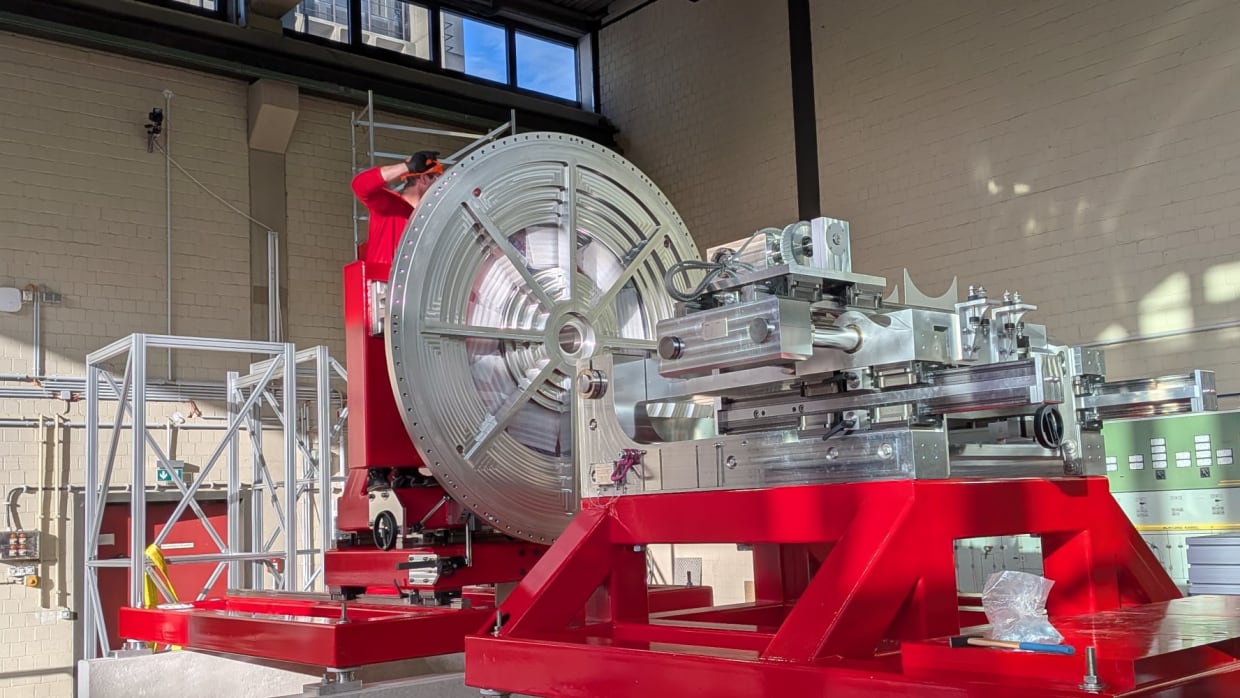
Today, the simulation becomes reality. In the same German city, the planet-incubator is being unveiled: a massive, round barrel with a diameter of two metres and weighing five tonnes. The company Pfeiffer Vacuum was commissioned to build the experiment. On the small screen, the colossus looks a fair bit less gigantic.
Our fascination with the universe dates back to prehistoric times. Yet there is much we do not (yet) know. How planets form, for example. We know that celestial bodies form from colliding pebbles (small, clumped-together dust particles; a sort of pebble) orbiting a new star. But exactly how those pebbles become pebbles is not yet known. The planet incubator is set to change that. The vacuum chamber simulates how dust particles clump together to form pebbles. Using a microscope, the scientists can observe the beginnings of a planet. “We’re not forming an entire planet here, but we’re taking the first step,” says Dominik.
Building blocks
Dominik clicks a large digital button and the circular chamber on the screen begins to rotate. Using the simulation, he demonstrates how the experiment they intend to carry out with the planet incubator, works. Pressing the button a second time causes dust particles to fall into the cylinder. Light-green dots, representing the particles, move along with the rotation of the drum. Dominik explains that, provided everything is set up exactly right, the rotational movement creates a state of weightlessness. In the experiment, the microscopic gas and dust particles can therefore move just as they would in space. “We’re not forming an entire planet here, but we’re taking the first step,” says Dominik.
“Planets form around new stars,” explains Dominik. “Around that star is a region where gas and dust particles float about. The gas particles push the dust particles back and forth. When they collide very gently with one another, they stick together and grow larger.”

In the simulation, the particles can already be seen floating around. “If we wait a little longer, I reckon we’ll soon see the first aggregates forming.” The dust particles can clump together, and if there are a great many of them, they can grow into a pebble, which in turn forms the building blocks for a planet. Dominik: “Aggregates are tiny grains, which are actually quite fluffy. Just like the dust under your bed. When they become more compact, we call them pebbles.”
The first little spheres on the computer screen are starting to merge. It’s not a pebble yet; that would require more than a billion particles. “We do understand how to turn pebbles into a planet,” says Dominik. “Those models are already well advanced.” Now they’re trying to work out how such a pebble forms. Once enough particles have come together, there must be a point at which they “probably start to shrink” and thus become more compact, eventually leading to pebbles, Dominik explains. “We’re trying to work out when and how that happens.”
Floating for days
Other scientists have previously tried to replicate this process. For example, by dropping an experimental chamber filled with dust particles from a 150-metre-high tower – because during the fall they also reach a state of weightlessness. In those experiments, that state could not be maintained for long enough. “It takes time for the particles to grow together. You have to let them levitate – that’s what we call it – in other words, let them float. If they fall to the bottom, they stick together and are of no use anymore.” In the other experiments, the particles were given too little time to move without the influence of gravity. In the planet incubator, the particles must be able to remain suspended for two full days. “This is possible because there is a very small amount of air in the chamber. When the chamber rotates, that air flows upwards slightly on the right-hand side, counteracting gravity,” explains Dominik.
Hypotheses
There are still various hypotheses as to how dust particles become pebbles. “It may be due to collisions,” explains Dominik. Another explanation is that the gas flows cause the aggregates to compress into pebbles. “If the gas is slightly turbulent – if it sometimes moves towards each other and sometimes away from each other – that might be enough to make them shrink.”
“The collisions will certainly have some effect,” Dominik expects. “But perhaps not enough. We really need to look closely at the gas flows.” He questions the assumption that all dust particles share the same properties and that they all turn into pebbles. “I think the current assumption – that all possible dust particles are contained within pebbles with exactly the same properties – is wrong.”
The calculations astronomers use to try to explain the formation of planets and answer other questions about the universe are based on those assumptions, Dominik says. Scientists modelling the formation of planets take the pebbles as their starting point, “as if they were already there, ready-made,” he explains. “It hasn’t been proven that this is the case. The properties may be different. We want to know whether the models we use to create planets are based on the right assumptions.”
Never finished
The particles are too small to be seen with the naked eye. But using microscopes and cameras, the researchers are monitoring the entire process. “To do that, we first need to build all sorts of equipment. Then we’ll carry out the first experiments. We’ll learn from those.” Based on the information from the initial attempts, they’ll adjust the variables where necessary and start again.
The experiment is never finished, says Dominik. Today, the planet incubator is arriving in Braunschweig, but it won’t be used straight away. “I don’t think that’ll happen until January,” says Dominik. The project will last a total of five years, the first of which has already passed. “In four years’ time, we really want to have answers. But the first results will come sooner.”