Synesthesia teaches us that we all experience the world differently

Experiencing Bach’s music as a geometric palette of colors, feeling sound waves as vibrations in your body, or seeing letters in colors. These are all forms of synesthesia. The University of Amsterdam is hosting an international symposium on the subject. But what is synesthesia exactly, and how does it work in the brain?

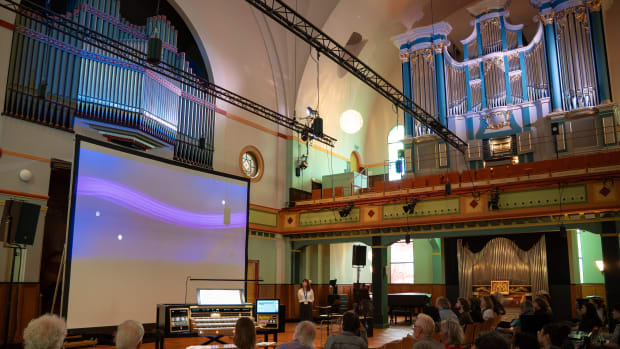
Yesterday marked the opening of the three-day international symposium on synesthesia at the Orgelpark. “It’s the first time we’ve organized such a large gathering in Amsterdam about synesthesia,” says UvA researcher Romke Rouw. “It’s very special.” She is one of the symposium’s co-organizers on behalf of the UvA.
“I see the sound before I hear it, and then I search for the tone that matches it,” says speaker Zoë Ng at the start of her presentation. Ng frequently shares experiences related to her synesthesia online and gives a talk about “how her synesthesia wrote a song.” A packed audience watches in fascination as mixtures of purple shades appear on the screen in different forms. In the music video for her song Coloured Clouds, she allows the audience to briefly see the world through her eyes.
Another World
A synesthete connects “different sensory perceptions” with one another. For example, they may see the letter A as red, or perceive shapes and colors while listening to music. And those are just two examples — there are many more forms of synesthesia. Four percent of people are synesthetes, Rouw explains. But many do not realize it. They have always perceived the world this way, she says. “We often hear that synesthetes assume everyone experiences it like they do.”
Synesthetes perceive the world differently, yet no two synesthetes experience it in exactly the same way. Still following? For Rouw, synesthesia demonstrates that all of us — regardless of who we are or how our brains function — perceive the world differently. That is why she believes more attention should be given to synesthesia. “We all live in the same world, yet something completely different is happening inside each of our minds. The fact that everyone experiences things differently is a reality we should be more open to.”
So how do you know whether you are a synesthete? “It has to be consistent,” says Rouw. Synesthesia does not simply appear randomly; it is present from birth. “And what a synesthete perceives always remains the same,” Rouw explains. The specific colors they perceive may differ from person to person, but there is still a certain logic to it. “If you put a group of synesthetes together, it is relatively common for people to say that the letter A is red,” says Rouw.
From 27 to 29 May 2026, the International Association of Synaesthetes, Artists, and Scientists (IASAS), in collaboration with the University of Amsterdam (UvA) and others, is organising the international synesthesia symposium. The first day took place at the Orgelpark. Presentations were given by synesthetes, scientists, musicians and artists, among others.
They truly see it
What synesthetes perceive often also feels “right” to non-synesthetes. “When others walk through my art installation, they say it feels just as perfectly natural to them as it does to me,” says British artist and researcher Angelina Marshall. She has auditory-tactile synesthesia, meaning that she not only hears sounds but also feels them on her body. In her interactive art installation, she makes sound tangible for everyone by recreating these sensations using carved surfaces.
“We all associate things with one another to some extent,” Rouw explains. “But for synesthetes it is extremely specific. If you ask them which color they see, they can point to the exact shade. They truly see it.”
A synesthete’s brain genuinely functions differently, Rouw says. “Their brains are exceptionally good at making connections between sensations. They have structurally extra neural connections and form these links more quickly.”
Magical?
“Most synesthetes I know are very happy to have it,” says UvA psychologist Nicholas Root, who will also speak later at the symposium. Synesthesia can make it easier to remember things, and it makes the world far more colorful, according to him.
That may sound magical, but it also has a downside. “I have fourteen forms of synesthesia, so please: handle with care.” Ng includes this disclaimer in her presentation. Because synesthetes perceive more stimuli, they can become overwhelmed more easily, Root explains. In addition, synesthetes — especially at a young age — are often misunderstood. “If a child in class says that 2 plus 3 is yellow, they are easily laughed at,” says Rouw.
“By studying synesthetes, we are actually studying all of us,” Root argues. “Synesthetes consciously perceive things that are often true for everyone. They are very good at explaining what they see and experience, and they are often highly self-reflective people.” A lot of research on synesthesia can still be done and many questions are yet to be answered. Take, for example, the colors associated with letters: at a group level, there is often a certain logic to them. These associations could help with learning a new language or alphabet. Root: “What if we could identify those logical colors? Could everyone then learn a new language faster?” A hypothesis he considers “plausible”, which he hopes to confirm through his research.