Surfing on the IJ and improving water quality – is that possible?

Following Rotterdam’s lead, there are now plans in Amsterdam for a surf pool in the heart of the city, which would also help improve water quality. Too good to be true? Researchers from the University of Amsterdam are testing the prototype at Science Park.

It’s still a long way off, but if entrepreneur Frederik van Os has his way, a Louvre-style glass dome will soon rise above the IJ in Amsterdam. Beneath that canopy, on a floating platform measuring 12 by 30 metres, around eight people will be able to surf at the same time.
Surfing in the city is nothing new. Two years ago, Rotterdam was the first to launch the Rif010 surf pool, a huge concrete tank of water with waves, right in the city centre next to the Markthal. The floating surf platform, Surf Pill, Frederik van Os’s dream, could be the second, and the world’s first surf pool that also purifies water.
How feasible is that? Does the surf platform actually contribute to water quality in the IJ and biodiversity in the city centre? To find out, Van Os enlisted the help of UvA researchers from the Institute for Biodiversity and Ecosystem Dynamics (IBED), who are now investigating this on a small scale.
Standing wave
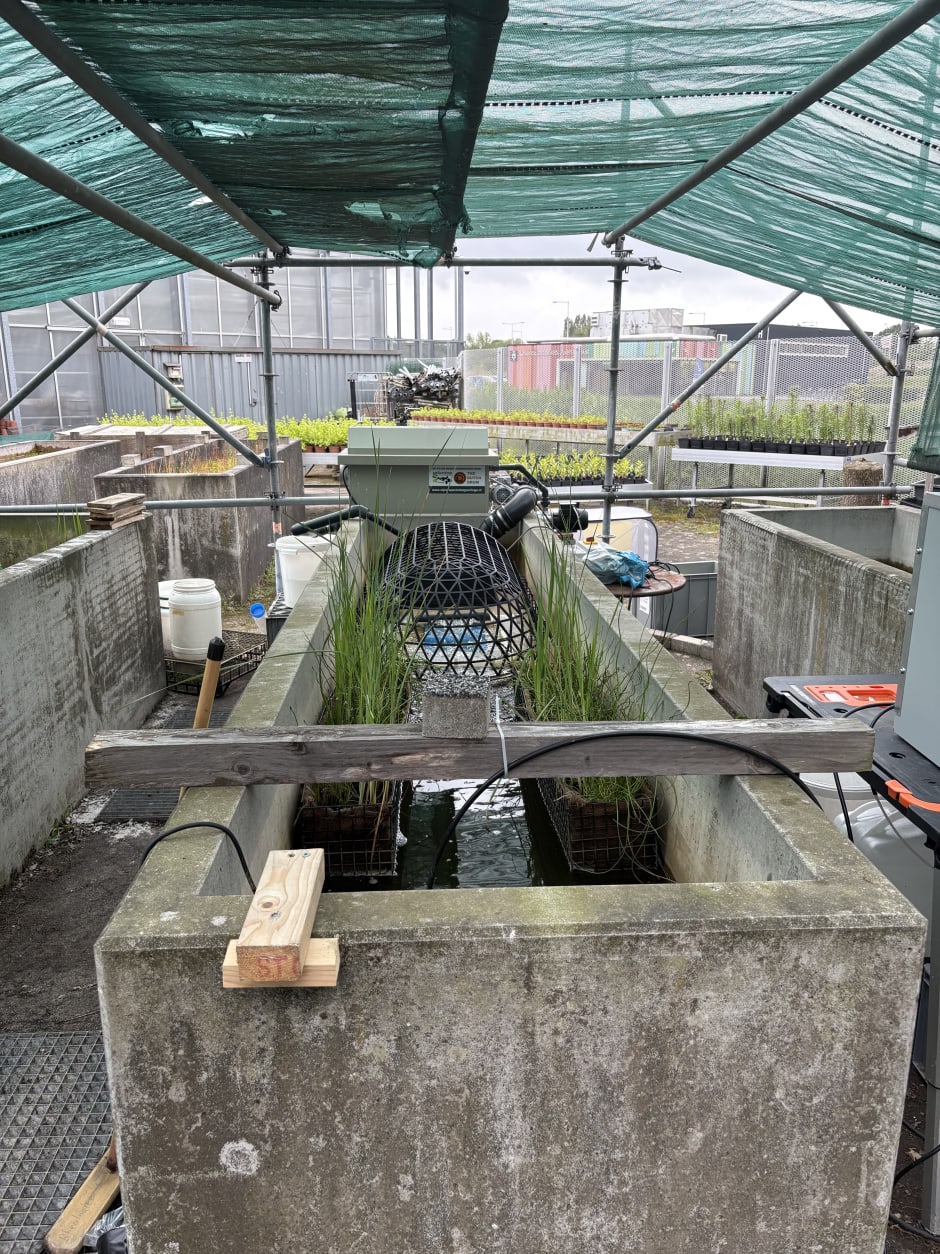
Biology student Willem Morsink opens the gate to the IBED’s water labs at the Science Park. Under a canopy stand two large concrete tanks filled with canal water. The prototype of the surf platform floats in one of the tanks; the other serves as a control.
The surf platform consists of a pill-shaped dome with a blue rubber sail underneath. A pump sprays water onto a bulge in the sail. “You can surf on the edge of that bulge,” Willem points out. It is a so-called standing wave, an existing concept from a New Zealand company that supplies the necessary technology.
Safe swimming water
Unlike in Rotterdam, where waves are created in a sealed concrete tank, Surf Pill uses surface water. That water does, however, need to be purified first. Despite the fact that the water quality of Amsterdam’s canals has improved in recent years thanks to interventions, the water is still not officially classified as safe for swimming. Especially when the sewers overflow after heavy rainfall, intestinal bacteria such as E. coli and cocci end up in the canal.
To meet the requirements for safe swimming water, Surf Pill uses three types of filter systems. Willem opens the device’s hatch and shows a mechanical filter that has turned green with algae. “We use this to first filter all suspended particles out of the water.” Willem is going to investigate what effect that filter has on aquatic life. “Which particles don’t pass through the mechanical filter? Do water fleas survive the filter, for example?”
The water is then purified using a UV lamp, which kills bacteria and blue-green algae in the water. To prevent all life from being killed, Surf Pill uses a Swiss measuring device that monitors the bacterial content in the water. If the readings exceed the standards for safe swimming water, only then does the
UV lamp switch on.
And then there is the ecological purification. Aquatic plants surrounding the floating platform filter excess nutrients, pharmaceutical residues and heavy metals from the water. In addition, Surf Pill is said to increase the oxygen content in the water through circulation within the surf platform.
No side effect
All these steps should contribute to water quality in Amsterdam. Water purification is not a side effect, according to entrepreneur Frederik van Os. “Surf Pill was designed first and foremost as a water purification system. It’s not a marketing stunt; water purification is one hundred per cent the goal.” Surf Pill would also raise surfers’ awareness of water quality, says Van Os. “For me, the added value is that city dwellers connect with the water through surfing.”
That is also why the University of Amsterdam (UvA) is facilitating the research into Surf Pill. “It’s a beautiful vision, and research must show to what extent it can be realised,” says Arie Vonk, UvA aquatic biologist and Willem’s supervisor in the research into Surf Pill. “Ultimately, it’s about how this invention fits within nature and must not have any negative effects on the ecological water system you’re using.”
Excessive algae growth
One of the challenges facing Surf Pill is that it aims to address different types of water quality that are at odds with one another in a city like Amsterdam. “You have bathing water quality and ecological water quality,” explains Vonk. “For good bathing water quality, you want to kill off certain harmful organisms in the water, but for surface water you can’t simply use chlorine. A UV lamp is a good alternative in that case, although research will have to show how best to use it.”
“Many problems with ecological water quality in the Netherlands revolve around an excess of nutrients,” Vonk continues. “There is too much nitrogen and phosphorus in the water, and that causes excessive algae growth in the upper layer of the water. This reduces the amount of light reaching aquatic plants, causing water quality to deteriorate further. If Surf Pill purifies the water of bacteria, algae and excess nutrients, you would expect the light supply to improve and other aquatic plants to grow better.”
At the Science Park’s water labs, Willem rolls up his sleeves and fishes a small aquatic plant from the bottom of one of the tanks. “This is feather grass,” he shows us, “a good indicator of water quality.” Willem placed several feather grass plants of equal size in both concrete tanks – one with and one without the prototype – to investigate which plants had grown the most after twenty days.
Treating the symptoms
So is this just treating the symptoms? “Yes,” sighs Vonk. “Ultimately, of course, we need to prevent any more nitrogen and phosphate from entering the water. At the same time, if we were to stop that now, we would still be dealing with an excess of nutrients that have accumulated in the sediment of the surface water. All solutions to remove those nutrients from the water contribute to improvement.”
And isn’t a nature-friendly bank – a gently sloping transition from quay to land where aquatic plants can grow – a more effective way to improve water quality than a floating surf platform? “There isn’t space for a nature-friendly bank in every part of the city,” says Vonk. “And a place like the IJ is already an artificial system; there’s so much wave action there that a nature-friendly bank stands little chance.”
Permit
The IJ would be one of the better locations in the city for the surf platform, as the water there is deeper than in the canals. This also means there is less harm to aquatic plants beneath the platform, which itself blocks out a fair amount of light; after all, the depth of water in the IJ is only about a metre or a metre and a half.
So how the system ultimately operates also depends on the location. According to Van Os, this must also be a social space. “It doesn’t necessarily have to be the IJ in Amsterdam-Noord. We’re also looking at the Marieneterrein, the Houthavens or the Johan van Hasselt Canal.”
But before that can happen, a permit is first required. As Dutch water systems are under pressure, the Water Board also wants to ensure that Surf Pill does not harm the environment before granting a permit. “We’re waiting for that now,” says Van Os. “The technology we’re using has already been proven. If the permit is granted, we could be ready to build within a year.”
Even then, UvA researchers will remain involved to monitor the effects on a large scale. What is already clear is that the water purification effect of Surf Pill will be very local. Vonk: “If Surf Pill is installed at the Marineterrein, the bathing water there may improve. For Amsterdam’s canals and the IJ as a whole, it will of course make no difference.”