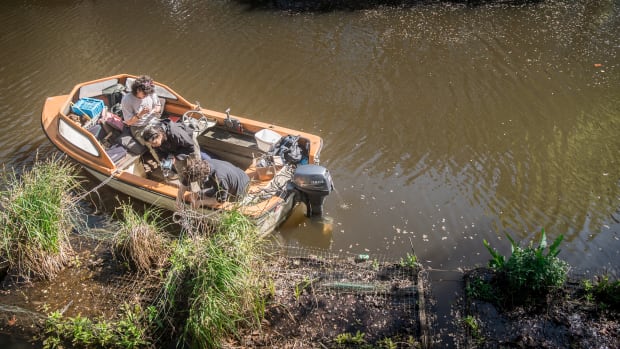
Those Amsterdam water gardens are lovely. But do they contribute to biodiversity?

Amsterdam’s water gardens have been floating in the city’s canals for twenty-five years. But do these gardens actually lead to more insects in the city centre? To find out, UvA ecologists are placing hundreds of insect hotels in the canals over the coming months. “Once we know exactly what contributes to biodiversity, we can advise the council to implement those measures.”
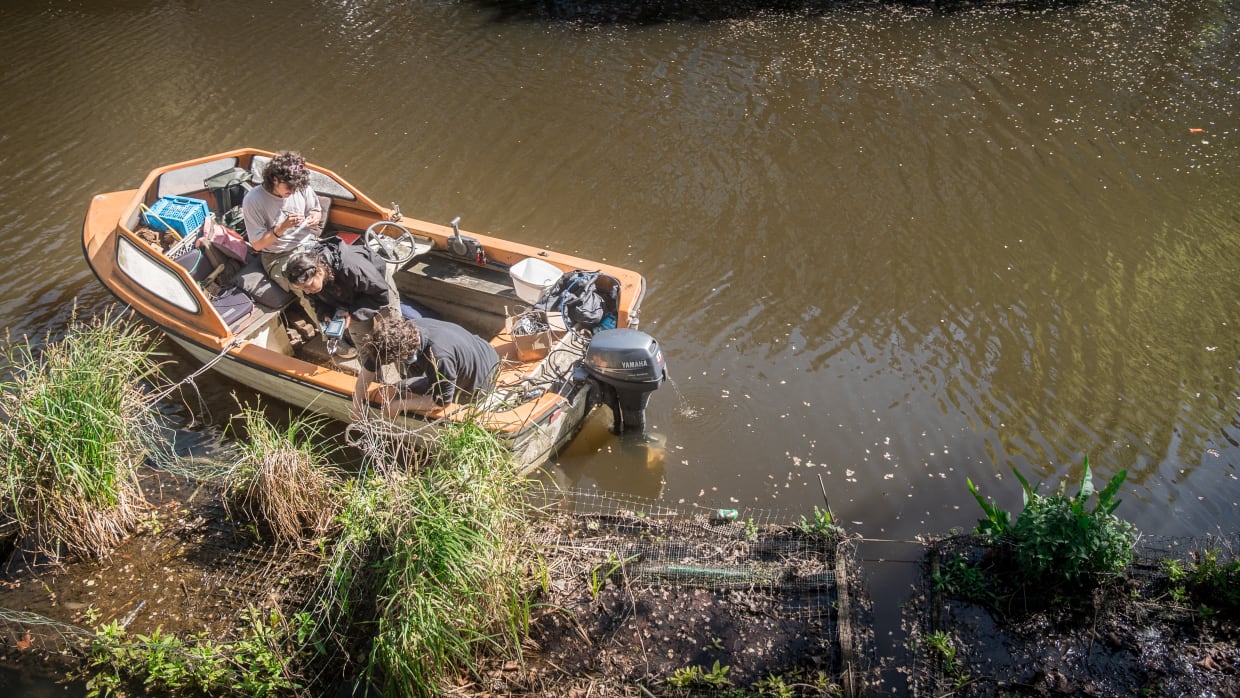
“What are you doing?” A German tourist watches curiously as three UvA ecologists in a small, orange boat place a measuring device in the floating gardens on the Lijnbaansgracht in the Jordaan.
It is two days after King’s Day and Amsterdam’s canals are overflowing with litter. The floating gardens are also littered with plastic bags, beer tins and paper cups. A coot has built its nest out of them. “Are those gardens for the birds? Or what are they actually for?” asks the German tourist.
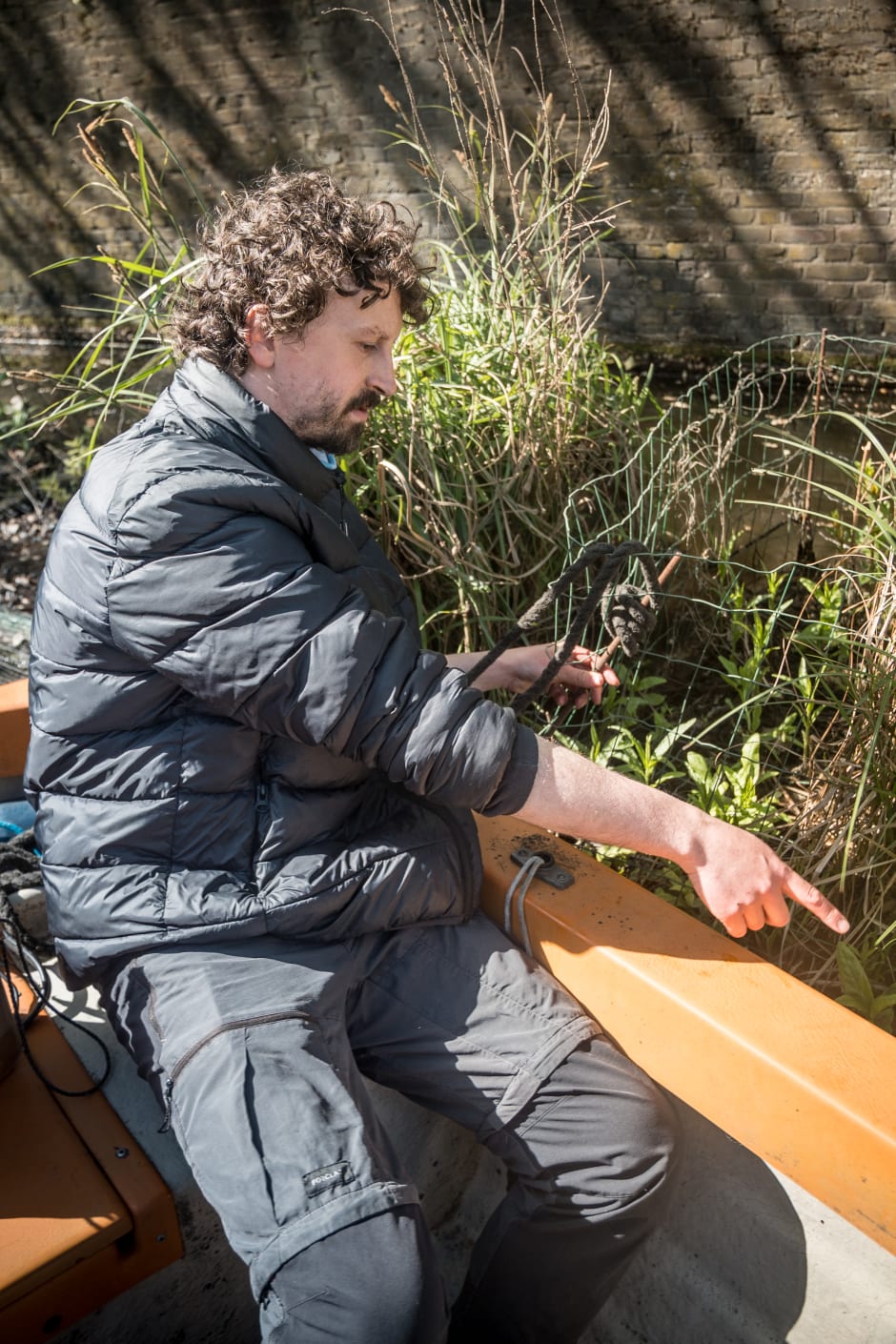
That is precisely what PhD student in ecology Max Verweg and his master’s students will be investigating over the coming months. The water gardens – a row of floating wooden rafts covered with netting and overgrown with aquatic plants – were created twenty-five years ago by volunteers in the Boerenwetering to bring more greenery into the city. Birds nest on the rafts, and fish also like to take shelter amongst the roots of the plants and lay their eggs there. But little is yet known about how the rafts contribute to biodiversity in the canals and to water quality.
King’s Day
This is important, because the water gardens are one of the measures the City of Amsterdam can take to improve water quality in the city. Water quality is, in fact, in a poor state in the Netherlands. And this is particularly true of Amsterdam’s canals, despite the fact that pollution has been significantly reduced over the years thanks to improved sewer connections. At the point where the Amstel flows into the city centre, water quality declines, and with it the number of aquatic insects, as Verweg observed in his findings last year.
“That’s not unexpected, because there’s more pollution in the city,” says Verweg. “You have sewer overflows and events like King’s Day or Pride, where a huge amount of urine ends up in the canal: in a single day, an entire generation of insect larvae and eggs can be wiped out. There’s not much you can do about such peak moments. It sometimes feels a bit like trying to mop up with the tap running.”
Hundreds of insect hotels
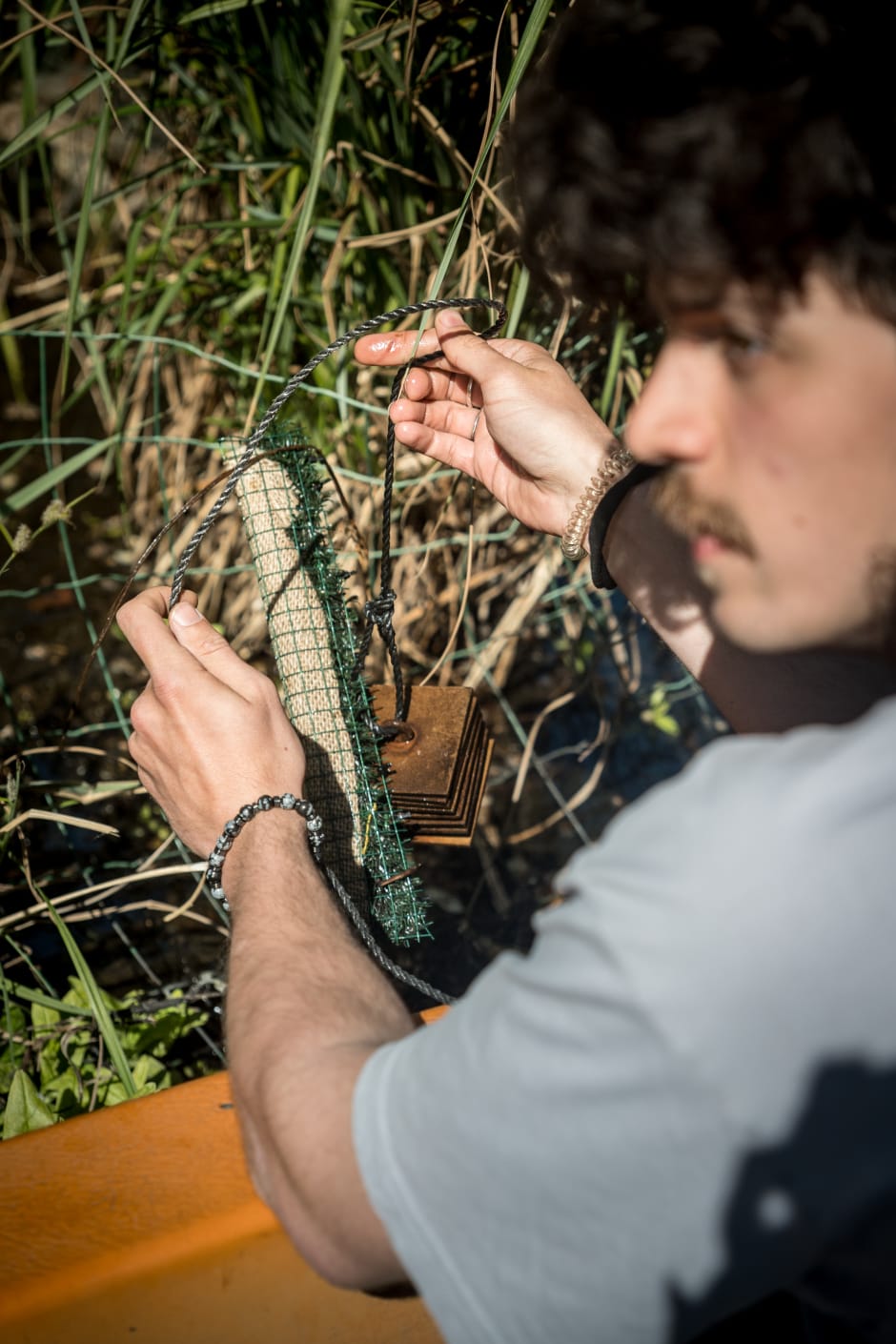
This year, he is conducting research into the city centre together with master’s students. On the boat, students Tol (26) and Yasmin (22) are putting the finishing touches to the underwater insect hotels. These consist of two parts: jute sacks and plastic aquarium plants, held together by chicken wire and a stack of wooden planks measuring 12 by 12 centimetres. Insects can nest in them, and this provides a more reliable picture of how many insects live in that area than simply sweeping the water with a landing net. Over the coming weeks, the students will place more than a hundred of these insect hotels in the canal.
“Once we know exactly what contributes to biodiversity in the city centre, we can advise the council to implement those measures,” explains Verweg. “What role do the water gardens play? What impact do boats have? And where are plants growing?”
To answer that last question, student Yasmin, for example, is walking along all the canals in the city centre, armed with a rake and scanning for aquatic plants. “You mainly see the more hardy plants, such as reeds and yellow irises. What’s already striking is that far more plants grow in the outer part of the city centre than, for example, on the Prinsengracht. Only a stretch of dead-end canal near the Hortus is the exception to the rule, because no boats go there and the bank slopes gently.” The gently sloping banks, such as those along the Ringdijk, Het Singel and Stadhouderskade near Leidseplein, guarantee more plant growth. “That’s also where marsh forget-me-nots and cattails grow.”
The timing of the research is no coincidence. Amsterdam’s bridges and quay walls are in dire need of replacement, and the City of Amsterdam is working with universities and contractors on a new quay wall, with one of the requirements being to improve water quality and biodiversity in the city. UvA ecologists such as Verweg and ecologists from Wageningen University are also involved in advising the council.
City Council
Meanwhile, a small group employees of the City Council on the bank are gesturing urgently towards the water gardens. “Do you have any money?” the eldest of them asks the trio in the borrowed boat. “No, why?” comes the reply. “The council has all sorts of plans to bring more greenery into the canal, but that does require funding.”
“I thought that wasn’t allowed here, because of the flow rate,” replies Verweg from the boat. “Waternet says it’s possible,” comes the reply. And: “We’re going to see what we can do now; we’re also thinking of willow branches, green quay walls and the EcoWal (green cladding for quay walls, developed by the VergroeningSingel030 foundation, an initiative group aiming to make the canal in Utrecht greener and more attractive – ed.), as at the Dutch Central Bank. The water gardens might well stay. Utrecht is already working on this, but we want more.”
Names and contact details are exchanged, then the officials disappear again. Meanwhile, the ecologists sail on quietly. Two more measuring points and then on to the next water gardens.