Food forest course set to become a permanent fixture at the UvA: “An interesting landscape to get you thinking”
There is considerable enthusiasm at the University of Amsterdam (UvA) for an elective course on food forests – an “edible” forest as an alternative to the current agricultural system. What is the appeal? And will the food forest ever be able to compete with conventional agriculture?
Former UvA student Sacha Brons (25) will never forget his first experience in the Ketelbroek food forest, just south of Groesbeek. “Stepping out of the blazing sun, you enter a layered, living ecosystem. Very different from most forests in the Netherlands, which are more like cemeteries. And then it turns out that everything on the trees, shrubs and plants is edible, and the plot yields three times as much food as the maize farmer next door.”
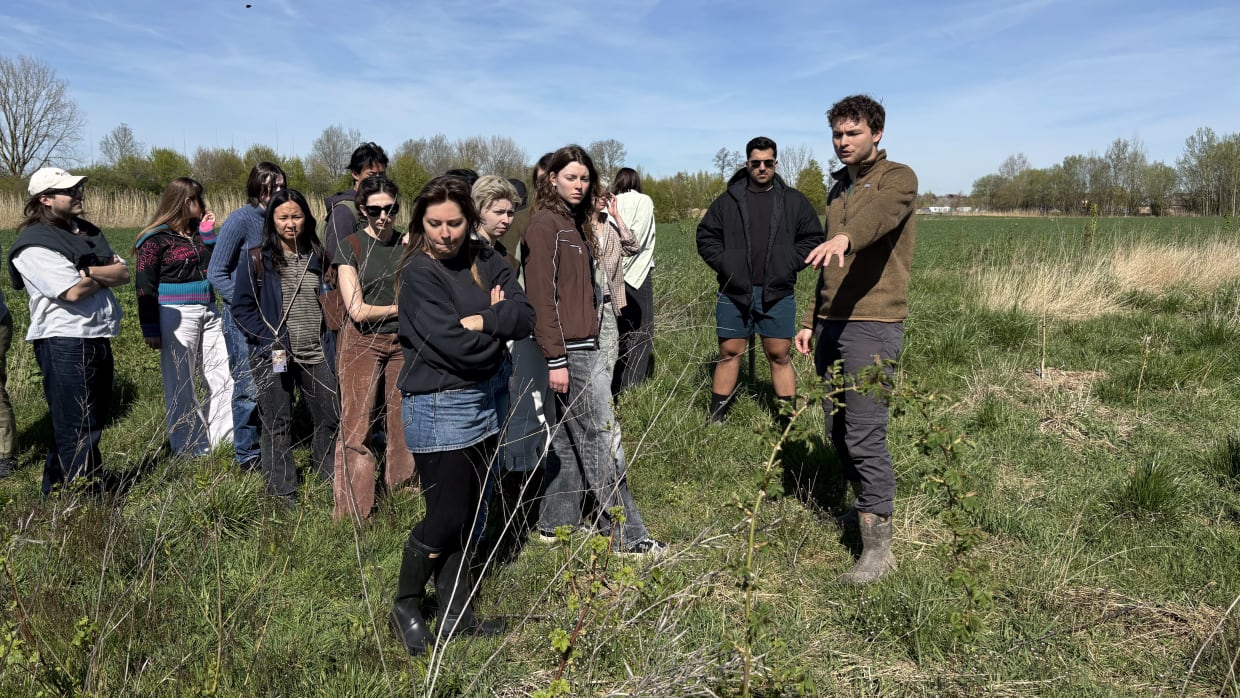
A visit to the food forest turned his entire worldview of humanity’s relationship with nature on its head, Brons tells a group of around sixty UvA students taking the food forests elective. On a sunny day in April, they are travelling by coach to the De Laar food forest between Arnhem and Nijmegen, of which Brons is now a co-owner. Later that day, they will also visit Ketelbroek, a mature food forest near Groesbeek.
The excursion is one of the reasons why the food forests course has been fully booked for three years running. Due to its success, the course will become part of the core curriculum of the Bachelor’s programme in Future Planet Studies from September. And this at a time when courses on climate and sustainability are attracting fewer and fewer students, as recently revealed by research by the daily newspaper Trouw. What is the appeal of the food forest? And what can it contribute to the fight against climate change?
More and more food forests are being established in the Netherlands. In five years, the area of food forests has increased tenfold. There are now 367 hectares of food forests in the Netherlands, equivalent to 514 football pitches. That is still a very small proportion (0.016 per cent) of the total 2.2 million hectares of agricultural land in the Netherlands. By 2030, the government aims to have 1,000 hectares of food forests.
The lazy farmer
“Do take a good look around you,” Brons tells the predominantly international UvA students as the bus drives through an endless landscape of perennial ryegrass. “This is what a large part of the Netherlands looks like. It’s not for nothing that we call these green deserts; there is a lack of biodiversity because there are hardly any other species.”
In a food forest – a man-made forest of edible trees, shrubs and plants – there is, in fact, a great deal of biodiversity. A food forest is based on the philosophy of permaculture, which allows nature to take its course as much as possible and where weeds do not exist; it is also known as “farming for the lazy farmer”. It takes into account all the plants and animals in the ecosystem, rather than focusing on growing a single crop (monoculture).
Brons discovered his love for the food forest together with his secondary school friend Wytze Walstra (25) whilst studying for a bachelor’s degree in Future Planet Studies, where courses on climate change and food systems left them feeling disheartened about the current agricultural system. Brons: “By the end of the first year, half the students had become vegan and the other half had dropped out.”
Brons and Walstra took a different approach and designed a course on food forests, with which they won the Create a Course Challenge at the University of Amsterdam in 2022. Together with Katja Zweerus (29) and Simon Verboom (32), they form the Young Food Forest Farmers and, through crowdfunding, managed to purchase a 13-hectare plot of land from the province of Gelderland for 800,000 euros.
Social sciences
The students have similar motivations to Brons and Walstra. They are concerned about climate change and want to get their hands dirty. It is also striking that it is mainly students of social sciences who are taking part, studying subjects such as media & culture, sociology, and political science.
“I wanted to do something that’s more hands-on than writing essays,” says anthropology student Zhenya Shurupau (22). “And learn something that’s relevant in times of a climate crisis.” He became interested in food forests through the film Establishing a Food Forest by Australian permaculture guru Geoff Lawton. Sociology student Veronica (23) cites the film My Biggest Little Farm as her inspiration. A film about a family in America who swap city life for building a “natural” ecosystem on a barren piece of farmland.
According to philosopher and media scientist Elize de Mul, who is researching at Radboud University how food forests encourage a different way of thinking, the desire to create new little worlds is one of the reasons why food forests are so fascinating. “The longing for a little paradise, detached from the systems that have led us into the current climate crisis.”
Danique Caballer (21), a student of social geography and urban planning, chose the course “To be honest?” mainly for the credits. But she too says she is interested in what concrete steps can be taken to combat climate change and is curious to see whether “people in the future will be open to food production via food forests”.
Tons of food
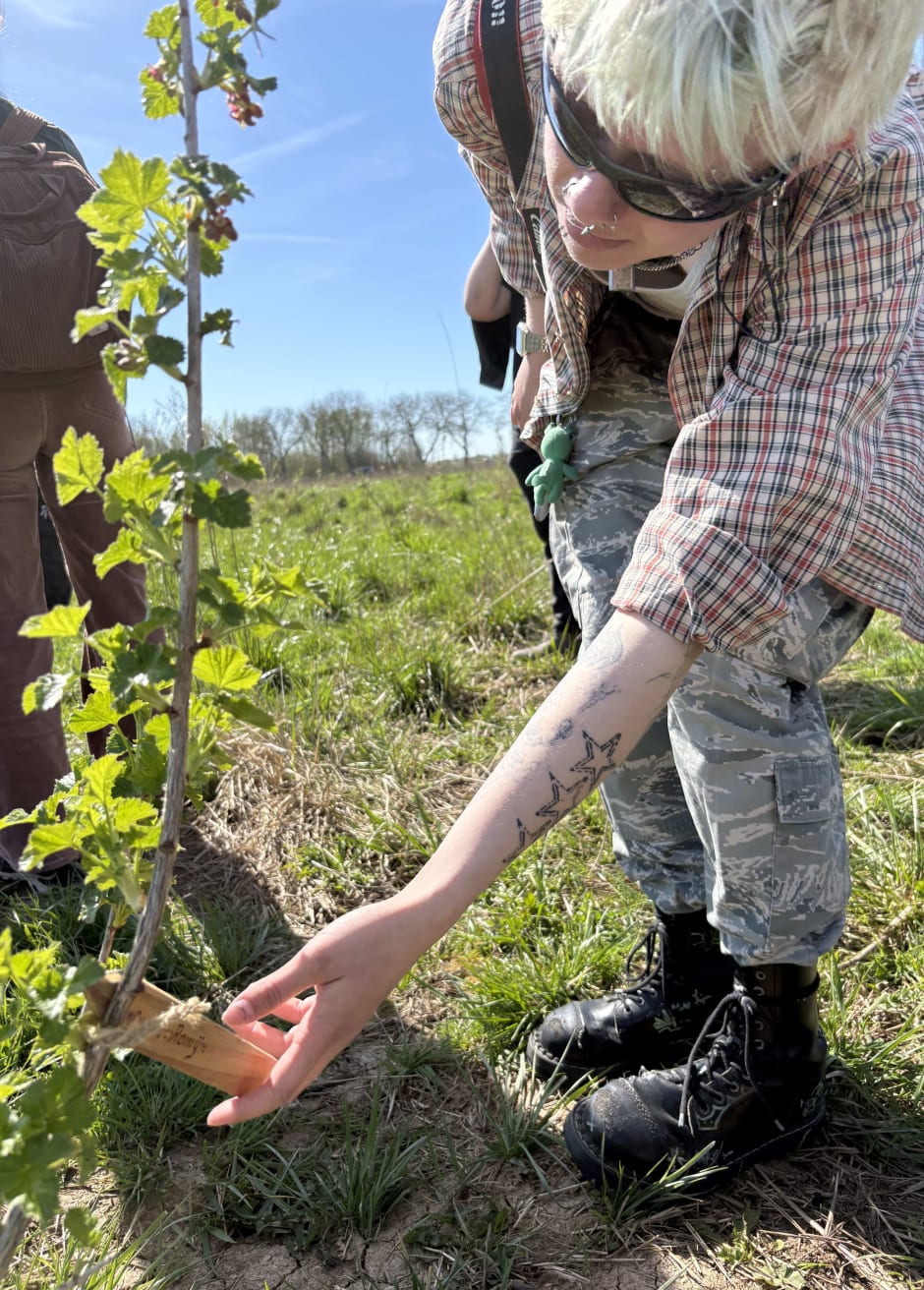
There is, in fact, quite a bit of scepticism surrounding food forests. Can they really compete with current intensive agriculture in terms of production to feed the world’s population? At the De Laar food forest, the Young Food Forest Farmers want to demonstrate that a food forest can indeed be productive. Brons: “We want to bridge the gap between the magical place that a food forest can be and compete with the agricultural production system. How do we build a food forest that can produce tonnes of food?”
To this end, the food forest farmers divided the land into three sections: the production forest, with “just” twelve species of trees and berry bushes planted in long rows to allow for mechanical harvesting; a self-harvest forest for local residents; and the romantic food forest with special varieties for foodies, designed for collaborations with local businesses and restaurants.
The layering in the design has been carefully considered, explain Brons and Walstra during a tour of the site. The forest is surrounded by tall alders and willows to provide shelter for the apple, pear and nut trees, in whose shade wild garlic, Japanese ginger and quinces can grow. The shrubs and trees are arranged from small to large, from south to north, so that the sun has an even effect on all the plants. To visualise this, the students need a bit of imagination; the De Laar food forest is still in its infancy, with some 20,000 young trees having been planted just sixteen months ago.
Privilege
Later that afternoon, the students visit the 16-year-old Ketelbroek food forest near Groesbeek. “You could hardly walk through it, it was so overgrown,” says anthropology student Maya Casanova (20). “That was a special experience, also seeing the people who work in the food forest. It’s a different way of life, much slower; you feel much more at one with your surroundings. It makes you think about how we relate to our food; I talked about it at length with my parents that evening.” Casanova would certainly consider starting a food forest herself. “But buying a piece of land isn’t an option for everyone. It’s quite a privilege.”
The food forest dinner at the end of the excursion, which students can join for ten euros, provides even more food for thought. The fried nettles, chestnut pudding, edible flowers, oil made from all sorts of nuts, wild garlic and Szechuan pepper taste fantastic, but preparing such a meal isn’t feasible for everyone on a weekday evening, Danique concludes. “Nor does everyone get the chance to learn about food forests. That does bother me. And so the food forest does feel like a utopia.”
Modernist ways of thinking
Setting aside the debate over whether the food forest will ever be able to replace conventional agriculture in the long term, course coordinator Jordy Willems sees the food forest primarily as an interesting landscape concept to explore. “The food forest raises all sorts of questions about the relationship between humans and nature. This lends itself to theoretical discussions that are actually of interest across all disciplines.”
De Mul also welcomes the food forest as an educational tool, precisely because it invites students not only to think about “nature” from their lecture seats, but to go outside and think in and with nature. Moreover, the food forest challenges modernist and dualistic ways of thinking about culture and nature, according to De Mul. “It is forest, field and park garden all in one.”
“You soon feel that it rubs you up the wrong way on all sides when you start working on a food forest,” explains De Mul. “Anyone who starts a food forest out of a romantic ideal cannot escape instrumental concepts in the food forest design literature. These stem from modern science and reduce non-human beings to their useful functions within the ecosystem.”
Anyone who actually starts a food forest and comes into contact with plants, fungi and animals – which have a mind of their own and do not simply adhere to your design and management – will naturally begin to reflect on the worldview and view of humanity with which you approach the world, according to De Mul. “In this way, the food forest becomes a place for reflection, challenging you to question assumptions, for example about weeds, pests or utilitarian thinking. In this way, food forests expose certain patterns of thought in the Western world and hopefully pave the way for new, more sustainable ways of thinking in times of climate change.”