“Climate history shows that things can change very suddenly”

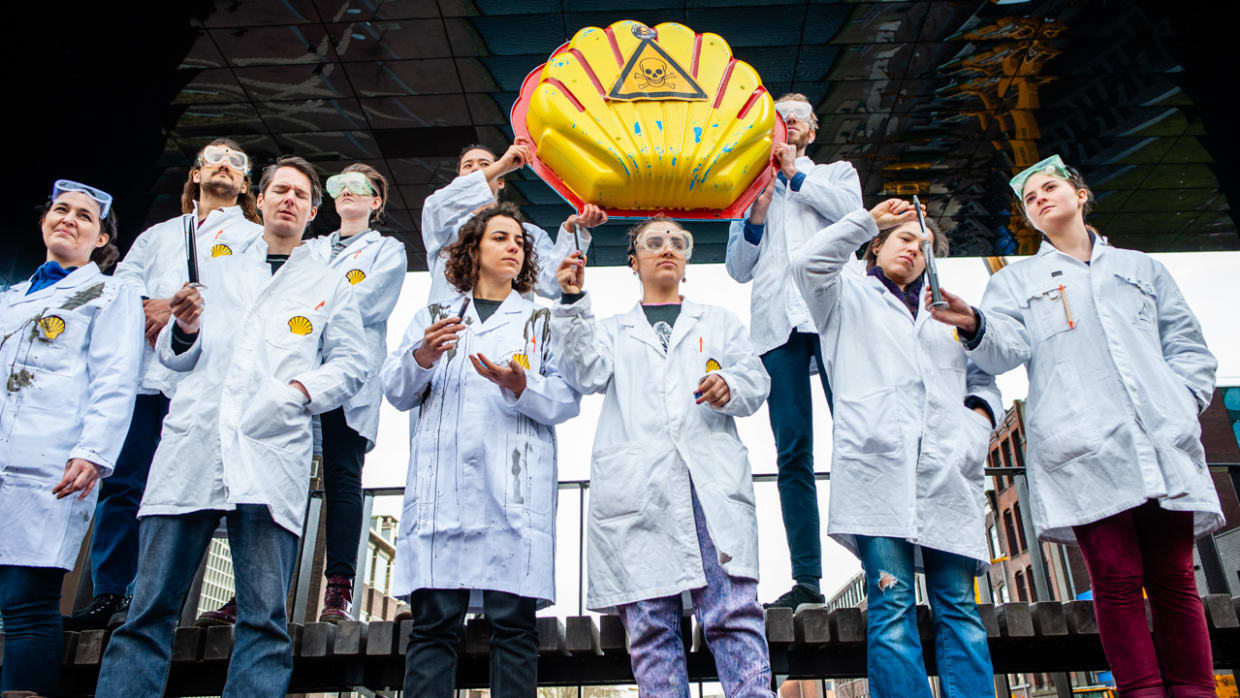
Greenpeace and Shell once worked together. During the Solaris campaign in 1998, climate activists and the oil company sold solar panels to Dutch households. How did it come to that? And what can the climate movement learn from this? UvA Professor of Dutch History Peter van Dam investigated this.
The momentum for the climate movement seems a long way off. Concerns about the climate are at their lowest in five years and are being overshadowed by Gaza, Trump and the threat of war. How do you view this from the perspective of climate history?
“Other issues may be more in the spotlight right now, but behind the scenes, organisations such as Greenpeace, Milieudefensie and Extinction Rebellion are simply carrying on with their work. The climate movement comes in waves, and the next wave is undoubtedly on its way. After all, the climate problem isn’t going away – unfortunately. We can’t escape it: if only because we’ll have to raise our dykes due to rising sea levels and prepare for periods of drought, heat and extreme rainfall. We’ll be talking about this a lot over the coming decades.”
How far back does the history of climate action go?
“The history of conservationists begins in the late 19th century, when organisations such as Natuurmonumenten started protecting nature from the consequences of human activity. The second wave of the environmental movement emerged in the 1960s and 1970s and focused on the consequences of post-war industrialisation: the rise of the car and the expansion of agriculture. Climate change only appeared on the international political agenda in the 1980s. It was around this time that campaign groups such as Greenpeace also became active.”
Is environmental history a phenomenon of the 20th century?
“That’s a dangerous thing to say, because it makes it seem like an unusual, recent issue. Environmental history goes back much further – even before people started talking about it in the terms we know today. Humans have always had to relate to nature. Even in the 16th century, the Dutch manipulated the landscape to be able to live alongside the water. That was also a matter of life and death. Yet it is also important to emphasise that the climate crisis we are facing now is more acute. The pace at which we are currently changing the climate through the emission of greenhouse gases, and the scale on which this is happening, bears little resemblance to the Middle Ages.”

A key success story in climate history is the Solaris campaign in 1998. In that campaign, Greenpeace and Shell collaborated to sell solar panels to Dutch households. How did that come about?
“Three developments in the 1990s made this collaboration possible for a brief moment. Firstly, there was technological development: within ten years, solar energy grew from an idea to panels on the roofs of Dutch homes.”
“Oil companies such as Shell had been researching for some time how to generate electricity using solar energy, and an alternative energy source came in very handy in the 1990s. It was a good opportunity for the company to polish up its reputation following a scandal in Nigeria (in which Shell executed nine residents of the Nigerian village of Ogoni who had spoken out against Shell’s activities in the region – ed.) and the Brent Spar affair (the plan to sink the Brent Spar oil platform in the North Sea, which turned into a PR disaster – ed.). Under these circumstances, Shell is also interested in collaborating with Greenpeace.”
“Greenpeace and other activist groups were, at that time, also specifically seeking concrete alternatives to demonstrations. Unlike activists in the 1970s who, disillusioned with the idea that they could change the world, retreated into communes to work on alternatives on a small scale, activists in the 1980s wanted to collaborate with large corporations to bring about change. Moreover, environmental activists were terrified that actions explicitly targeting climate change would lead politicians to focus on nuclear energy, at that time the only realistic alternative to fossil fuels that did not emit CO2. By collaborating with Shell, they hoped to put a concrete alternative to fossil fuels and nuclear energy on the agenda.”
“In 1997, Shell scaled up the production of solar panels at a factory in Helmond, and Greenpeace organised high-profile campaigns to attract media attention, such as the illegal installation of solar panels on the roof of the Torentje at the Binnenhof. The government also played a supporting role behind the scenes with subsidy schemes and tax incentives. This was not without success; in no time at all, the Netherlands became one of the frontrunners in the field of solar panels in Europe. Yet the collaboration was very short-lived. Within a few years, Shell withdrew from alternative energy and returned to focusing entirely on oil and gas.”
Why?
“It is difficult to say for certain, as Shell does not grant access to its archives. What we do know is that Shell feared competition from China, where solar panel production was booming at the time. When it became clear that Shell would receive no protection from the European Union – which was, at that very moment, in the process of liberalising the market – Shell made it clear that they were halting production because they did not see it as a profitable sector in the long term.”
Could things have turned out differently?
“Yes, I think so. The claim that solar panels weren’t profitable back then is highly controversial, as far as I can tell. There are Shell employees who later said that if we’d sold the solar panels outside Europe, we could have made a good profit from them.”
What can we learn from this?”
“Companies are often seen as machines, but ultimately they are just people making decisions based on sentiment and a few ideas. This is where the historical account of the climate crisis can really make a contribution. From a natural sciences perspective, we mainly see that more and more CO2 is being emitted, but we have no insight into the changes taking place beneath the surface. From the humanities, we know: it is not the same kind of emissions, and we are not dealing with the same political constellations now as we were in the 1990s.”
That is important for opening up the conversation. There is no single path from the past to the present; everything is constantly shifting, and people have a great deal of choice in that. Decisions made by individual companies, activists and politicians therefore really do matter in shaping history. In terms of historical writing, we can break free from a kind of rut: the idea that everything always moves in the same direction. Climate history shows that things can also change very suddenly, in a way you didn’t see coming. In a strange way, that can actually be a kind of comfort. I really need that feeling on my dark days too, haha.”
What does climate history tell us about the Netherlands?
“That’s a question I’m still thinking a lot about myself, and for now I’ve come to a paradoxical conclusion. The Netherlands has had close ties with the fossil fuel industry for a very long time. Shell was one of the companies the Netherlands was proud of. It even went so far that Dutch diplomats did internships at Shell for a while to learn about the ‘Dutch interest’. At the same time, in the late 1980s and early 1990s, the Netherlands was quite ambitious in the field of climate policy.
What I find typical of the Netherlands is the tendency to want to have it both ways. I therefore often compare Dutch environmental policy from the 1970s onwards to an ecoduct. On the one hand, the Netherlands pays close attention to environmental issues and is very aware of the risks our lifestyle poses to the environment. And at the same time, the Netherlands does not want to make the fundamentally necessary choices. Instead, the Netherlands builds an ecoduct over the motorway. Then perhaps that motorway can even be made a bit wider, and the wolf can still make it to the Veluwe.”