Four UvA researchers start fellowships at Nias
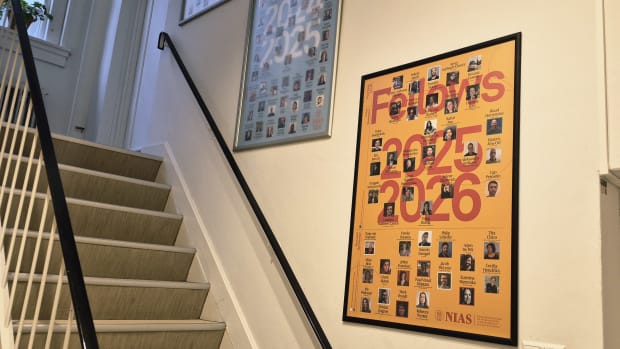
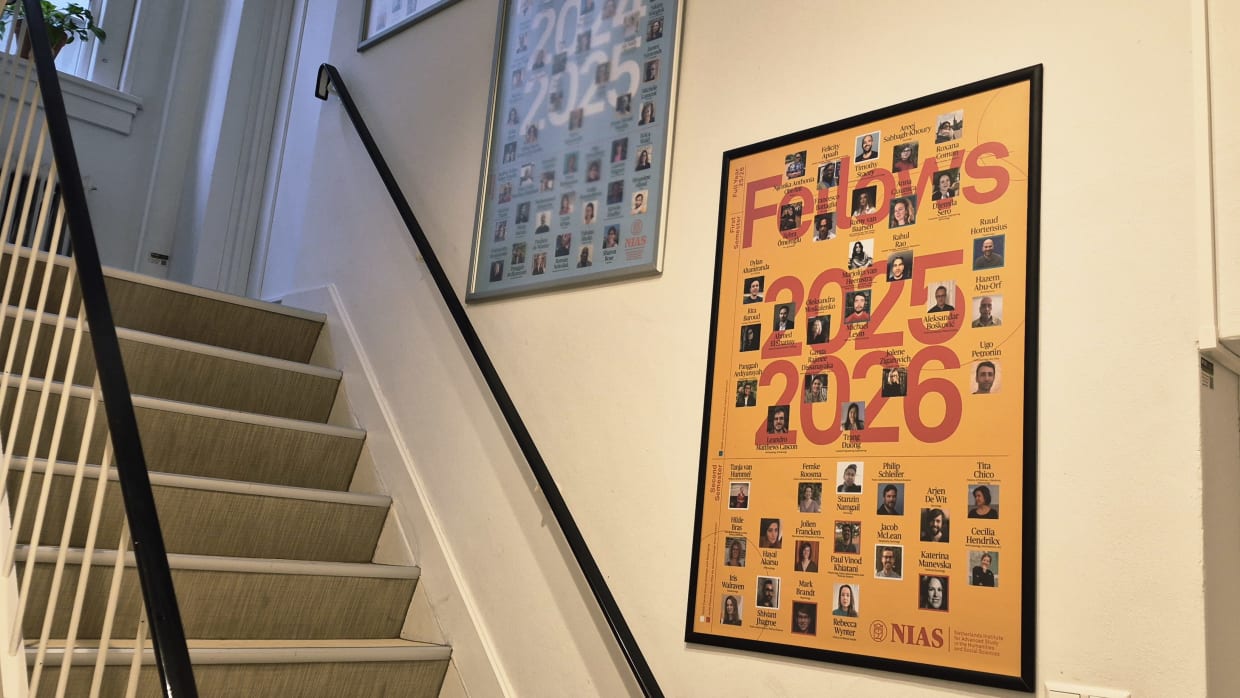
The Netherlands Institute for Social Sciences and Humanities (Nias) is awarding fellowships to four UvA scientists in the second half of this academic year. Last Wednesday, 11 February, the new semester was opened in the Waalse Kerk.
What is our consciousness? What should the reform of the welfare state look like? And how are large companies actually responding to climate change? These are some of the questions that four UvA researchers will be exploring in the coming period during their fellowships. These fellowships are awarded by Nias, a research institute that falls under the Royal Netherlands Academy of Arts and Sciences (KNAW), and enable researchers to focus entirely on their research for six months or a year.
Nias chair Jan Willem Duyvendak welcomed the new fellows on Wednesday 11 February during the opening of the second semester of Nias in the Waalse Kerk. During the meeting, Annelies Moors, emeritus professor of anthropology at the University of Amsterdam, gave a lecture on the first book in the series Nias Studies in Academic Freedom and Epistemic Diversity. In it, Moors argues that the new strategy of science funder NWO to apply stricter rules for transparency and replicability in Open Science is detrimental to researchers in ethnography. The fact that these rules can now be applied as conditions for funding puts pressure on the methodology used by cultural anthropologists to map cultures and behaviour.
Four scientists
The four UvA fellows are political scientist Femke Roosma, mental health historian Rebecca Wynter, political scientist Philip Schleifer and neuroscientist Jolien Francken. Roosma will investigate which policies are socially desirable for reforming the Dutch welfare state. Which groups benefit from a social safety net and how can this be implemented? Historian Wynter wants to use interviews to map out how the police deal with confused people (‘verwarde personen’) – a term she considers problematic for people with mental health issues – on the streets. Schleider will investigate how large companies deal with the climate crisis. He will use AI models, such as ChatGPT, as “research assistants”, an approach that Nias calls “transformative within social science”.
Francken, the last fellow, focuses on the question of what consciousness is and how we can measure it. Everyone might be able visualise it, but there is still no conclusive definition in science. Francken therefore wants to develop a “philosophical toolbox” to map consciousness. She is receiving the L'Oréal-UNESCO For Women in Science fellowship, which specifically aids female careers in science.
This semester, a total of twenty-four new fellows will start at Nias. In addition to individual fellowships, there are theme-based grants and places for journalists and artists. Nias also offers the Save Haven fellowship, for which the University of Amsterdam is funding two places. This fellowship international researchers who have fled their countries. One of these fellows is Palestinian journalist Hisham S. M. Zaqout. He is currently trapped in Gaza and is therefore unable to start his research. Despite having been granted a study visa, the Dutch government is not providing to depart the country, leaving him with the impossible task of collecting his visa in Jordan, reported NRC on 2 February.
Update: On Thursday, 12 February, journalist Hisham S. M. Zaqout finally entered the Netherlands and arrived at the Nias.