Coalition agreement: 1.5 billion for education and science “A historic step”

With a structural investment of 1.5 billion euros in education and science, previous cuts will be reversed. The coalition also wants to focus on an international university again. This is evident from the coalition agreement “Aan de slag” (Let’s get to work) presented by D66, CDA and VVD this afternoon. “A historic step.”
Informateur Rianne Letschert, who is also chair of the board of Maastricht University, announced this morning that her “academic heart” was happy. And this afternoon, it became clear why. The coalition agreement “Aan de slag” (Let’s get started) by D66, CDA and VVD shows that the cuts that have been hanging over higher education for years will be reversed with substantial investments in education. This year, an additional €1 billion will be allocated to education and science, rising to €1.5 billion per year from 2031 onwards. This will cancel out the previous €400 million in cuts made by the outgoing cabinet.
International university
The coalition is therefore once again focusing heavily on education and science and wants Dutch colleges and universities to remain “internationally leading”. To achieve this, the three parties want to “move towards the Lisbon objectiveThe Lisbon Strategy is an action plan by the European Union to become the most knowledge-based economy in the world.”, which means investing 3 per cent of GDP in public and private R&D. The Netherlands has been lagging behind this target for years.
The cabinet also wants to attract top talent and create a talent strategy to select the right scientific talent and retain it for the Netherlands. Universities and colleges must be given “more opportunities” to attract top international talent, according to the agreement. The Foreign Language Education Test (TAO) for new programmes will be scrapped and the current range of foreign language programmes will remain in place.
In order to control the influx of international students, binding administrative agreements will be made between the government and educational institutions on the capacity of foreign language programmes, with a numerus clausus for English-language bachelor’s programmes where necessary. The Balanced Internationalisation Act will remain in force and will be used to set a numerus clausus for students from outside Europe (non-EEA) with the option of an emergency numerus clausus in the event of unexpectedly high enrolment numbers.
Screening Act
There are also plans for practice-oriented research, for which cooperation between vocational colleges, universities of applied sciences and universities will be strengthened. In addition, the coalition wants to give valorisation a more prominent place and strengthen campuses “as engines for start-ups, scale-ups and cooperation between education, research and industry”. The knowledge security screening law, which has been discussed previously, will also be introduced. This law will screen researchers and PhD students from outside the European Union who work with Dutch knowledge.
Student
The coalition also wants to make student life more enjoyable and prepare students for a “bright future”. The grant for students living away from home will be increased and there will be an upper limit of 2.5 per cent on interest rates. There will also be a legally required internship allowance.
And finally, housing. The three parties want to make it easier to share accommodation and remove the obstacles to subletting. There will also be a focus on more shared forms of housing and fewer studios. In addition, educational institutions will be made “more responsible” for providing sufficient accommodation for international students. They will also be allowed to charge rent for accommodation.
 BodHoogleraarFMGFotoJeroenOerlemans_b4202a.jpg)
Whether the plans will actually be implemented remains to be seen. D66, CDA and VVD form a minority cabinet and will therefore need to obtain support from one or more opposition parties in both the House of Representatives and the Senate for each bill. Informateur Letschert jokingly advised the coalition to buy a good coffee machine.
Historic step
Rens Bod, professor of digital humanities and founder of the WOinActie action group, is pleasantly surprised and calls the investments a “historic step”.
“At first, I could hardly believe it. With the structural investments of 1.5 billion euros, we are even better off than we were with Education Minister Robbert Dijkgraaf in the Rutte IV cabinet. Not only science but also Dutch society will benefit from this. It gives us a little more confidence in the future.”
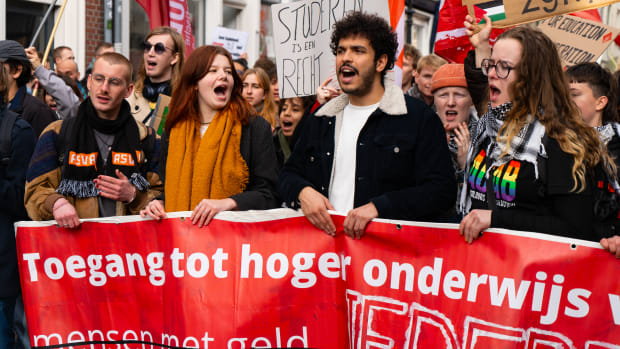
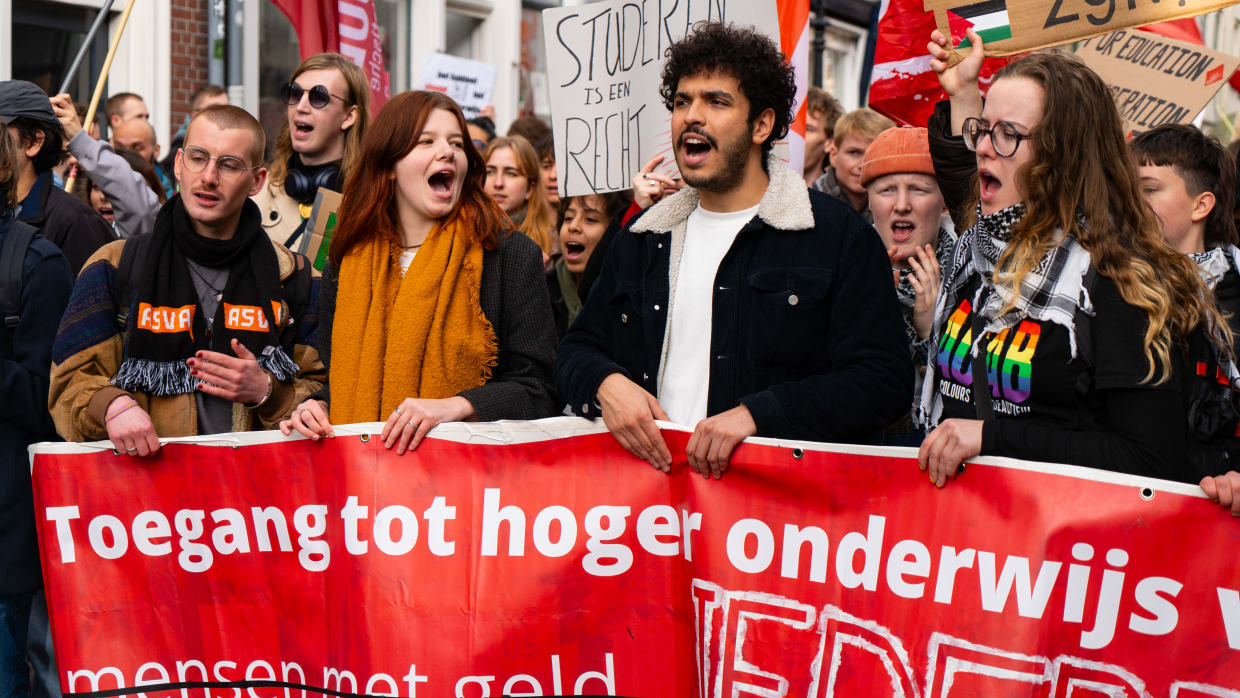
Are scientists now waking up from a bad dream? “We have fought hard for this, together with staff and students in education. Just over a year ago, 25,000 of us gathered at Malieveld to protest against the cuts. I realised then that there was broad support for this. This shows that demonstrating pays off.”
Bod does not expect it to be difficult to get the plans through the House of Representatives and the Senate, because the opposition parties Groen-Links-PvdA will undoubtedly support them. Nevertheless, WOinActie will not be sitting back and relaxing in the coming year. Bod: “The big question now is how we are going to invest this money. Three years ago, we were disappointed with the form of the investments: the starter and incentive grants. We thought that was an unfair distribution. We are now again arguing for the money to be distributed among all employees, after which the employees themselves can make a good plan for how to spend the money.”