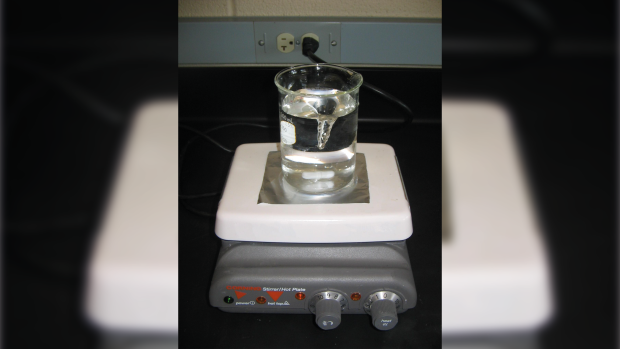
Commotion over the “stir bar” in chemistry

The stir bar, the magnetic rod that organic chemists have been using to mix reactions for decades, is said to serve no purpose whatsoever. University of Amsterdam professor Timothy Noël read the study – which received widespread support on social media – with astonishment and warns of the dangers. “This is fake news in chemistry.”
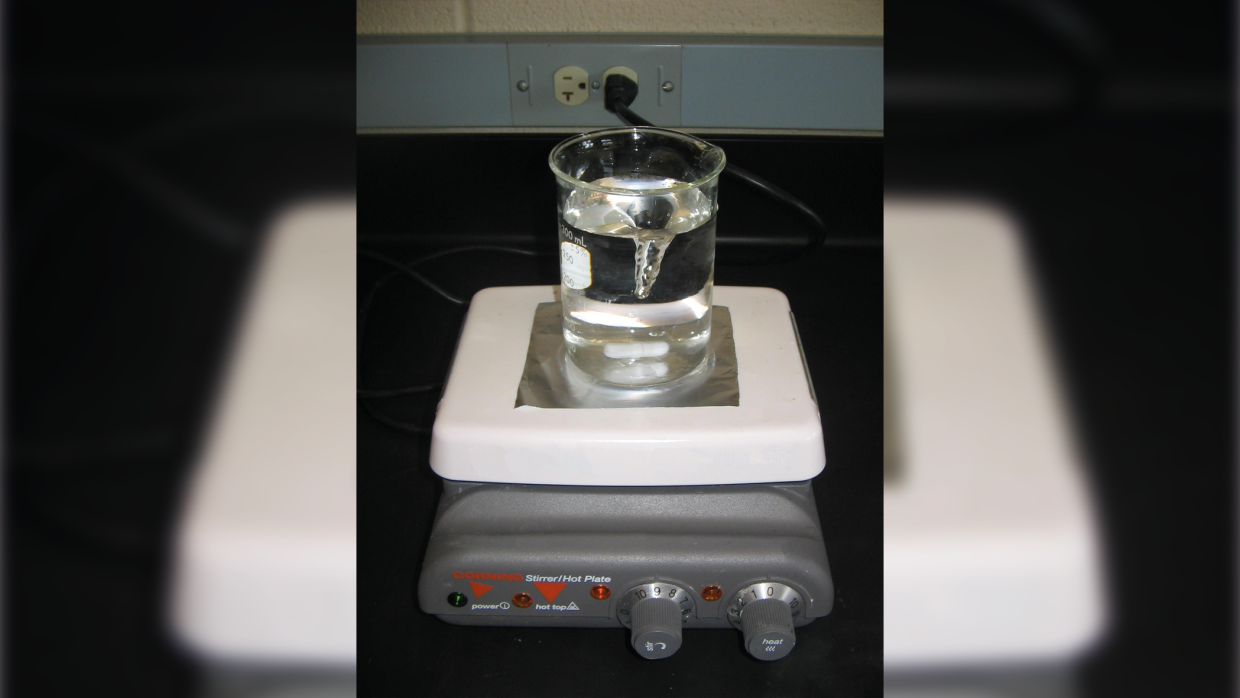
The stir bar – at first glance an innocent rod that uses a magnetic plate to stir a liquid in a chemistry laboratory – has caused quite a stir in recent months. The use of the stir bar has been a no-brainer in synthetic chemistry for decades, the field that revolves around creating new substances through chemical reactions. After all, chemical reactions proceed faster when substances are mixed.
But in early September, Chinese chemists threw a spanner in the works: the stirring rod would have little to no effect on a chemical reaction. It would even be better to leave it out, because the rods could cause contamination due to previous use. This was followed by the other extreme: the stir bar did indeed have an impact on the outcome of the reaction, said Russian researchers. They warned of the consequences that differences in stirring would have on reproducibility.
Fake news
Timothy Noël, professor of flow chemistry at the University of Amsterdam and trained as an engineer, was incensed by the publications. He calls the publications “pure nonsense” and “fake news in chemistry”. According to Noël, organic chemists are not always aware of the mathematical and physical principles underlying the execution of reactions. In September, discussions erupted on social media and he saw that the articles were receiving support from other chemists in the field.

This prompted Noël and his students to write an article within 24 hours in which they explain in detail the fluid mechanics behind stirring a reaction mixture. Researchers from Eindhoven University of Technology and Maastricht University also contributed. Last week, that article appeared in the journal ACS Publications.
Explosion
“Carrying out chemical reactions without a stirrer can even be dangerous in the case of fast or exothermic reactions – where heat is released,” Noël explains on the telephone. “You might get away with it on a small scale, but not on a kilo scale or industrial scale, where it can lead to explosions.” The only case in which a stirring paddle is unnecessary is when the reaction mixture mixes spontaneously through diffusion – think of a sugar cube dissolving in your tea – and occurs faster than the reaction takes.
Now, four months later, Noël’s pre-print has also been published in a scientific journal. “I am pleased that we have received attention for this and that it has been published in a journal with a higher rating than the original publication,” says Noël. Does this mean the discussion is now closed? “Well, we’ll have to wait and see,” Noël responds matter-of-factly. “We will probably have to wait for the next research group to look into the functioning of the stirring floor again.”