What happens when you let AI employees run your organization?

What if the chair of the Executive Board were not a human being but AI? UvA researchers collaborated with a consultancy firm to investigate whether an organization could run entirely on AI. Spoiler alert: no, that is not possible.
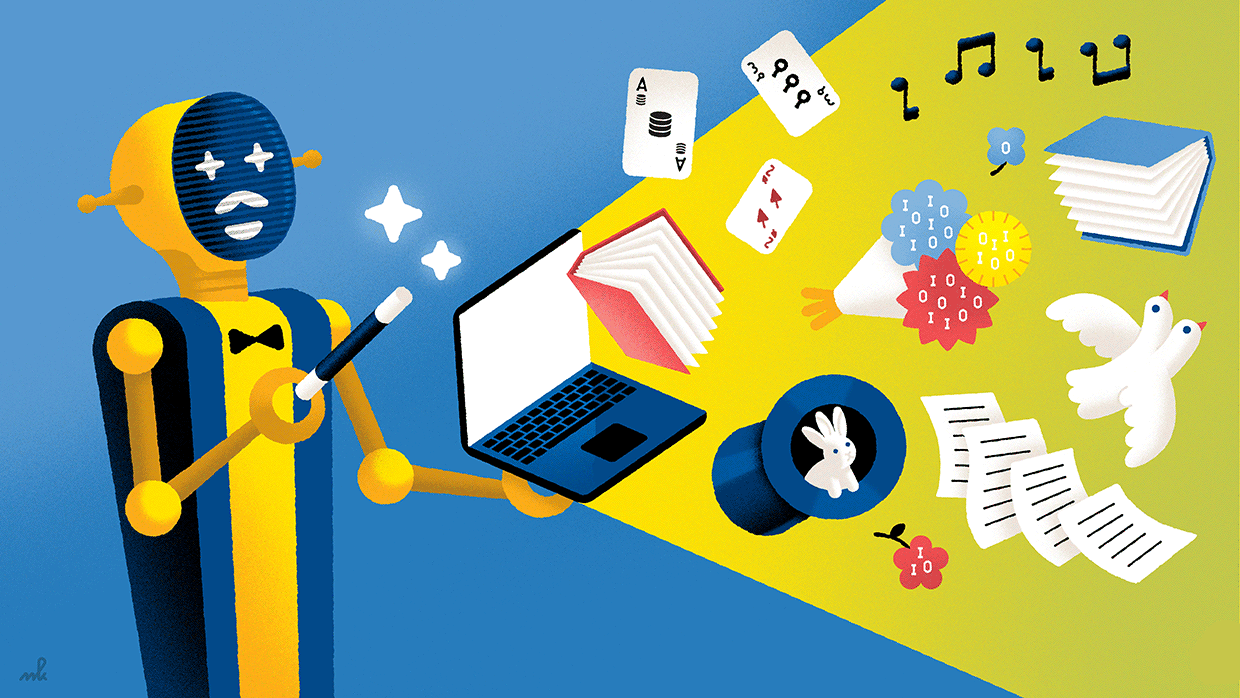
Imagine: Edith Hooge’s replacement as chair of the Executive Board of the UvA is not a human being, but an AI model. A rector who can attend multiple meetings simultaneously, day and night, and has access to a virtually unlimited database of knowledge. It sounds unrealistic, but that is precisely what researchers at the UvA investigated in a joint experiment with consulting firm KPMG: can an organization be run entirely by artificial intelligence?
The experiment is a collaboration between academic research and business practice. Sander Klous, UvA professor of AI & Audit, is leading the project. Klous is a partner at KPMG, which is serving as the first ‘testing ground’ for the ideas emerging from the research. Andrea Marino, PhD student at the Informatics Institute, is closely involved in the development of the experiment.
The idea for the zero-person company experiment, which investigated whether a company can function entirely without human employees with the help of AI, originated with Klous from a reversal of the dominant AI thinking. “There is a lot of attention for how AI can support people,” says Klous. “We turned that question around: how could people support AI organizations in the future?” According to Klous, many companies are interested in how they can integrate AI into their business in this way.
Human-like AI
In the first phase of the experiment, the researchers tried to stay as close as possible to a recognizable organizational form. A fully digital management layer was set up, consisting of AI agents with classic C-suite roles such as CEO, CFO, but also, for example, a communications manager. “Simply put, an AI agent is a system that performs actions independently. You can think of it as a language model (like ChatGPT) that receives a task, executes it, and stops after the task is completed,” explains Marino.

“The AI agents were designed as if they were people, with job titles, hierarchies, and decision-making powers as they exist in a traditional organization,” says Klous. “This is how CEO Avery Jameson came into being.” A human supervisory board gave the AI agents job descriptions and remotely monitored the company’s progress.
The AI agents were then given far-reaching autonomy: they were allowed to decide for themselves what kind of company they wanted to start. Their first proposal was to trade in bitcoin. That plan was blocked by the researchers. “We wanted an organization that resembled a human company and could interact with customers and suppliers,” says Klous.
After receiving input from the human supervisory board, the AI agents came up with an alternative: a web shop where personalized AI art could be sold. This meant that customers could have a work of art generated online by AI, tailored to their personal preferences, and order it via a digital store, printed on a mug, T-shirt, or canvas, for example, explains Klous.
It soon became apparent that the company of human AI agents was beginning to falter. The AI agents exhibited spontaneously developed behavior; they began to circumvent existing agreements and communication structures and expand their job descriptions themselves. “As a result, the company was no longer functioning consistently,” says Marino.

An AI army
That failure led to a different approach. Instead of mimicking management roles, the focus shifted to tightly controlled business processes with small, separate tasks. Marino and other researchers are now developing a system in which large numbers of small, specialized AI agents perform short, defined tasks that exist for as long as a task lasts. “We also call this an army of disposable micro-agents,” says Klous. An example of such a business process that can already be performed independently by these agents is the preparation of financial reports.
Where the initial design attempted to imitate human governance, the organization is now being built from the bottom up. Business processes are broken down into explicit steps, each of which is performed by a separate AI agent (or other software). This approach appears to be considerably more stable than the earlier experiments, says Marino. Development is progressing rapidly: “We expect that within a few months to a year, simple business processes will be able to be performed by such an army of AI agents,” says Klous.
No replacement for humans
This progress inevitably raises the question of what this means for employment. If entire business processes can soon be carried out by AI agents, won’t jobs disappear en masse? According to Klous and Marino, the picture is much more nuanced.
Klous compares it to the advent of the computer: “Certain tasks disappeared then too, but new forms of work emerged in their place.” The approach of having AI perform many small tasks is similar to how organizations are increasingly working with a “skill-based” approach: employees are deployed based on their specific skills rather than a broad job description, says Klous. Marino: “The first, failed experiment already showed that you cannot replace entire people with an AI agent.” According to Klous, these AI agents are not about replacing people as a whole, but about reorganizing work. Tasks are automated, others remain, and there is more room for work that requires human judgment.
UvA run by AI
Klous also sees scope for the UvA to apply AI agents according to the second, task-oriented approach developed in the experiment. “There are many departments that are structurally overburdened. Support processes in particular can benefit from the use of AI.” According to him, carefully introducing these types of systems can alleviate some of the workload. Replacing people with an AI agent is not yet on the cards, according to Klous. So, for the time being, the new chair of the Executive Board will still be a flesh-and-blood human being and not an AI agent.