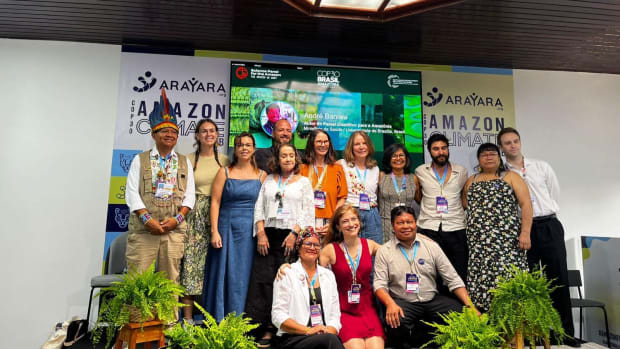
UvA alumnus collaborates with Indigenous communities at climate summit in Brazil
UvA alumnus Nina Witteveen travelled to the climate summit in Belém. Together with the scientific initiative Science Panel for the Amazon and the Indigenous population, she wrote a report on rainforest restoration that was published last week. “Demonstrating has an effect, but we still have a long way to go.”
What is the atmosphere like at the climate summit?
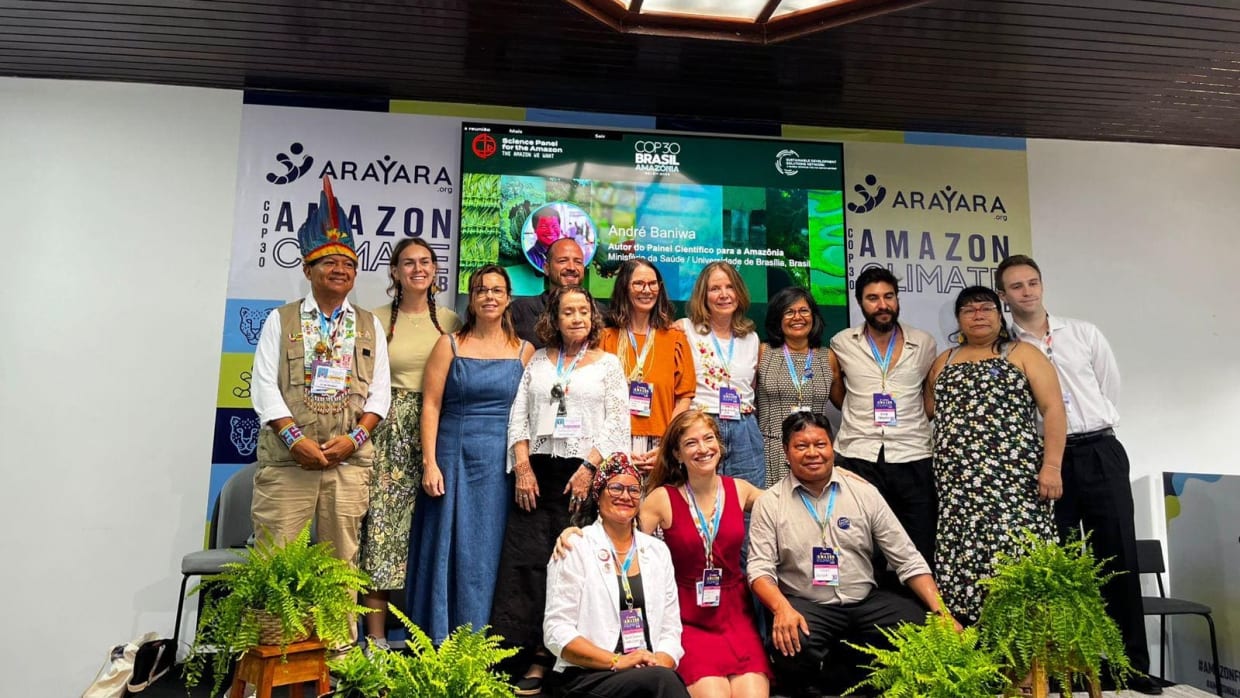
“Quite overwhelming. It’s my first climate summit and it actually feels like thirty scientific conferences rolled into one. We are in a building that resembles the inside of an inflatable mattress. There are lots of pavilions with negotiation rooms. And there are also all kinds of events where people come together to draw attention to certain issues. There are many agenda’s. The atmosphere is good; I’ve heard lots of great speeches and good discussions.”
How can UvA research contribute to preventing deforestation?
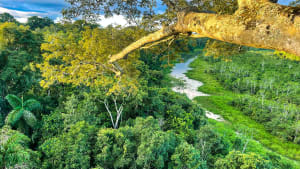
“In all kinds of ways. The Amazon is often referred to as the lungs of the earth because it converts a lot of CO2 into oxygen, but scientists are increasingly discovering that water also plays a very important role. The forests recycle rainwater, which flows via rivers to the regions in the south. There are many areas where rainfall depends on the Amazon, which is something scientists have figured out.”
The influence of thousands of years of human activity is still leaving its mark on the Amazon. This is the conclusion reached by UvA researchers led by Crystal McMichael in a recent article in the scientific journal PNAS. Indigenous peoples have been living in the Amazon for at least 13,000 years. All that time, they used fire, and later they also domesticated plants, cultivated crops and enriched the soil with charcoal.
The research also shows that European colonists played a greater role than previously thought. After the first expedition down the Amazon River in 1541, the Indigenous population collapsed due to warfare, disease, slavery and fragmentation. The European population continued to expand and the rubber trade had major ecological consequences.
These consequences are still affecting the biodiversity and carbon storage of the forest. Because part of the forest is still recovering, it now absorbs more CO2 than a mature forest. This has consequences for models that estimate how much CO2 the Amazon can absorb in the future. Crystal McMichael: “It means that in the future there may be less reduction in CO2 than we hope for.”
“Together with UvA researcher Crystal McMichael, I am looking at forest restoration and the role of local and Indigenous communities. Many Indigenous communities manage the forests in their own sustainable way, and we can learn a lot from them. This is very different from the way European colonists used the forests for gold or rubber extraction.”
“That is why I work as a postdoctoral researcher for the Science Panel for the Amazon, an initiative of 300 scientists, mainly from countries in the Amazon region that brings together scientific and Indigenous knowledge. Together with 140 authors, 10 per cent of whom are Indigenous, we launched a report here at the climate summit last week. It was a very intensive process. With this report, we want to translate plans to stop deforestation into policy”
The Indigenous population of the Amazon is also present and wants to have a say. Will that be possible?
“The Indigenous community has demonstrated a lot at this climate summit. As a result, 13 additional Indigenous grounds have now been recognised. This means that Indigenous territories now also have rights over their own habitat. So it is having an effect, but we still have a long way to go.”
“To give you an idea: the Amazon is almost as large as the United States, with 7.8 million square kilometres, and about half of that area is also the habitat of Indigenous communities. One million square kilometres of that habitat is not recognised. Recognising areas is important – not only for the Indigenous people themselves – but also to combat deforestation. All deforestation takes place outside those areas.”

President Lula da Silva is calling for a global investment of 125 billion euros to prevent deforestation. Do you think that is a solution?
“Yes, the idea is that different countries invest money in a fund and that the interest from that fund is paid to countries to prevent deforestation. We are positive about this, partly because the plan is for 20 per cent to go to Indigenous communities. It is important to protect the forests that still exist, also for the climate. Deforestation releases a lot of CO2 back into the atmosphere.”
What else needs to be decided at the climate summit in Belém in order for it to be successful?
“One of our main recommendations is to scale up funding for forest conservation. At least another half a million square kilometres of forest where Indigenous communities live must also be recognised. The most important conclusion of our report is that we must view the Amazon as one large interconnected system. Literally, because deforestation causes fragmentation in the ecosystem. But the eight countries and various communities that make up the Amazon must also be connected. Often, when one country tightens a particular law, people simply move to neighbouring countries. Regional cooperation prevents logging and other illegal activities such as gold mining.”