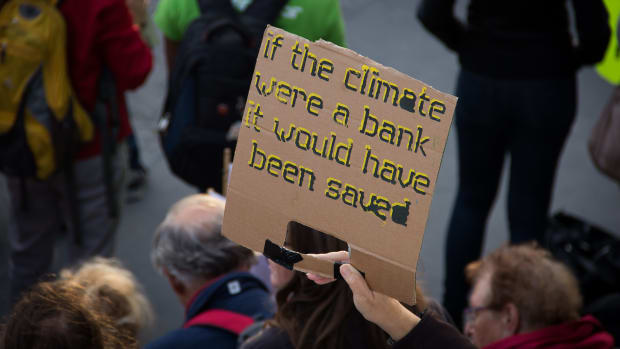
Why climate change is conspicuously absent from the election campaign

Housing shortages, healthcare, migration: climate change is barely mentioned in the political parties’ election campaigns. Force majeure or strategy? “Climate change polarises public debate, and that doesn’t help anyone.”

In 2021, climate change still played a prominent role in the campaigns of Dutch political parties. The election programmes were clear: the VVD, CDA, PvdA and ChristenUnie wanted to reduce greenhouse gas emissions (compared to 1990) by 55 per cent by 2030, while D66 and GroenLinks even proposed a 60 per cent reduction.
These targets now appear to have become unachievable. The Netherlands Environmental Assessment Agency recently calculated that the chance of the Netherlands achieving the statutory climate target of a 55 per cent reduction in CO2 by 2030 is very small. Yet no political leader is sounding the alarm about this. Why are these elections not about the climate, and is that a bad thing?
Scientists also see the climate crisis fading into the background in the election campaign. Scientists for Future, a coalition of concerned scientists, is therefore calling on political leaders in a letter to put climate change at the top of the agenda next week. More than 160 scientists signed the letter.
In the letter, scientists urge political parties to publicly declare – before voters go to the polls – that no new fossil fuel infrastructure will be added in the next coalition and that the 40 to 46 billion in fossil fuel subsidies in the Netherlands will be ended.
Waning attention
Thijs Etty, senior lecturer in environmental law at Amsterdam University College, agrees that the climate seems to be a low priority in these elections. “Political parties are also taking a more cautious stance in their election programmes than they did in 2021. At D66, the climate has been relegated to a sub-section in paragraph 5.”
According to Etty, this is related to what he calls “the eternal problem of environmental issues”. “A political horizon lasts about four years, while the climate has a horizon of twenty years or more.”
John Grin, professor of political science at the University of Amsterdam, also finds it unsurprising that attention to the climate has declined. According to him, this has everything to do with the attention cycle, the phenomenon whereby issues in politics alternate over time. “Climate was an important theme in the last two elections. But the last cabinet put migration high on the agenda.”
Etty calls this ironic. “It is precisely the parties that insist so much on asylum migration and the economy that should be concerned about the climate, because it can prevent asylum migration, conflicts and economic burdens.”

This cycle of attention is also reflected in an opinion panel conducted by EenVandaag. Two years ago, 30 per cent of Dutch people considered the climate to be one of the most important issues in the elections, but this year that figure has fallen to just 19 per cent. Due to changes on the world stage, the climate has made way for the housing market, defence and international politics.
As a result, the climate disappeared from the spotlight during the last cabinet term, Grin continues. Meanwhile, the PVV, NSC, VVD and BBB did commit to the progressive climate policy of the Rutte 4 cabinet in the outline agreement.
Nevertheless, Climate Minister Sophie Hermans did not receive sufficient funding for climate change in the Spring Memorandum (the national budget). As a result, part of the climate policy was scrapped, including the phasing out of fossil fuel subsidies and the tax on plastic and CO2. Grin: “That was a technical story, not a very sexy topic for journalists. And Hermans also had no interest in taking that story to the media.”

Not sexy
The fact that attention to the climate has waned is perhaps understandable, but absolutely unjustified, says Bart Verheggen, climate scientist at AUC and climate advisor at the KNMI. “Climate change seems to be accelerating. Sea levels are rising faster, the oceans are warming up faster and last year we reached 1.5 degrees of warming for the first time.”
The consequences of climate change, such as extreme weather, are also more extreme than previously thought, Verheggen continues. The Gulf Stream could come to a standstill much sooner than was thought until recently, and corals worldwide seem to have already reached their tipping point. “So the rational response would be to do everything possible to prevent things from getting worse.”
Yet political parties do not bring up the climate in public debates. And according to Thijs Etty, there is a strategy behind this. “I am inclined to think optimistically that GroenLinks-PvdA and D66 are not mentioning the climate now out of pragmatism – because it is not really a sexy election topic – but that they will raise it in the cabinet formation. You can perhaps win elections with migration, but you can lose them with climate change.”
According to Etty, the political situation in America has contributed to this. “Donald Trump has made climate denial mainstream again. If you were already on the fence, Trump gave you the push you needed.”
Young people are feeling less and less engaged with the issue of climate change, according to the Climate Crisis Coalition, a collaboration of organisations such as Milieudefensie, Greenpeace and Extinction Rebellion that are committed to climate action.
After the lack of response to the Youth Agreement in March, a proposal to put the climate back high on the political agenda, the Young Climate Movement (JKB) wants to make its voice heard more loudly. Chairman Daan Zieren: “Politicians and the media must do more to make the climate and the future of young people a topic of discussion during these elections.”
On Sunday 26 October, the JKB, together with the Climate Crisis Coalition, is organising a climate march, which will start at 1 p.m. at the Malieveld in The Hague.
Grin also sees the danger of bringing climate change into the public debate. “It’s very easy to turn it into a populist discourse in a debate. What difference does a little warming make, and who’s going to pay for it? That only contributes to making the climate more controversial, and that doesn’t help anyone.”
Hope
Grin believes that, as a political party, it’s better not to talk too much about the climate, but simply to get on with it. “The election manifestos show that GroenLinks-PvdA and D66 want a more robust climate policy, as does the CDA, albeit to a lesser extent. If one of those parties plays a key role in the formation of the cabinet, and I think there is a good chance of that, it will result in a better climate policy than we have now.”
Grin also draws hope from the Social Alliance, a broad coalition of parties including the Interprovincial Consultation (IPO), the Urgenda foundation and the employers’ organisation VNO-NCW, which has already written several letters to the government asking it to be consistent and to persevere, and has provided concrete ideas for accelerating climate policy. “That is also a factor during the formation of the cabinet.”
Etty is also hopeful. “Attention in politics is a pendulum swing. I really hope that Trump will leave in just under four years and that the tide will turn. That will also have an impact on Dutch politics. Moreover, more and more court cases are being won to enforce stricter climate policy.”
Grin also expects that, whatever cabinet is formed, it will be more decisive than the current one. “If there is one thing that the Dutch population agrees on, according to analyses, it is this: we are fed up with the bickering and infighting in politics; something has to be done.”