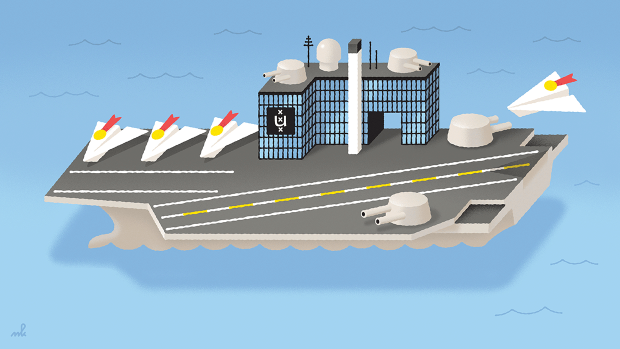
The response to a world marked by conflict should not automatically be more militarisation

Irmak Youdjelten fears for the future of alternative perspectives in education and research if collaboration between universities and the Ministry of Defence continues to grow. “What will happen to Marxist, decolonial or anarchist perspectives?”
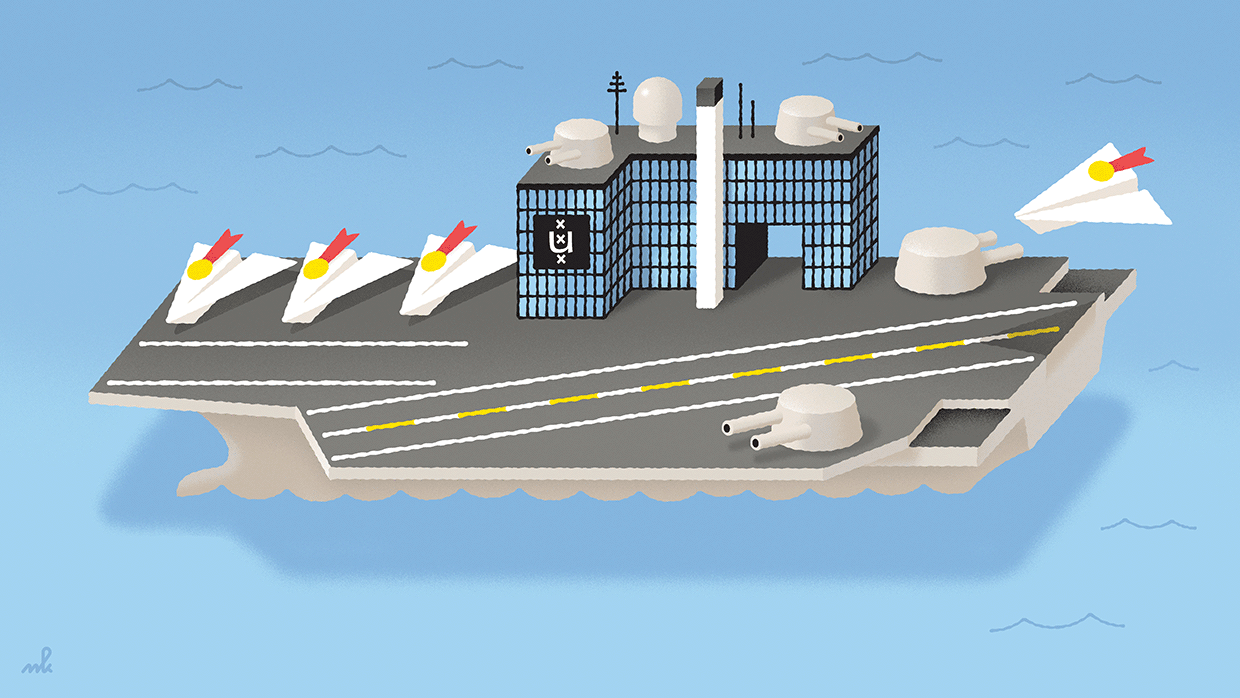
Across Europe, governments are increasing their defence spending, military recruitment is becoming more visible, and the words ‘defence’ and ‘security’ are featuring ever more prominently in everyday life. Universities are not immune to these developments. They are being asked to contribute to a changing security landscape, and the UvA is no exception.
This issue was discussed last week in Folia’s opinion panel, which asked whether closer cooperation between the UvA and the Ministry of Defence is a good idea. Two out of three responses were positive. They emphasised that closer ties with the Ministry of Defence could secure more research funding and benefit academia, particularly the natural sciences.
These arguments are based on an optimistic view of “security” and “resilience” as self-evident social values. But security for whom, and resilience against what? This approach risks overlooking the political consequences of closer ties with the defence sector, particularly for the social sciences and student life.
Militarisation
The UvA’s Executive President is a member of the Advisory Council for Science, Technology and Innovation (AWTI), which published a research report last year (in Dutch) on the need for collaboration with the Ministry of Defence. Yet a fundamental question remains largely unanswered: do students actually have any say in the increasing militarisation of their university?
Militarisation can extend beyond the visible presence of military personnel or warfare-related research; it includes dependency on military funding, normalization of military recruitment, and the presentation of military priorities as the primary and only realistic response to war and insecurity.
Yet the response to a world marked by conflict should not automatically be more militarisation. When military expansion is presented as the only realistic response to insecurity, the political choices behind it disappear, as do the possibilities of diplomacy, conflict prevention and other approaches to security. Instead of accepting this trajectory, there is a pressing need to challenge it and resist the military's encroachment on academic life.
Vulnerable position
One of the participants on the Folia panel rightly points out that military applications have contributed to important scientific developments. But highlighting this history fails to address the ethical and political consequences of such collaborations. More importantly, it reflects a narrow view of the value and position of science in society. The emphasis is on what research can yield for military or technological use, whilst the vulnerable position of the social sciences and humanities remains out of the picture.
The argument that closer cooperation with the Ministry of Defence will bring more research funding is understandable, particularly when universities face financial pressure. But this is only half of the debate. We should also ask why universities are facing financial pressures in the first place. If universities are struggling financially while governments increase spending on defence and security, turning to the Ministry of Defence for funding risks reinforcing the very priorities driving this shift. Rather than addressing universities’ financial problems, it can make military involvement increasingly normal within academic life.
Propagandists
The problem is not that researchers will become propagandists, but what research becomes possible in the first place. If defence funding grows while humanities and social sciences remain under pressure, research aligned with military priorities may become easier to fund, while research that challenges militarisation may struggle. What happens, then, to Marxist, decolonial or anarchist perspectives? Therefore, accepting funding from the Ministry of Defence risks reproducing research that legitimises war while simultaneously undermining critical research.
Student life
The panel overlooks the question of how military involvement might affect everyday life on campus. Beyond research funding, recruitment events and institutional partnerships can ensure that the presence of the Ministry of Defence becomes increasingly commonplace. This has already happened at the VU. What would prevent the UvA from going down the same path?
At a university such as the UvA, with a long history of protests and occupations – during which the police have at times resorted to violence – closer military ties should concern anyone who values the right to dissent. Students who oppose these developments must not be treated as a security risk simply for challenging the university’s direction.
The presence of military personnel on campus may seem unthinkable today. But what seems unthinkable can become the norm. This raises a fundamental question: whose interests does the university protect when it collaborates with the military-industrial complex? Is it protecting academic research and financial stability, or responding to legitimate security concerns – or is it becoming increasingly suspicious of its own students and the political challenges they bring to campus?
Pluralism and protest
Students who protest against the university management are often criticised for ‘disrupting the peace’ or allegedly making dialogue impossible. But where is that tolerance when the views in question come from students labelled as ‘radical’ or ‘far-left’? A university should not shield itself from differences of opinion. It should be a place where pluralism extends even to politics considered uncomfortable or extreme.
More importantly, protest should not automatically be treated as a disruption of debate. It can itself be a form of public deliberation: a way for people whose grievances are not taken seriously through existing institutions to bring them to public attention.
Limited influence
This is particularly relevant at the UvA, where student councils have limited influence over the board’s decisions. We sit across the table from the dean and are heard, but being heard is not the same as having power. Meetings are held, concerns are acknowledged and advice is given, but our arguments can get lost in a bureaucratic maze in which, ultimately, we still do not have the final say.
Moreover, much of the information needed to critically assess decisions is confidential. When institutional channels offer only limited influence, it is hardly surprising that students seek other ways to make their voices heard – for example, by taking to the streets.
Critical thinking
Universities should provide a space for critical thinking. Students must be able to challenge governments, businesses, the military and university governing bodies without being treated as a threat, simply because their political views are uncomfortable.
The question, therefore, is not merely whether universities should collaborate with ‘the Ministry of Defence’. The question is whether we are prepared to accept a university in which military interests gradually become part of the infrastructure of academic life. And once such relationships have become the norm, it may become much more difficult to ask where the line should have been drawn.
Irmak Youdjelten is a third-year political science student at the UvA and member of the Activist Party.