Under the guise of “safety,” our democratic rights are being dismantled at a rapid pace

If the police are allowed to freely share data about students with educational institutions, that is nothing less than the next step in the erosion of our right to protest, argues Asva chair Sahand Mozdbar. “Educational institutions should precisely be places where citizens can express themselves critically and resist oppressive power structures.”
Security guards breathing down your neck for wearing a keffiyeh? Being followed by plainclothes security because you attended a protest? Not exactly the most normal course of events, if you ask me—but it has happened often enough. The fact that The Hague still feels the need to escalate this further, by giving the police the ability to share student data with universities, is utterly outrageous. As if it wasn’t bad enough to be beaten black and blue, students exercising their democratic rights now also risk being expelled from their studies.
Safety for whom?
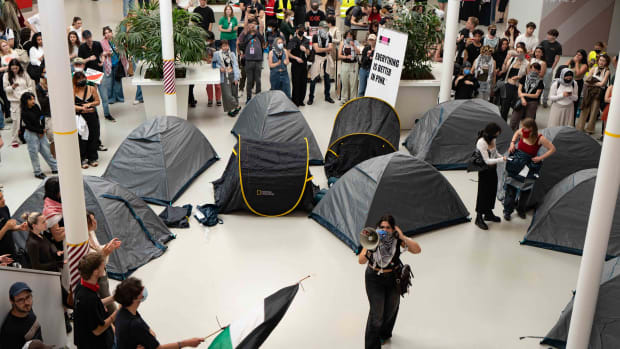
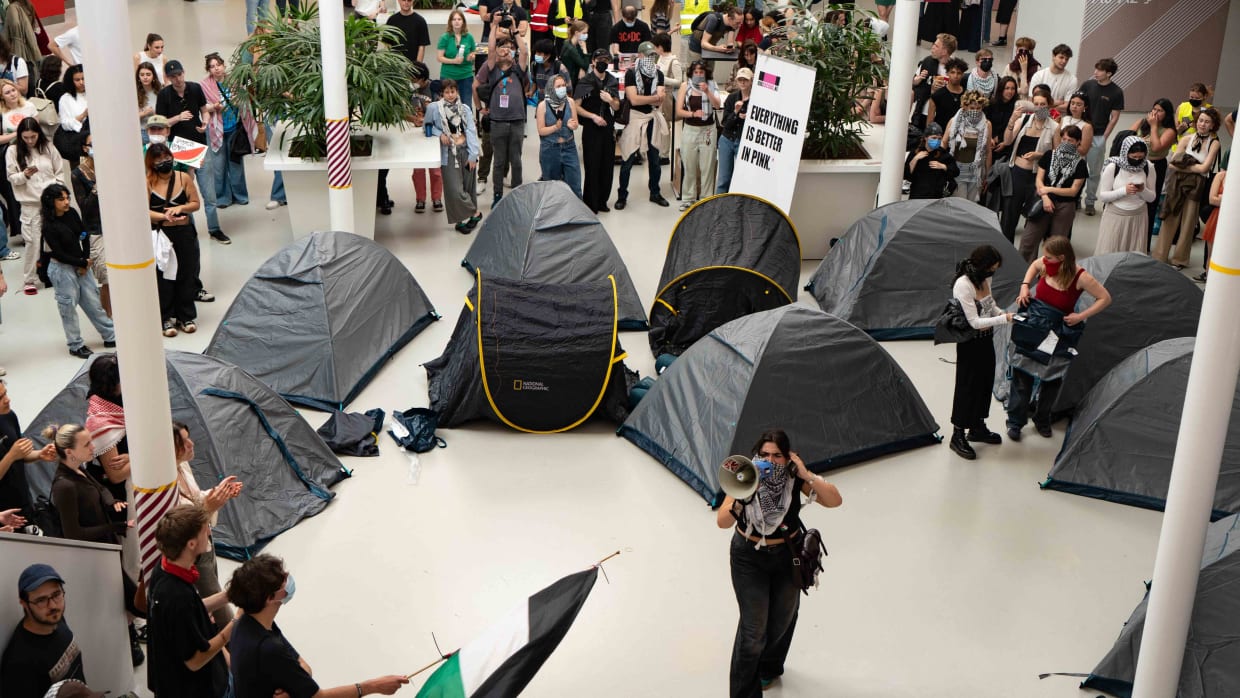
The stated justification for this motion is, as so often, “safety.” I call it a justification, because this measure clearly does not aim to protect people. In fact, the safety of students exercising their right to protest is coming under enormous pressure as a result. The motion enables the police to share data on students involved in so-called “serious public order disturbances.” Actions such as blockades or occupations are explicitly mentioned as examples. The debate around safety at universities often revolves around whether occupations should be allowed, and whether educational institutions should intervene more forcefully in such actions.
According to the European Court of Human Rights and the UN Human Rights Committee, blockades and occupations do not fall outside the scope of the right to protest. Even actions that disrupt and cause inconvenience are protected under the right to protest. In assessing whether a demonstration falls within the right to demonstrate, it is important that the action remains peaceful. This means that protesters must not use violence and must not intend to use violence. In its case law, the European Court has emphasized that even when a small group within a demonstration uses violence, this does not automatically mean the entire protest is no longer peaceful. In other words, sharing the data of students involved in such actions is simply a violation of the right to protest and protects no one—except, of course, educational institutions that benefit from toothless students. And that is precisely whose “safety” this is actually about.
A broader pattern
Since the beginning of the Palestine protests at educational institutions, there has been a pattern of disproportionate police violence, surveillance, and intimidation. Journalism platform Delta revealed through a freedom of information (WOO) request that TU Delft has been systematically sharing the names of students and staff who protest with the police. In 2024, Leiden University deployed plainclothes security guards on campus with the aim of photographing students during protests. Students wearing keffiyehs were even eavesdropped on by security staff at Radboud University during a meeting of the Nijmegen student union AKKU. There are countless more examples, not to mention the physical injuries students have sustained during demonstrations as a result of police violence.
If the police are allowed to freely share student data with educational institutions, that is nothing less than the next step in the erosion of our right to protest. Educational institutions should precisely be places where citizens can express themselves critically and resist oppressive power structures. Threatening to expel students from their studies because they participate in entirely lawful demonstrations—including occupations—calls the very essence of this fundamental right into question.
History, however, shows that meaningful change is never achieved without resistance. Students do not risk their health by participating in occupations without reason. Punishing this harshly by threatening suspension does nothing to undermine the just demands students have been making for so long. It merely reveals where the priorities of both politics and educational institutions lie: in controlling a movement that has the power to force change.
Conclusion
It is beyond comprehension that The Hague is working so hard to turn the Netherlands into a police state. Instead of taking the legitimate—and lawful—criticism from students seriously and taking steps to sever ties with a state that has been guilty of genocide for two years, the response is to expel students for having the courage to speak out. Protests are meant to be uncomfortable. Perhaps it is time to simply cut ties with Israel, rather than reaching for every possible measure to suppress social criticism.
Sahand Mozdbar is president of the Asva and studied philosophy at the University of Amsterdam.