A “hangout” for seniors can make a valuable contribution to the academic ecosystem

Professor of music cognition Henkjan Honing will be retiring in the spring of 2026 and that is casting a shadow ahead. “At a time when we are – rightly – paying a lot of attention to inclusivity and diversity, it strikes me that the UvA pays considerably less attention to seniority.”
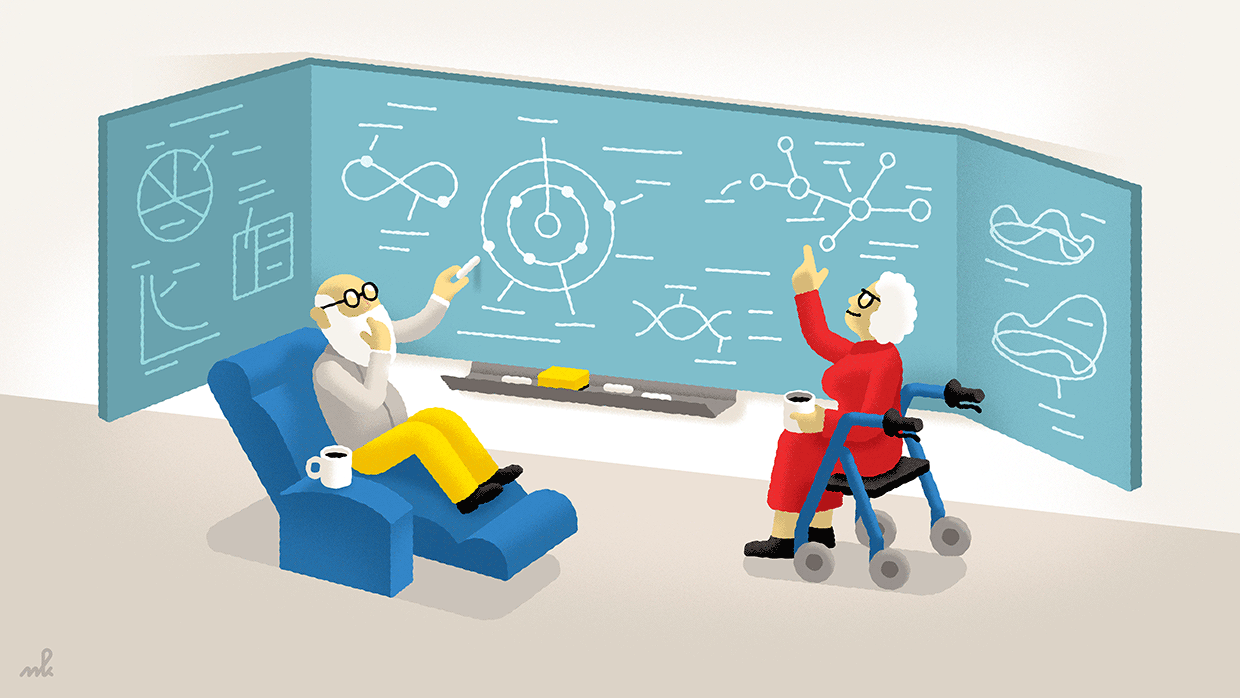
Last spring, I asked the UvA’s HR department – somewhat ahead of time, I thought – what my position would be after my retirement next May. The response from HR was friendly and efficient: my email would continue to work for another ninety days, as would my web page on the UvA site. But on the day I turn 67, it dryly stated, all access to the administrative systems would expire. Projects that do not adhere to that biological limit and simply continue would have to be “delegated”. It felt like I was walking towards an automatic sliding door that was closing right in front of me.
Inclusivity
At a time when we are – rightly – paying a lot of attention to inclusivity and diversity, it strikes me that the UvA pays considerably less attention to seniority. Precisely now that we are striving for a broad and open academic community, this form of diversity – which has to do with experience, institutional memory and long-term commitment – seems to be hardly taken into account. Within the Institute for Language, Logic and Computation (ILLC), I have been working for some time to strengthen the role of emeritus professors, including with the idea of a “professors” hangout', a place where experienced colleagues can continue to contribute in various ways.
Not very collegial
Against this background, abruptly terminating an email account and removing a personal web page seems like a rather uncollegial gesture. For those who want to continue writing, organising or participating in ongoing projects, it is also extremely inconvenient from a practical point of view to become digitally untraceable from one day to the next – not to mention the fact that without access to systems, it also becomes impossible to apply for or finalise research funding. In my opinion, there is room for improvement in this area.
I believe that such a “hangout” can make a valuable contribution to the academic ecosystem. Not a parking space for seniors, but a meaningful meeting place where students can drop in spontaneously, PhD students can ask questions and young staff members can seek advice.
Living memory
The lack of such facilities is a missed opportunity. Universities function by virtue of long lines: research programmes that span decades, international networks that develop slowly, PhD students who grow into colleagues, and theoretical ideas that take years – sometimes decades – to mature. Senior researchers often form the living memory of this whole. They know where certain choices come from, why certain directions have been taken, which pitfalls have been identified before, and what the common threads are throughout the institute’s history.
Within the ILLC, the value of seniority is clearly visible. The founders are still actively involved. They no longer formally teach, but they lead working groups, participate in colloquia, are involved in PhD programmes and – sometimes almost unnoticed – form the backbone of intellectual debate. This raises the question of why the university as a whole does not consistently exploit this potential.
A simple but intellectually stimulating space could make a big difference. A hangout where conversations arise naturally; where students are not intimidated by titles or age, but rather become curious. Where someone like Johan van Benthem or Martin Stokhof – both examples of intellect that has no expiry date – drops in, grabs a cup of coffee and casually makes a comment that helps a young researcher on their way.
Academic history
Such a facility would also send a powerful signal: that the university is not only building for the future, but also recognises and values its academic history. A form of inclusivity that does not stop at the retirement age, and a community in which you do not fall out of the system as soon as you no longer fit into the administrative frameworks.
Cutting seniority under the guise of efficiency is not a policy; making room for the next generation is. But let's not sideline academic memory in the process. A university that ignores its past loses its direction for the future.