New University Library fits perfectly into Amsterdam city centre in terms of function, space and architecture

In his column last week, Nikola Edelsztejn argued that the new University Library is a disfigured and meaningless monstrosity of restored old buildings. Nothing could be further from the truth, writes historian Hanco Jürgens. “Edelszteijn has fallen victim to a romantic dream.”
“The result of a brainstorming session by drunken architects on a team-building trip to Vlieland”. That is how columnist Nikola Edelszteijn describes the new University Library (UB). He has fallen victim to a romantic dream. There is no place at all in Amsterdam’s city centre for completely new architecture that stands like a house, as Edelszteijn would like. That would be a real monstrosity. If there is one building that fits functionally, spatially and architecturally into Amsterdam’s city centre, it is the new UB.
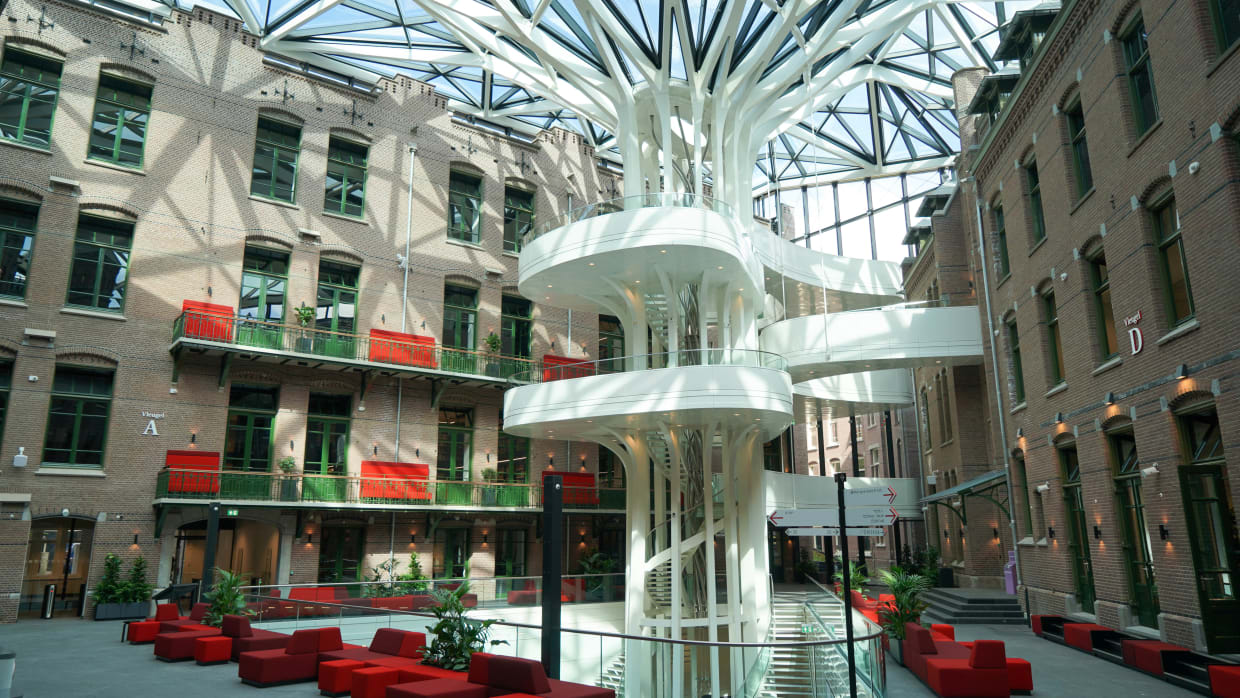
Sandwiched between Nieuwe Doelenstraat, Binnengasthuisstraat and Vendelstraat, a natural environment has been created where students can hang out in the large hall, make phone calls on benches in the corridors and study in one of the many rooms that are ideally suited as study areas: not too big, with a clear overview between the books.
Brutalism
Immediately after the UB opened, it seemed as if this building had always been there. That was indeed the case, but now it had been restored. It immediately evoked a warm feeling. Not modernist brutalism, but fused with the city. As part of the much larger building complex of the former Binnengasthuis hospital, the new UB fits perfectly into the seventeenth-century metropolitan environment: the books have been placed in the building in a completely natural way. They are abundant in every room without dominating the space. A perfect reflection of our times.
Theatre
The building is also successful because it offers a wide variety of experiences. Take the surgical theatre, a modern operating theatre of the former medical faculty, with high benches for students who could thus follow the operation live. What a history! And how wonderful that this room from 1901 has been restored to its former glory. You can’t help but think of Rembrandt’s famous painting The Anatomy Lesson of Dr Nicolaes Tulp, which was created not far away. The scene was set in the Waag. It was commissioned by the Amsterdam surgeons’ guild. The room has great acoustics. During a graduation ceremony, even the softest voices were clearly audible.
The most striking feature is the hall that opens up the urban environment. The building offers an extensive living environment where students feel at home. It has been a success from day one. This will become a problem during exam periods when students want to use the UB even more often. The bicycle parking facility, which can accommodate 863 bicycles, also meets a need. However, this does not mean that the project is completely finished. For example, the UB could focus much more on books than it does now.
Book Lab
Why has the much-needed exhibition space, the Book Lab, been placed on the second floor, and why are new acquisitions only displayed downstairs in the Atrium? How can we further encourage students to actually borrow and read books? Would it be a good idea to hold a weekly reading session or organise a series of lectures on the history of books? The UB’s digital catalogue also needs a revamp. The catalogue works fantastically well for those who want to borrow books. But those who want to order books from another university library via the interlibrary loan system often have to figure it out for themselves.
For example, the important WorldCat Discovery catalogue can be found under the heading Database. All of this could be made a lot more transparent. What’s more, the Binnengasthuis site is far from finished. The vibrant UB stands next to a deserted building, and the old canteen has been empty for years. The empty buildings that were once used by students and staff of political science and anthropology are also crying out for new users. When will something happen there? I hope soon. The UB will benefit from the entire site being put into use. So hurry up!
Hanco Jürgens is a researcher, teacher and member of staff at the Institute for German Studies at the UvA and fellow at the Montesquieu Institute in Tha Hague.