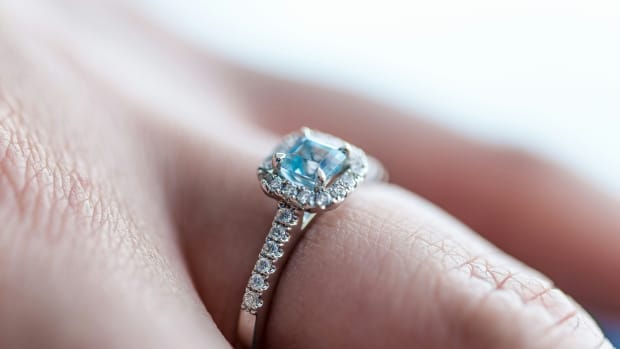
Willemijn van Dolen | Love can only be expressed in diamonds – right?

Through clever marketing, we’ve come to believe that sealing our love requires a diamond ring; one worth at least two months’ salary. That was until this summer, writes columnist Willemijn van Dolen, when textile chain Zeeman finally broke the spell with a diamond grown in a laboratory.

I was walking through the station when my eye caught Zeeman’s advert: “Diamonds are for everyone.” Wow, I thought, and wondered: would Mary of Burgundy be turning in her grave? In 1477 she was one of the first to receive a diamond engagement ring: rare, and meant to seal a bond of love.
Centuries later, Zeeman has packed that magic into a silver pendant set with a lab-grown diamond for €29.99. Affordable, accessible, “for everyone.” The diamonds sold out in no time, the webshop crashed, and tens of thousands of people signed up for the waiting list. On online marketplaces, the coveted diamonds are now being offered at extortionate prices.
To understand why this has caused such a stir, we need to go back to the story we’ve all come to believe: that a token of love should contain a diamond. The love ring was already known to the Romans. These rings were first made of iron and later of gold, recognisable by the decoration of two hands clasping each other. Mary of Burgundy’s ring is often cited as the earliest known example of a diamond engagement ring. Diamonds were rare in 15th-century Europe and were hardly used in jewellery. It never became a widespread trend.
In 1938, a diamond dealer decided to change all that. This dealer, De Beers, had a problem: there were too many diamonds and too little demand. The solution? Not to sell fewer diamonds, but to create more demand. The company hired an advertising agency with one goal: to make everyone believe that a diamond ring was the way to show love. The advertisers had Hollywood stars wear diamonds in films and on red carpets. They influenced fashion journalists to write about them. Even schoolteachers were approached with teaching materials portraying the diamond as the symbol of engagement. The idea was that children would learn from an early age that an engagement required a diamond ring.
In 1947, De Beers launched the legendary slogan: “A Diamond is Forever.” These four simple words linked diamonds to eternal love, and implied that such a ring would never be given up. Which meant no second-hand market for diamond rings, and therefore more new sales. And the campaign didn’t stop there. De Beers promoted the notion that an engagement ring should cost one month’s salary. Later, two. “Isn’t she worth two months’ salary?” the adverts asked. The diamond narrative spread from America to Europe, Japan and beyond. Everywhere, De Beers tailored the campaign to local cultures, but always with the same message: love = diamond.
The Netherlands even had its own variation: the groeibriljant (the “growing diamond”) introduced by jeweller Willigen & Zonen in 1932. A diamond that ‘grows’ with life’s important moments: you trade in your stone each time for a larger one. Clever, seemingly affordable. But ultimately just a sales tactic to keep customers tied to the shop.
And then comes Zeeman, decades later, with a diamond that is chemically identical, at a price that dismantles the idea of financial sacrifice as proof of love. No wonder the Zeeman diamond has struck a nerve. It invites reflection. What is the value of a symbol that no longer needs to be rare? Can you show love without financial pain? Perhaps a thirty-euro diamond finally frees us from the expensive fairy tale, and brings the ring back to what it was always meant to be: the gesture.