Han van der Maas | I have no blood on my hands

The pro-Palestinian protests at the University of Amsterdam have long overshot their target, writes Han van der Maas. “The UvA is not the enemy. This internal left-wing struggle over a few European Horizon projects achieves nothing positive.”
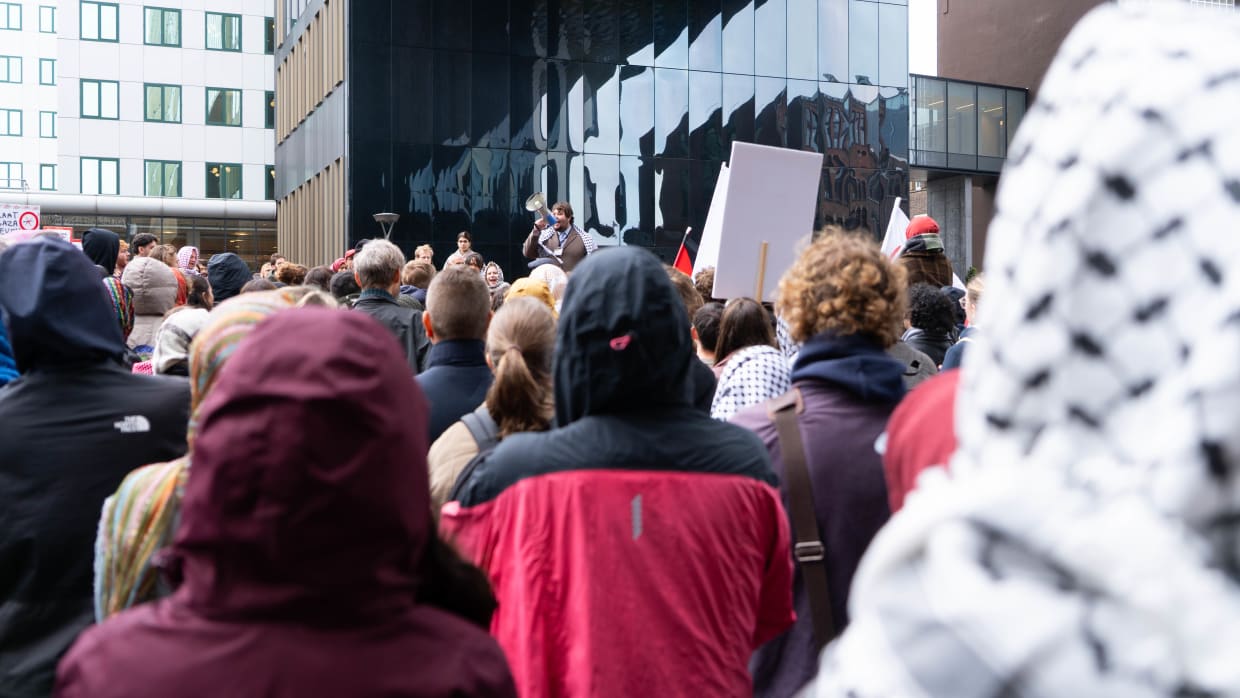
On Sunday and Monday, Amsterdam saw two very different demonstrations. The Rode Lijn demonstration was a celebration of democracy, calling for effective political, economic, and diplomatic sanctions against Israel. Attendance was impressive, there were no disturbances, and there was room for a broad range of viewpoints. As inclusive as the Sunday demonstration was, Monday’s protests at the UvA and Radboud University were exclusive. Calls were replaced by demands, and anyone who did not agree was accused of having blood on their hands.
Much has already been said about the content of these demands. The debate focuses on European collaborative projects in which Israeli researchers sometimes participate. These collaborations can be seen as institutional, but because no funds are exchanged, they are more accurately considered individual collaborations—or even not collaborations at all, since researchers work on separate sub-projects. Withdrawing from such projects is also very costly.The UvA has for now suspended new collaborations and student exchanges.

Unfortunately, it was still deemed necessary to hold the UvA—and, by extension, a large portion of its staff and students—partly responsible for civilian casualties in Gaza. I, however, believe the UvA’s current policies are well-considered and sufficient, and I have no blood on my hands. Please stop with these accusations. They divide people who are, in principle, on the same side: those who want an immediate halt to the bombings and who also want more pressure on Israel for a long-term solution. Attention must also be paid to Hamas’s acts of terror. The suffering on both sides deserves recognition, precisely if we want an end to the violence.
Frustration over the ongoing acts of war is understandable—but it is misdirected. The UvA is not the enemy—take a step back. In the Netherlands, across Europe, and in the United States, a majority of the population votes for parties that see universities as left-wing strongholds. The institutions that these activists are now fighting so hard against face major budget cuts, partly justified with reference to earlier occupations. We may disagree with that, but politicians like Trump don’t care. These internal left-wing struggles over a few European Horizon projects achieve nothing positive. Moreover, the UvA has already largely given the activists what they wanted.
But I have no illusions. The underlying battle is one over power within the university. Even the 2015 Maagdenhuis occupation was, at its core, about that, and the current anti-UvA demonstrations are an outgrowth.
A group of activists wants to shape the UvA to fit its political agenda. They adopt a narrow view of what a university is and does. In their simplistic worldview, in which almost everything is reduced to colonialism, there is no room for complexity or nuance. Yet the UvA is a complex, self-governing network organization where no one dictates precisely what I must do and with whom—not the Executive Board, and not a few activist colleagues. The university facilitates research and education, and it must do so in the most politically neutral way possible. There are many ways to exert influence, but issuing demands, silencing speakers, occupying buildings, and accusing administrators of complicity in genocide are not among them. This little game of tug-of-war has only losers.