Room for Discussion is an altar for the icons of the status quo

Last week, activists disrupted a Room for Discussion interview with Defence Minister Brekelmans (VVD). Activist and student of political science and philosophy Zep van de Visse agreed wholeheartedly. “Anyone who thinks Room for Discussion is a place for open debate is completely wrong.”
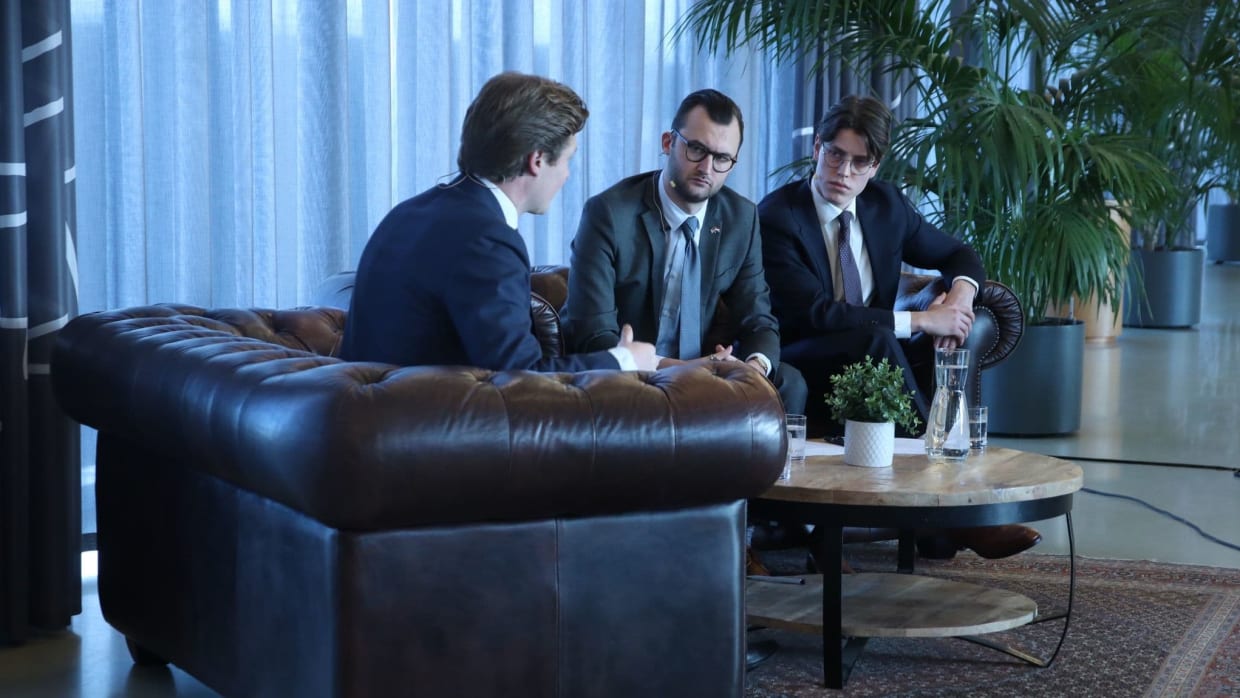
The message of the demonstrators during the disrupted interview was clear: stop the Dutch government’s war propaganda. Brekelmans spoke about “the price of peace”: billions going to weapons, while the government is making severe cuts to higher education. Students are rightly furious about this.
The student protest on 5 February was just an old-fashioned peace protest, motivated partly by anger that our incompetent government is spending education money on tanks. There is an arms race going on that many students see as leading to war.
NATO through the Netherlands
The interview with Brekelmans coincided with the start of the government campaign NATO through the Netherlands, under the auspices of the Ministries of Defence and Foreign Affairs, a campaign that states that peace and security are “not self-evident”. Brekelmans was able to normalize the government’s extreme right-wing and militaristic policy through this route. That is not a real open debate. The protest was not intended to stifle free discussion, but rather to prevent a one-sided, uncritical narrative from gaining a foothold at our university. Is that a “blow to free society’’ or is it the critical thinking skills that can be expected of students?
Room for Platforming
Anyone who thinks that Room for Discussion is a place for open debate is completely wrong. As a regular visitor since 2021, I constantly noticed how superficial the interviews were. Critical questions? Rarely. Follow-up questions to evasive answers? Even less. Interview questions were sent to speakers in advance and sometimes even supplied by them. The speakers – often powerful figures with a problematic track record – were given a platform without any serious counter-questions from second-year business administration students on the bench opposite them.
Audience participation was also discouraged. At the end of the sessions, the audience was briefly given the opportunity to ask questions, but the microphone was often taken away immediately after a question was asked. An evasive answer from the guest? No follow-up. Even demonstrable lies, such as Nick Clegg's claim that Meta censors messages from Israel and Palestine equally, were accepted indiscriminately.
For these reasons, my fellow activists and I first started sending messages to Room for Discussion, to try to get a second speaker on stage for speakers who are scientifically or socially controversial, an expert in the scientific field under discussion, for example, a kind of live fact-checker who can offer more of a counterweight to falsehoods than two second-year business administration students. We received a very clear answer to this. The organisers of Room for Discussion were not keen: no!
Room for Bias
To find out why Room for Discussion has not yet changed a clearly failing formula, we took a look at the CVs of the interviewers. A quick look at LinkedIn shows that many of them, after their role at Room for Discussion, did internships at organizations such as the American government, the John Adams Institute or multinationals such as Shell. Coincidence? Probably. Moreover, many of them end up in the consulting industry. It begs the question to what extent their career prospects play a role in the friendly, uncritical interviews with representatives of these organizations.
Media and culture
I see the organizer of Room for Discussion, the Sefa study association of the Faculty of Economics and Business, as an organization that primarily wants to provide jobs for its members: Sefa has close ties with the government and large companies such as KLM, Amazon and Shell. They do not benefit from sharp criticism and Sefa certainly benefits from job opportunities for its members. It is in Sefa’s best interest to appear in the news in a positive light, which draws the attention of not only individuals, but also companies. Even interviewers who have not had any journalism training have a better chance of finding a job or internship when controversy arises. Why isn’t the interview platform simply run by media students with journalistic ambitions?
Room for Improvement
Perhaps it is time for a fundamental revision of the Room for Discussion formula. Imagine a debate platform where not one, but two experts with opposing viewpoints sit down at the table. No uncritical questioning by gullible and prejudiced second-year business administration students, but substantive confrontations between specialists. Or put the speaker in the middle of the audience and let students ask real questions for an hour. Give students a microphone and they no longer need a bullhorn. It is less media-friendly, it is less career-promoting, but it is a method that allows the audience to gain a real understanding of a subject, and speakers can be held accountable for their actions.
And students, you have more power than you realize. Did you know that you can hire out the E-hall for your own discussion session? Discuss it with a group of friends and go for it. Invite speakers who really have something new to say. Let a thousand rooms for discussion flourish – and perhaps something better will grow from there than the current altar to the icons of the status quo.
Zep van de Visse is a University of Amsterdam student of political science and philosophy, human rights activist and student council member of the Faculty of Humanities.