Third party collaborations at UvA: thoroughness cannot excuse inaction


The UvA Executive Board’s proposed review framework for cooperation with third parties makes significant progress over the current framework, but fails to ensure democratic participation and transparency and risks allowing cherry-picking. Urgent action is crucial to suspend ties with Israeli institutions pending further investigation, write Candida Leone and Ueli Stäger.
We praise the work of the Advisory Committee on External Collaborations (ACEC) in producing a new assessment framework. Many critiques of UvA Staff for Palestine, students and others have been considered. A first area of partial improvement is that the announced focus on armed conflict has been complemented by the separate criterion of “gross and systematic human rights violations”. A second laudable change is that “serious and irreversible adverse impact on climate, environment, biodiversity or cultural heritage” has been added to the list of basic criteria for assessment. This constitutes a big win for an intertwined ecological and human rights movement, and it speaks to the heart of environmental and cultural destruction in Palestine.
The publication of the draft framework constitutes a good, if terribly late and badly communicated step towards an operationalizable framework for collaboration with third parties. However, with the framework, UvA does not have a comprehensive human rights policy for research ethics. A framework is not a policy, as the cover letter from the Committee states itself: “These guidelines are to be complemented with a revised Policy framework on external collaborations”. The framework does not set a comprehensive working method for the Committee, nor does it provide any indications of which factors the committee should weigh in its assessment. Rather than a method for triaging cases, UvA needs to have a fully developed policy with a plan for how the committee is to be composed, how democratic accountability is secured, and different contributions to decision-making.
Two-pronged strategy
Urgency necessitates pause, not permanence. The limitations of UvA’s approach of “thoroughness over speed” are evident for all to see. In the face of an ongoing genocide, UvA leadership has chosen the route of proceduralism and obfuscation rather than erring on the side of human rights and international law. A precautionary suspension of all ties to Israeli institutions (and companies) seems an almost obvious move in the face of recent developments. The state of ongoing proceedings before the International Criminal Court (ICC) and the International Court of Justice (ICJ) have clear legal implications for the Netherlands, with consequences for public universities like the UvA, according to the Dutch AIV. While Israeli attacks against Palestinians continue daily, UvA is no further in its evaluation of ties with Israeli institutions. This is all more evident now that suspension of all ties has been recommended to the University of Tilburg, on the basis of extensive research and considerate deliberation, by its own ad hoc committee.
The development of a new framework then, appears as a stalling tactic, hiding the politicized question of suspending ties with Israeli institutions. We continue to call for a two-pronged approach that combines urgency and thoroughness without deflection. In the short-term, we call for the suspension of ties with all Israeli institutions until further investigation. In parallel, and in the medium-term, we call for the development of a fully-fledged policy for third-party collaboration, of which the proposed draft framework is an insufficient but necessary building block.
Transparency and participation
The proposed framework does not offer possibilities for democratic accountability and participation. Relevant representative bodies (such as Students and Works Councils) are not informed or allowed to intervene even in the most controversial procedures. The evidential basis on which the ACEC bases its deliberation seems left to serendipity, with no possibility for external parties to provide input or challenge an outcome. In other words, the process is ultimately seen as a private consultation service rather than public deliberation mechanism. The Committee also seems to have only an advisory role. It is unclear whether the advice will be made public, whether compliance with the Committee’s advice is entirely facultative (not even a comply-or-explain mechanism being apparently envisaged). Consequently, the framework is overly focused on risk mitigation rather than outright rejection of institutional collaborations if they are assessed as ethically unacceptable. The intrinsic impossibility of full consistency in applying the framework should be openly accepted through serious motivation requirements rather than being hidden behind non-binding deliberations.
Insufficient resources
UvA’s academic excellence should directly feed into decision-making about its academic partnerships. At present, committee members are appointed based on the committee's previously limited mandate – double use and “knowledge security”; they are given no time and hardly any secretarial support - how can they do proper fact-finding? The student- and workers councils have just observed the same, demanding that UvA allocate dedicated resources to the Committee and the framework as a condition to approve its 2025 budget. Relying on external scholarly expertise where necessary should be the norm. Opening the committee’s deliberations and inviting input by concerned individuals and groups at UvA could not only democratize the factfinding but also strengthen evidence-based decision-making based on UvA scholars’ thematic expertise. In parallel, UvA staff will need ethics training. The framework will only gain traction among researchers if it equips them with practical tools to articulate the dilemmas they are asked to evaluate.
Abusing the “level of assessment”
Finally, the framework’s use of levels of assessment takes an approach to academic collaboration that does not align with contemporary debates on academic complicity in human rights violations. The framework defines collaboration partners in a manner that could support arguments emphasizing a segmented view of institutional responsibility. The definition specifies that “the level of assessment depends on the level of institutional collaboration (whole university, faculty, department/institute, depending on who is signing a collaboration agreement).” This definition could potentially enable cherry-picking a specific institute or department that is part of a complicit institution, circumventing the whole procedure by arguing that the chosen specific partner is not involved in controversial activities.
Context is not enough, and one university department or institute cannot be assumed to be financially and operationally independent from other, complicit units of the same overall institution. The framework should stay away from tests of conscience of the institutions in question and instead consider financial, operational, and political forms of institutional complicity.
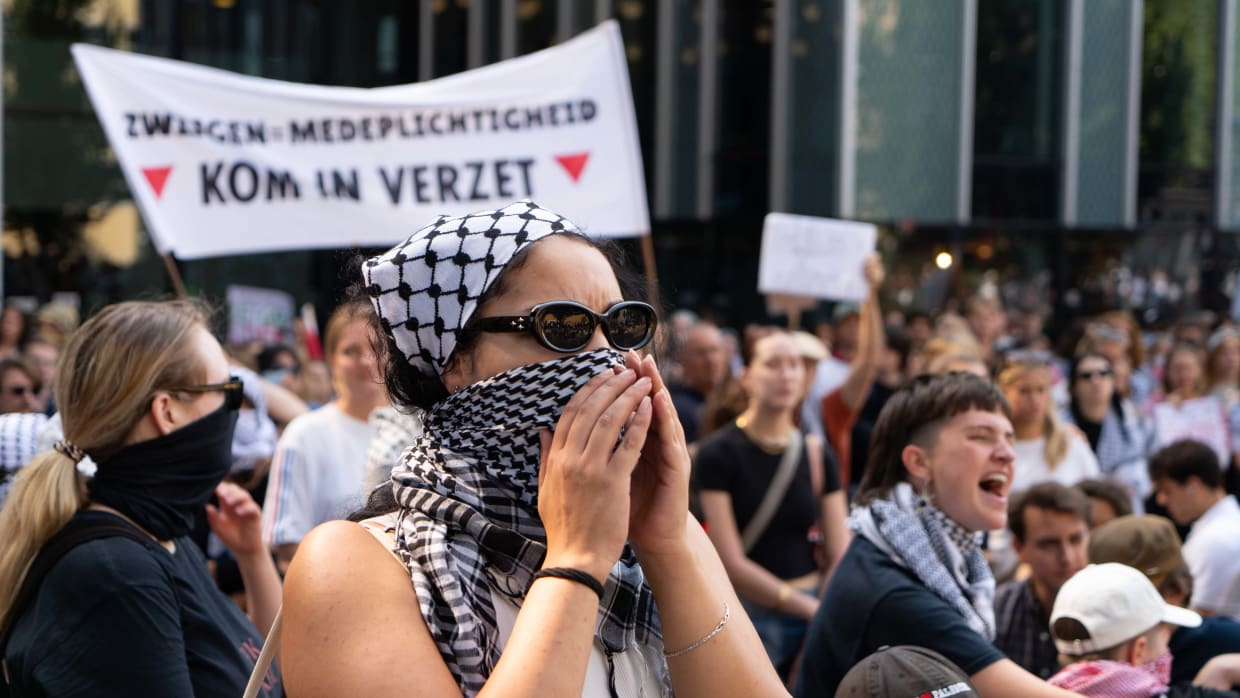
A lot is at stake with this framework. Protests and the FNV strike around UvA’s handling of institutional responsibilities considering the genocide and war crimes in Gaza and other parts of the Occupied Palestinian Territories are also happening because extant mechanisms offer insufficient opportunities for community participation in decision-making. This is about much more than Gaza: If UvA fails to institutionalize more participatory possibilities on collaborations with third parties, it creates the very grounds for future protest, disruption, and potential strikes for when human rights and ecological crises are met with deafening silence once again.
Candida Leone is associate professor private law at the UvA and Ueli Stäger is assistant professor international relations at the UvA. They wrote this article in consultation with UvA Staff for Palestine.