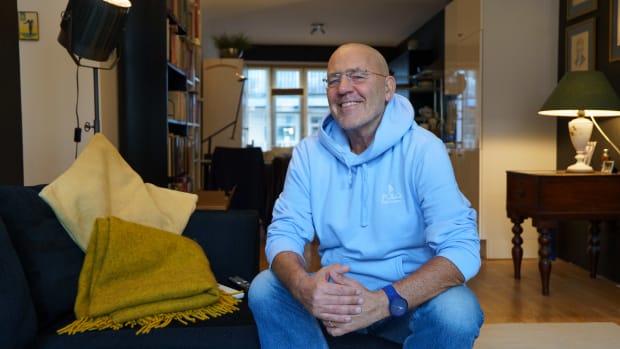
Editor-in-chief Dirk Wolthekker leaves Folia: “At times, I was a wolf in sheep’s clothing”
After almost 27 years, including the last four as editor-in-chief, journalist Dirk Wolthekker (66) will leave Folia next week and retire. He looks back on more than a quarter of a century of university journalism at the University of Amsterdam. “From day one, Folia felt like a perfect fit.”
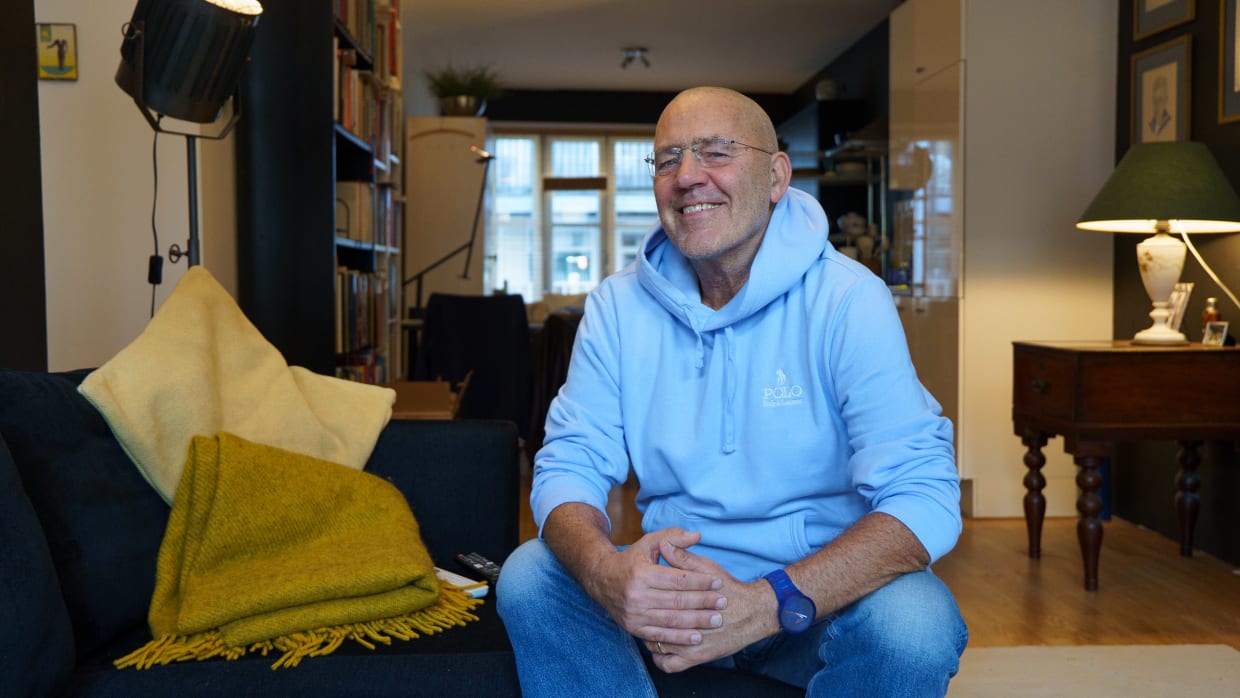
I know Dirk Wolthekker (66) primarily as ‘my boss’: the editor-in-chief of Folia. The walking UvA encyclopaedia in the newsroom. The man I can occasionally see, from about two and a half metres away, practically burying himself in his computer screen – sometimes muttering, more often typing furiously.
But after almost 27 years at Folia, Dirk will be saying goodbye next week and retiring. For that reason, “Mr Folia” is the interviewee for a change today. And that takes some getting used to – for him too, as I notice when I start recording the interview.
Dirk: “I would never record an interview like this myself. Of course, it’s allowed. I have no problem with it. But I’ve always advised you against doing it. People just keep chattering away in life. That’s why I always tried to write interviews that conveyed what the other person actually meant, not just what they said. And because I’d been around here for so long, I was able to do that. Especially in recent years. More often than not, I knew better than the university administrators I was interviewing.”
Doesn’t that create a rather unusual dynamic?
“Sometimes it does. There have been plenty of occasions when people were genuinely nervous about being interviewed by me. I didn’t really think that was necessary, but you do notice it. Ultimately, what helped most was that I knew everyone, and everyone knew me. Whenever I asked for an interview, I got one. Nobody ever refused. They also knew that if Dirk didn’t get an interview, he would simply write the article himself. And that wasn’t necessarily going to be any more pleasant for them.”
Did things get that bad when you wrote the articles yourself?
“I’ve written many articles about people being forced out of their jobs. And what about the new University Library? I practically wore out my pen writing about that. People weren’t always happy with it. I think it’s the tone. I can write with tremendous bite, but I’m not particularly unpleasant in person. I’m someone who’ll happily go for a beer with people. But that sometimes led people to get the wrong impression of me. Quite a few people thought I was a wolf in sheep’s clothing. And sometimes, I suppose, I can be.”
Next week, after almost 27 years, you’ll be saying goodbye to Folia. How have you managed to stick it out for so long?
“I didn’t join Folia with ambitions of building a great journalistic career. I’ve met countless people who did have that kind of journalistic dream. But I never had that. Ideally, I wanted to do a bit of research, write some books and travel a lot. But most writers don’t earn much – and I do like to make good money. Besides, I’m someone who believes that if something is good, it’s good. I’m not going to change that. If I hadn’t enjoyed it, I would have left.”
So the conclusion is that you’ve enjoyed it for all those years.
“Of course, there have been ups and downs, but that’s right. I’ve seen entire generations of young journalists come and go, and I’ve watched Folia change enormously. In my first few years at Folia, it really was still a little canal-belt magazine: a publication for the people who knew each other. It also fitted more with the stereotypical image of journalists spending all day at their desks typing up articles, with a drink on the side.”
I can’t say I recognise that image now, unfortunately.
“Perhaps that’s for the best. But things really were different back then.”
What was the biggest change you experienced at Folia?
“There were actually two. First of all, the merger with Havana, the magazine of the Amsterdam University of Applied Sciences (HvA). Thank goodness that was reversed. It was a complete disaster, mainly because nobody at Folia wanted to write about the HvA. I didn’t either. I simply refused to do it. And, of course, in 2018 we stopped publishing the print magazine.”
Do you miss the magazine?
“Not at all, to be honest. I think print media are dirty and messy. The decision wasn’t mine at the time; if it had been up to me, the magazine would have been scrapped much earlier.”
And yet Folia has since started appearing in print again from time to time.
“We’ve discovered that it helps us reach our readers. At first, we thought we would always be able to reach them, but it turns out to be a challenge. If we’d never run into financial difficulties, we probably wouldn’t have discontinued the print magazine. But print is expensive, and we could see that the magazine racks were largely staying full.”
Looking back on your time at Folia, what are you most proud of?
“There isn’t one particular story or investigation I’m most proud of. Once, I wrote an article in which I absolutely tore the entire Faculty of Law to shreds. And I did an in-depth reconstruction of the case of an ACTA dean who was completely incompetent. I thought that was quite a good piece. Above all, I’m proud that I’ve always enjoyed writing my stories. I was speaking recently with Sijbolt Noorda, ‘my’ first president of the Executive Board. He said: ‘From day one, Folia was a perfect fit for you.’ I can only agree.”
Four years ago, you became editor-in-chief somewhat unexpectedly. Did that role fit you too?
“Much to my own surprise, it did. I’d never aspired to become editor-in-chief. I thought: I’m perfectly happy as I am. And, after all, I was already Mr Folia. I knew more than anyone about the UvA and picked up most of the news stories, regardless of who was editor-in-chief at the time. But in 2022, one editor-in-chief left, and his successor tragically died within a year. That’s when they came to me. I hesitated, but eventually thought: I might as well give it a go. And if I don’t enjoy it, I’ll be gone in four years anyway.”
After writing about the university for so many years, how do you view the UvA now?
“It’s a very unusual place. A place full of creative, eccentric people. At the same time, the UvA can be rather dogmatic. I find that quite difficult: all those people with such strong, principled views. I’m not sure how much we actually achieve that way. And, of course, it’s a very politically engaged university. Left-wing politically engaged, I should add. I’m not nearly that left-wing myself.”
You’ve sometimes said in the newsroom: “If you want to become right-wing, you should go and work at the UvA.”
“Yes, I stand by that. It’s not as though I’m particularly right-wing myself, but everything at the UvA is very ideological. I sometimes find it rather lacking in any sense of pragmatism. And you have to find a way to move forward together as a group. For example, I understand why people were so angry about everything that was happening in Palestine. But you can’t remain stuck on those issues. At some point, you have to move on. I played a part in that too, of course. We published countless opinion pieces on the whole Palestine issue, for instance.”
Should you have handled that differently?
“At the time, we thought: this is such a prominent issue; we have to publish everything we can about it. Looking back, I think we contributed to people becoming entrenched in opposing camps.”
How is Folia doing these days?
“Pretty well, I think. The important thing for Folia is that everything we produce must be about the UvA. People outside the university are welcome to read it, but our coverage has to be about us. I’ve seen plenty of people wanting to raise their profile and reach a wider audience beyond the UvA. That’s the wrong strategy. You should never do that. You have to accept that you’re the local village newspaper, and then hope that everyone else reads along too. I’m sure Folia has a future in that role.”
What advice would you give your successor?
“Be patient. The UvA is a large, politically sensitive, bureaucratic world where the wheels turn very slowly. You start something and before you know it, a year has gone by. You have to be able to cope with that. I’m not really like that myself, but over the years I’ve obviously become a product of the UvA. You get used to it.”
I find it hard to imagine that you’re planning to put your feet up once you leave. What are your plans for the coming years?
“Of course, I’m going to write a little book about the UvA. I owe it to myself, given my position. I imagine the UvA is expecting one too. It’ll be a work of fiction about university life as I’ve experienced it: what I’ve seen and heard, including things I’ve heard that never made it into Folia. After that, I’ll probably write a few more biographies. I’ll spend more time with my husband in France. And, of course, we’ll travel. And then perhaps travel some more. And then maybe travel.”
Will you miss the UvA?
“The UvA has given my life a great deal of structure. And it’s more than just work: it’s also a very sociable place. So I think I will miss that. But it’s also possible that once I’m gone, everyone will be perfectly happy. Well, in that case, that’s that. Job done.”