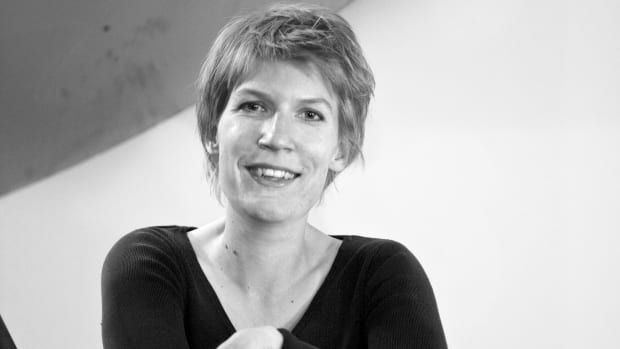
Paulien Cornelisse did not want to stay at university: “First, I wanted to go out into the world”
She excelled in research – graduating cum laude in psychology from the UvA – and had her own thoughts about it. As an author, cabaret performer and columnist, Paulien Cornelisse knew how to put those thoughts into vivid and razor-sharp words when she worked as an editor at Folia. Last wednesday, 30th of September, she passed away in presence of her loved ones.

The unique perspective that the late Paulien Cornelisse (1976–2026) had on life was reflected in her work as an author, theatre-maker, cabaret performer and in her various television appearances. Whether she was performing for a small or large audience, her words made people laugh or made them think.
Her career began during her psychology studies at the UvA and at Folia, where she worked as a trainee editor for a year in 2001. Her choice to study psychology was an unusual one. Both of Paulien’s parents were already psychologists, so after secondary school she wanted to study “anything but psychology”. Instead, she spent a year in the United States, where she studied at Brandeis University near Boston in the American style, taking courses in theatre, art, linguistics and, yes, psychology.
It was there that she discovered her love for the subject. “In America, I discovered that the questions asked within psychology – as pathetic as it may sound – are the most essential questions in life,” she said in a 2010 interview with Folia editor Dirk Wolthekker. “Such as the question of what it means to be human. Psychology also studies the soul, while the soul has actually already been abolished. That sounds quite sympathetic.”

Infantile
And so, in 1995, Cornelisse nevertheless began studying psychology at the UvA. She did not have particularly fond memories of her first year. “Six hundred first-year students, all saying they wanted to “do something with people”. It seemed very infantile.” She also missed the motivation she had seen among her fellow students in America. What ultimately got her through that first year were the orchestra and the cabaret courses at Crea.
Later, she began to enjoy studying psychology as well: “The further you get in your studies, the more interesting it becomes.” She enjoyed it so much that in 2000 she graduated cum laude with a thesis supervised by philosopher Jaap van Heerden on truth and honesty. “He gave me an insight into what research should be. The conventional idea is that research is constructed and recorded using a method. But good research is about creativity and inspiration.”
Japan
That same year, she also started working as an editor at Folia. Her first article was about the country where she had spent seven months as a student and developed a fascination with: Japan. The emperor came to Amsterdam to mark the four-hundredth anniversary of relations between Japan and the Netherlands. “It turns out there are actually Japanese students at the UvA,” Cornelisse wrote in the opening of her article. “The Japanese students wonder whether they will have changed as a result of their experiences in the Netherlands, where people eat while walking and kiss in the street.”
Her personal interests also featured in other articles. She wrote about research – which she was often critical of – architecture, American elections, bands, cabaret, anthropologists making films and the history of chocolate. Her vivid use of language and unique observations were already characteristic of her writing style. Whether she was writing about a croquette sandwich or about the collection of what was then the Zoological Museum Amsterdam, she brought the same distinctive perspective. Of the latter, she wrote: “Alongside the easily recognisable starfish, the collection also contains sea lilies: it looks like a flower, it has a flower’s name, but it is an animal. Not much further on, the phallic-looking sea cucumbers stand companionably alongside the innocent sea urchins.”
Around the time she graduated, she still occasionally considered pursuing a career in research herself, but she felt that “after graduating, you shouldn’t stay in the womb of the university. First, I wanted to go out into the world.” A career in cabaret and journalism was already waiting for her. “You can’t choose that anymore when you’re forty. So I thought, let’s do that first.”