Magazine | These students go back to analogue

Students want to break free from endless scrolling. To take on the algorithm, they’re turning to analogue alternatives such as books, cameras and games.
Young people’s screen time is nothing to sneeze at: according to research by the Trimbos Institute, Gen Z’ers spend an average of around 9.2 hours a day behind screens, 4 hours and 27 minutes of which is on their smartphones.

There now seems to be a countermovement: students want to reduce their screen time and are using analogue means to achieve this. In 2026, Google searches for ‘analogue hobbies’ peaked and vinyl sales last year rose by 21% compared to the previous year.
Breaks
Lise-Marie Nassen is a researcher at AScoR and studies screen time among young people. She recognises the trend that young people actively and consciously want to reduce their screen time.
“We see that young people are voluntarily taking breaks from their screen time, for example by replacing their smartphone with a phone that simply has fewer features, so that they are less tempted to pick it up.”

Vinyl
Or by using analogue alternatives. This is also the case for Master’s student Entertainment Communications Jacklyn Tedjajuwana (23). Although she has a considerable screen time of 5.5 hours a day, she is doing her best to reduce it.
Recently, she has gone back to reading paper editions of books, she takes analogue photographs and, as a DJ (stage name: Jackie Ong), she is increasingly spinning vinyl. That is a conscious choice: “I love the connection between yourself and the physical,” she explains. “It ensures that you are truly in the moment.”
Backgammon
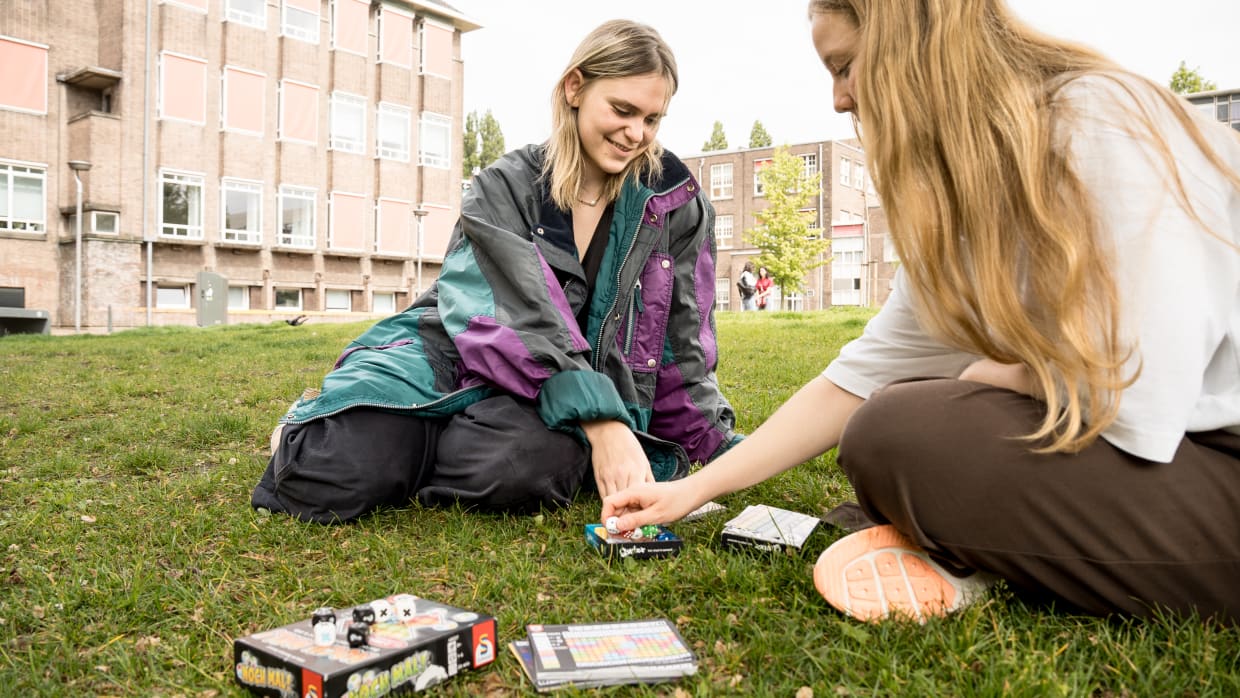
Because when you’re on your phone, you can’t be in the moment, agrees Psychology student Saulė Jakučionytė (23). Her tactic? She plays analogue games, such as Qwixx and backgammon, on campus too.
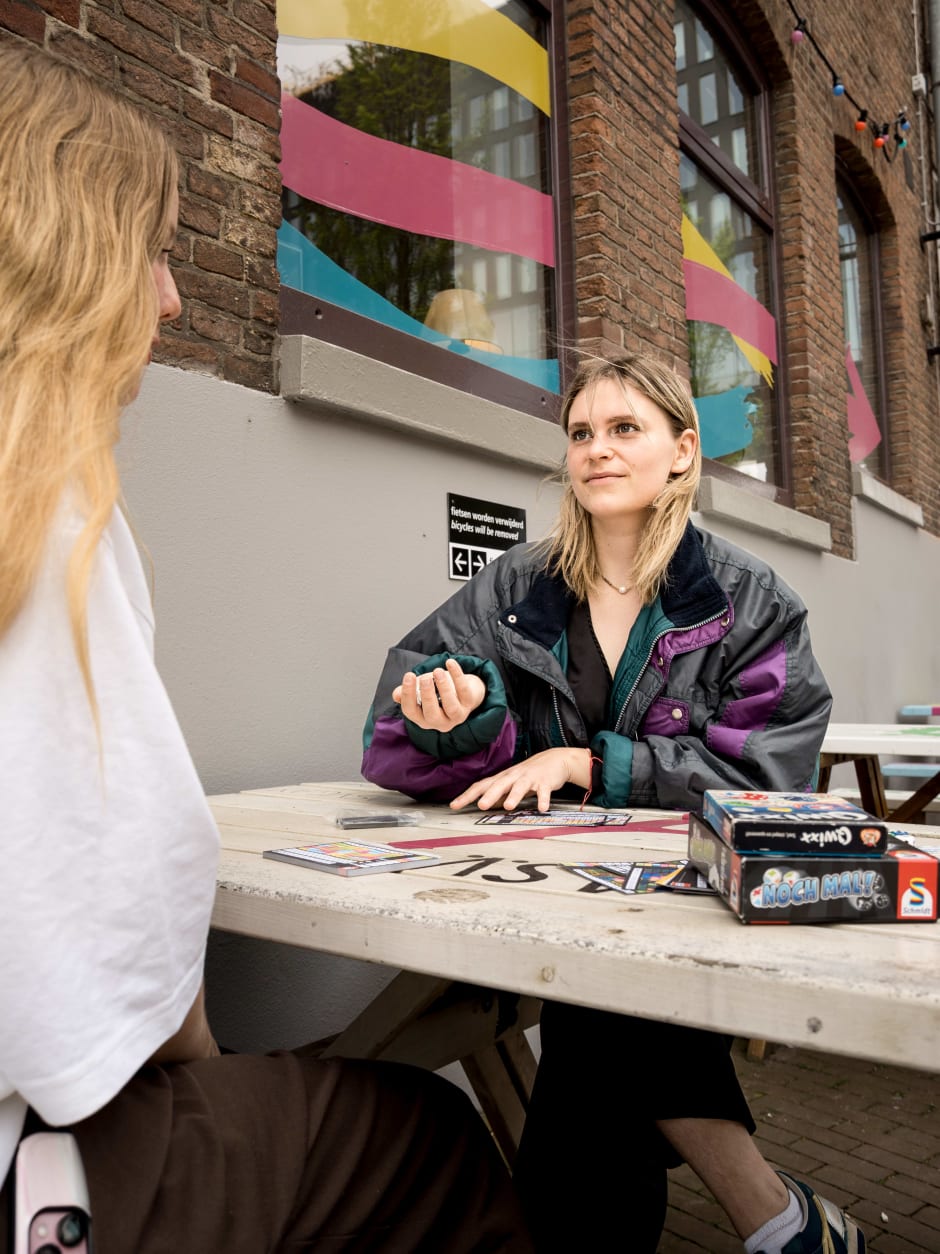
They help her stay away from her phone and connect with others: “The games keep you engaged; they help me connect with the people I’m with; it’s a lovely ritual to wind down.” The games she plays usually last about thirty minutes: “That’s thirty minutes during which you’re not on your phone.”
It’s no surprise that students, in particular, are actively looking for ways to reduce their screen time. “The responsibility for self-control lies entirely with the students,” says Nassen. “There’s no mum or dad around to take the device away. That’s when a realisation hits: what am I supposed to do now?”
In the past, you could scroll to the end: your feed had a limit. These days, apps are designed so you can keep scrolling indefinitely, explains Nassen. “Self-control doesn’t work. So students think to themselves: I need to cut down.”
Dopamine
Jacklyn also realises that her generation must take responsibility. “We have a problem: our phones have made us addicted to dopamine. That’s not our fault, but it is our responsibility to do something about it.” Integrating more analogue activities into her life is therefore going down well. “That requires a certain amount of patience that I was lacking in my life, a patience that my whole generation lacks because we’re online all the time.”
Nassen does note that, generally speaking, there is no evidence of major negative effects from high screen time, though that doesn’t mean it can’t be harmful to some people. “How you experience it yourself is important. One person is completely drained after an hour of scrolling, whilst another is fine after six hours. What constitutes problematic use is personal.”
Barrier
Although Jacklyn still takes photos with her mobile, for her work – she’s a photographer as well as a DJ – she uses only her analogue camera; a proper old-school one, with old-fashioned film rolls. So just snapping away at random isn’t really an option. “With mobile phones, you take loads of rubbish that you never look back at.” Take concerts, for example, she says. “I took so many videos, but then hardly ever watched them again.” A shame, she thinks: “Holding your phone up creates a technological barrier between you and the moment. That’s less the case with analogue film. I remember every analogue image I’ve taken.”
The games Saulé plays with her friends on campus are moments when they’re completely focused on each other. “My friends were quick to get on board. We also play together on trips. When you’re tired at the end of the day, or between classes, it can be easy to all just scroll silently on your phones. Instead, we play games.”