Magazine | How do students keep their studenthome clean?

Over the coming weeks, Folia will be dedicating a special print magazine to the theme of ‘democracy’. Student houses are mini-democracies in their own right – places where power and participation play out even in something as trivial as a cleaning schedule. Who scrubs the loo, and just how (un)fair is the schedule really?

Weesperflat
Lodi Kamman (23) and Loreley Fournil (21), live in the Weesperflat. They live with 17 people. Lodi studies physics and astronomy, Loreley studies art history.

Lodi: “We have fourteen chores and seventeen people in the house. I oversee the schedule, so I wrote a piece of code that assigns the tasks. The code spits out an Excel file - that’s our cleaning schedule. I also send a poll in the group chat every week with that week’s assignments.”
Loreley: “We also have a dishwasher list - it’s a points system. If you load or unload the dishwasher, you get a point. The person with the most points wins a prize. But people cheat - they give themselves points without doing anything. If you don’t do your task, you get a ten-euro fine. You basically get one day to do it; after that, others can claim the task and earn ten euros.”
Lodi: “In the end, our system makes sure everything gets done. Fines are handed out pretty often, although some housemates get fined more regularly than others. I also manage the house account, but I’m not that strict. The rules are strict, but if you need more time for a good reason, I’ll usually allow it - as long as you communicate. Otherwise, you just get fined.”
Loreley: “The cleaning rules have been around for years. This way it works. A strict schedule and fines are in the group’s best interest. And all house decisions are made through another poll on WhatsApp.”
Lodi: “The previous person in charge of the roster burned out - there were a few more guys living here at the time. I think that once I move out, things will go downhill pretty quickly.”
Bijltjespad
Pippa Goossens (22), Louise Zweghuis-Zierleyn (20), and Roos de Kort (22), live at Bijltjespad. They live with 12 people. Pippa studies art history, Louise interdisciplinary social studies, Roos applied psychology.
Pippa: “We’ve got a paper schedule on the fridge. It works fine in theory, but the showers haven’t been cleaned for weeks now. When new flatmates move in, we want to redesign the system. There are two pieces of paper on the fridge, one with the rota, and the other explains exactly what each task entails. Everyone has their chores every week, plus every other week someone checks up on everyone. That person checks whether everyone has done their chores. It’s a separate task, and it’s a different person every week.”
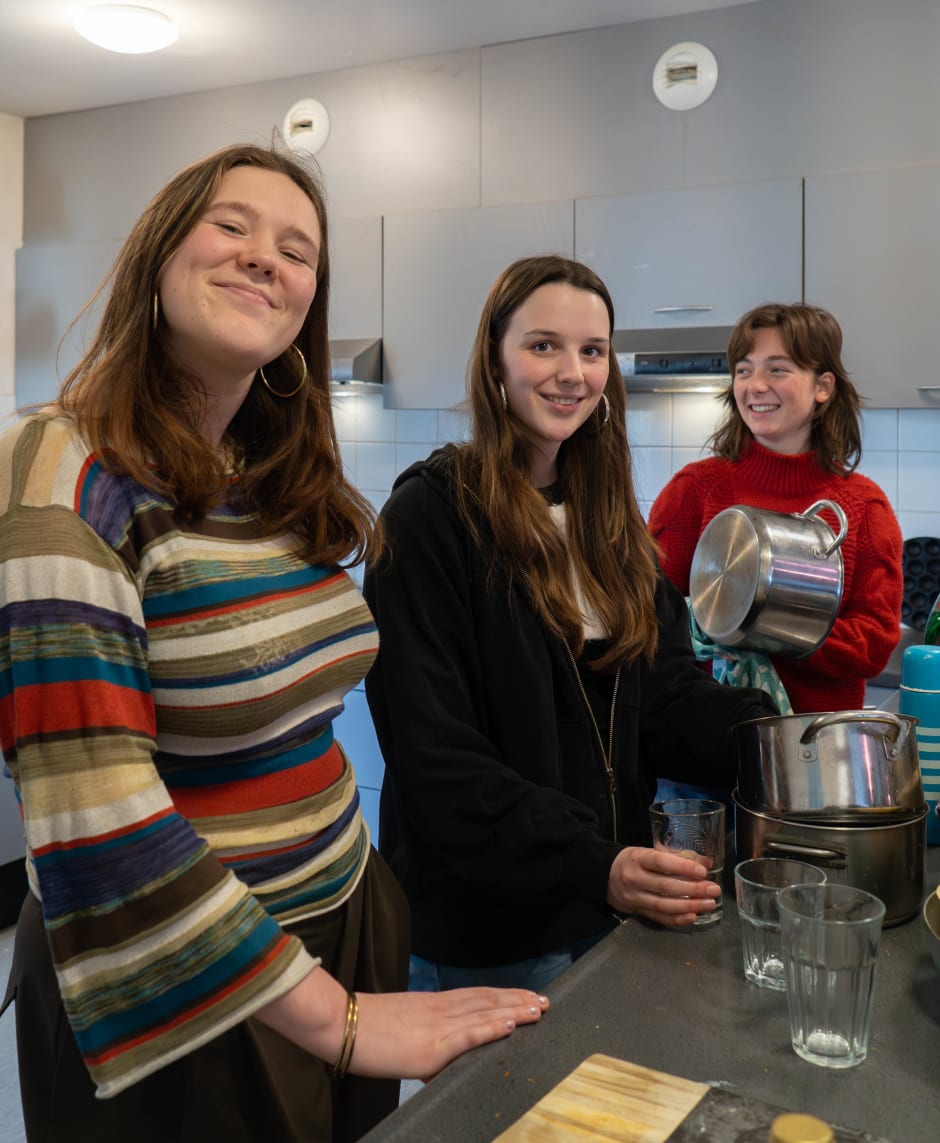
Louise: “There are annoyances, but people don’t really get angry.”
Pippa: “It can happen that someone forgets their task once in a while, but as often in a row as it’s happening now, that really shouldn’t be the case. Everyone agrees on that.”
Roos: “You never see some people. The less social cohesion there is, the less obliged people feel to tidy up and clean.”
Louise: “It’s not the dirtiest house ever, but we really need to sort out the kitchen. It’s actually a bit too gross.”
Roos: “It used to be even worse; back then you couldn’t even make a sandwich, it was that dirty. The cost of cleaning supplies goes through the app Splitwise… But that’s never paid. And nobody washes their pans. That only happens once a message’s been sent about it.”
Pippa: “We’re having a kitchen meeting soon. We’ll discuss it then and make agreements, which hopefully everyone will stick to. Quite democratic, actually.”
From 28 April, a new edition of Folia will once again be available in purple distribution racks. The free print magazine will be disposable on all campuses from that date onwards, featuring democracy as its central theme.