UvA becomes greener, but does not meet its sustainability targets

Less flying, more sustainable procurement, and generating more of its own energy: in March 2021, the University of Amsterdam set itself an ambitious sustainability agenda with its White Paper Sustainability. Five years later, the university has indeed become somewhat greener, but many of its sustainability targets now appear to be unachievable.
An ecological footprint that is a quarter smaller than in 2021. When the University of Amsterdam presented its White Paper on Sustainability in 2021, that was the main sustainability target for 2026. By limiting air travel, phasing out gas, making canteen offerings more sustainable, and generating more of its own electricity, the university hoped to achieve that central goal.
Five years later, it is clear that many of the goals it set for itself proved too ambitious. Although progress has been made on nearly every concrete point outlined in the policy document and its accompanying appendices, not all of the objectives the University of Amsterdam had envisioned have ultimately been achieved.
Paris targets
To start with some good news: the university is still on track to meet the ambitions of the Paris Climate Agreement by 2040. In 2021, the UvA stated that its annual energy use would need to be reduced to around 70 kWh per square meter to achieve this. Over the past six years, that figure has already dropped significantly: from 186 kWh per square meter in 2019 to 125 kWh in 2025, a decrease of nearly 33 percent.
At the same time, it is not yet certain that the target of 70 kWh by 2040 can actually be achieved. In a draft version of the sustainability section of the 2025 annual report, the university acknowledges that reaching this goal will be “challenging”, citing “heritage buildings that are difficult to insulate, delayed renovations, budget cuts, and grid congestion,” among other factors.
Grid congestion also plays a major role in other sustainability goals. Due to limited capacity on the electricity grid, the university has been unable to meet its energy demand without using gas. As a result, it failed to make the Science Park nearly gas-free by 2025, as originally planned. For the same reason, the ambition of a gas-free Roeterseiland campus by 2030 also appears increasingly unattainable.
Own energy generation
The transition to a gas-free campus is not the only area where ambitions are proving difficult. Goals for generating sustainable energy on campus have also fallen short. In 2021, the university set a target of producing at least 10 percent of its electricity consumption itself by 2026.
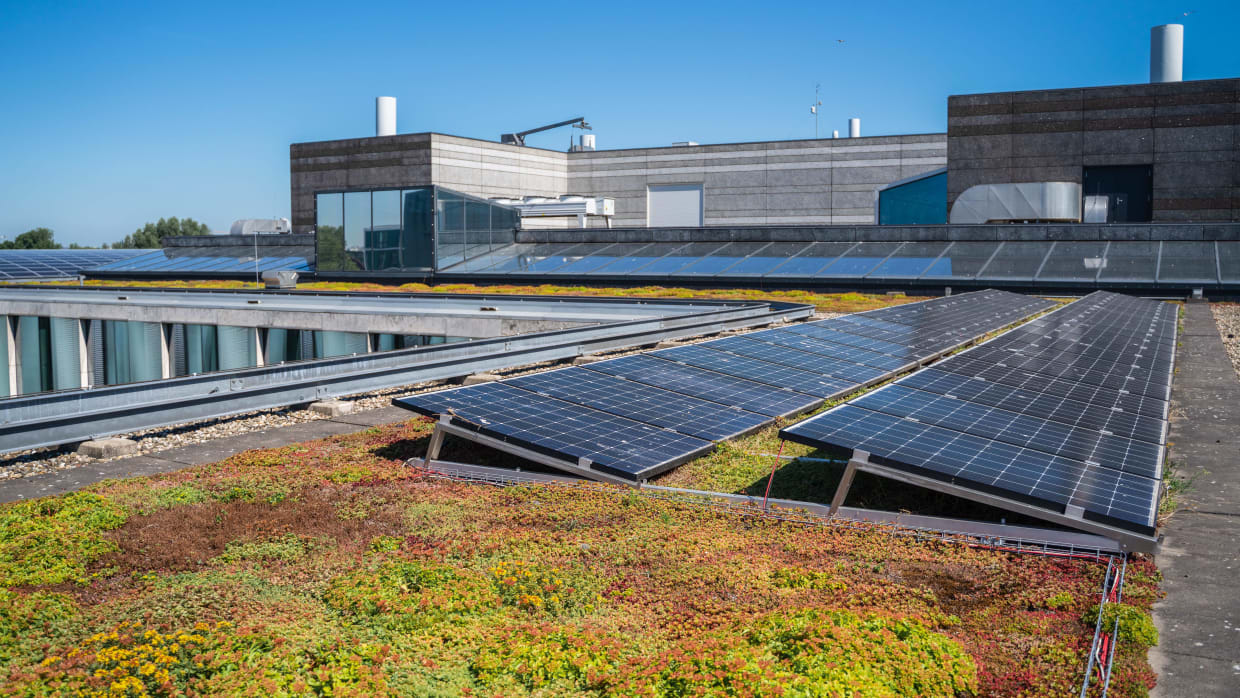
However, current figures show that this target is far from being met. Solar panels on university buildings generated 1,059 MWh of electricity in 2025. While this marks a clear increase from 2022 – when output stood at 661 MWh – the overall contribution remains modest. The university currently produces only 3.1 percent of its total electricity consumption, up from 1.9 percent in 2022. It now states that reaching the 10 percent target will only be possible “if larger-scale generation can be realized, for example through ground-mounted solar panels or a wind turbine.”
Ecological footprint
It is not yet fully clear whether the university has achieved its central goal of a 25 percent reduction in its ecological footprint. Significant progress has been made in terms of energy use, with a reduction of more than 36 percent in CO₂-equivalent emissions. The target to reduce annual waste to below 792 tonnes has also been met. In addition, the number of printers has been nearly halved, and important steps have been taken in making catering more sustainable, with further opportunities for improvement under a new hospitality model.
At the same time, some key figures are still missing. The university also aimed to drastically reduce the CO₂ impact of business travel, but data on actual progress is not yet available. Recent reports acknowledge that the university still lacks a complete overview in this area. “To assess the impact of our measures, a precise analysis of the ecological footprint of our flights is needed. We are therefore conducting a new assessment focused on air travel,” the university writes in its forthcoming annual report.