How do you listen to a fellow student you fundamentally disagree with?
What do you do when someone says something that makes your blood boil, but you are still in the same working group? That question was at the center on Monday during the first edition of “Vrijplaats voor Verschil” (“Safe Space for Difference”), a newly established dialogue evening for students with diverse opinions and perspectives.
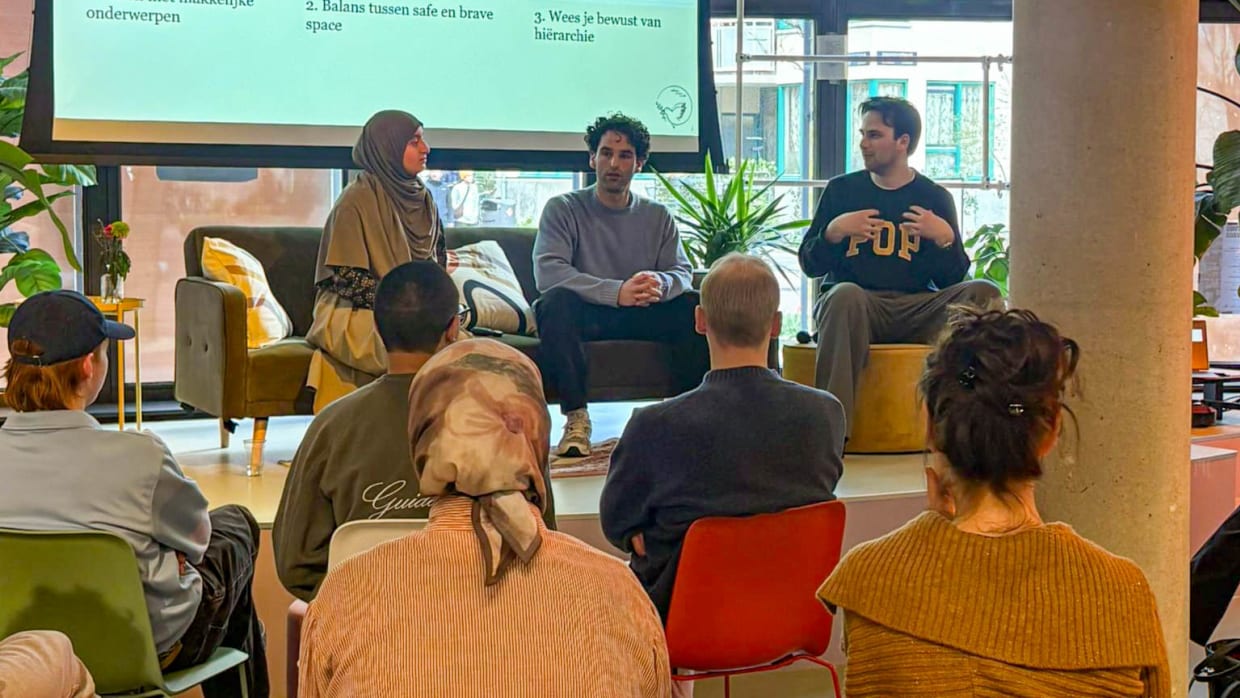
A remark that lingers. An opinion that grates. Or that one thought: how can anyone think this? And yet you have to keep going together — in a working group, in the lecture hall, or maybe even at the kitchen table at home. How do you do that? That question was at the heart of Monday’s first edition of “Vrijplaats voor Verschil” (“Safe Space for Difference”), a discussion evening at VOX-POP, designed to invite students to share their opinions and insights, and, most importantly, to listen to other ideas.
“With evenings like this, we want to provide a space where students have the time and room to engage in dialogue with each other,” says organizer Nienke Booij. According to her, the Safe Space is specifically for students who do want to discuss societal issues but do not always speak up. “We hope they feel encouraged to share their perspective here. With the Safe Space, we also want to show that as students from different backgrounds and perspectives, we can have meaningful conversations about difficult topics.”
Crash course
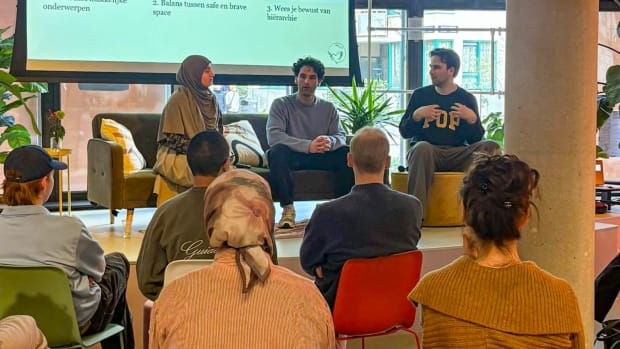
To guide the process, the few dozen students present first received a crash course in listening to viewpoints far removed from their own. This was led by pro-Palestinian activist Oumaima al Abdellaoui and Jewish University of Amsterdam alumnus Boaz Cahn, both involved in the Jewish-Islamic initiative Deel de Duif. Although they often take completely opposing positions on content, they manage to stay in dialogue, they say. In fact, according to Al Abdellaoui, she and Cahn even appear on stage as friends: despite all the differences in political views on issues close to their hearts.
For that, it helps above all to keep asking questions, according to Al Abdellaoui. “To engage in a conversation, it is important to be curious about why someone views a topic in a certain way.” And if it proves difficult in practice to have a proper dialogue, you can always start with a simpler topic: whether those fried potato strips are called “patat” or “friet” in Dutch, for example.
Difficult topic, calm conversation
For the Safe Space for Difference, that last advice was hardly necessary. The second part of the evening, in which students discussed in groups of four, focused on perhaps the most controversial topic at the university: the situation in the Middle East and the impact of the conflicts there on university life. Yet the evening proceeded calmly and amicably. In a confidential setting, students – encouraged to seek out people they didn’t know – shared their experiences and perspectives with one another.
The student groups discussed for nearly an hour various statements related to freedom of expression at the university, engaging with people who held different views on the Israel–Palestine conflict, and campus safety. In the plenary session, a few more perspectives were shared, with the discussion focusing mainly on “the universal truth” and to what extent one should take people with their “own truth” seriously.
Own truths
For Willem Volker, student assessor and the main initiator of the Safe Space for Difference, this was one of the most remarkable moments of the evening. Especially because it closely aligns with why he wanted to start the dialogue evenings in the first place: developing more mutual understanding. “In the end, we concluded that most people don’t have their own truth, but rather a selective collection of facts. I personally think that when we layer these ‘complexes of facts’ on top of each other, we move a little closer to greater understanding of one another.”