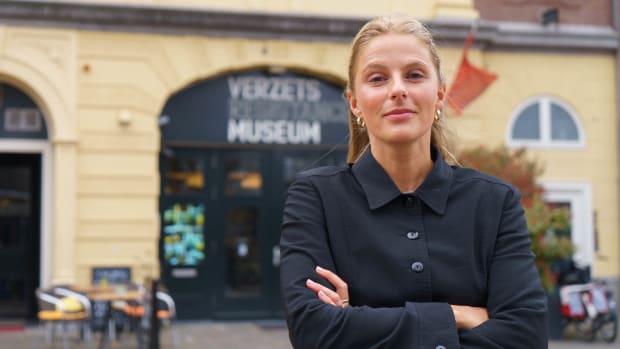
This UvA student created an exhibition about the Iranian women’s resistance

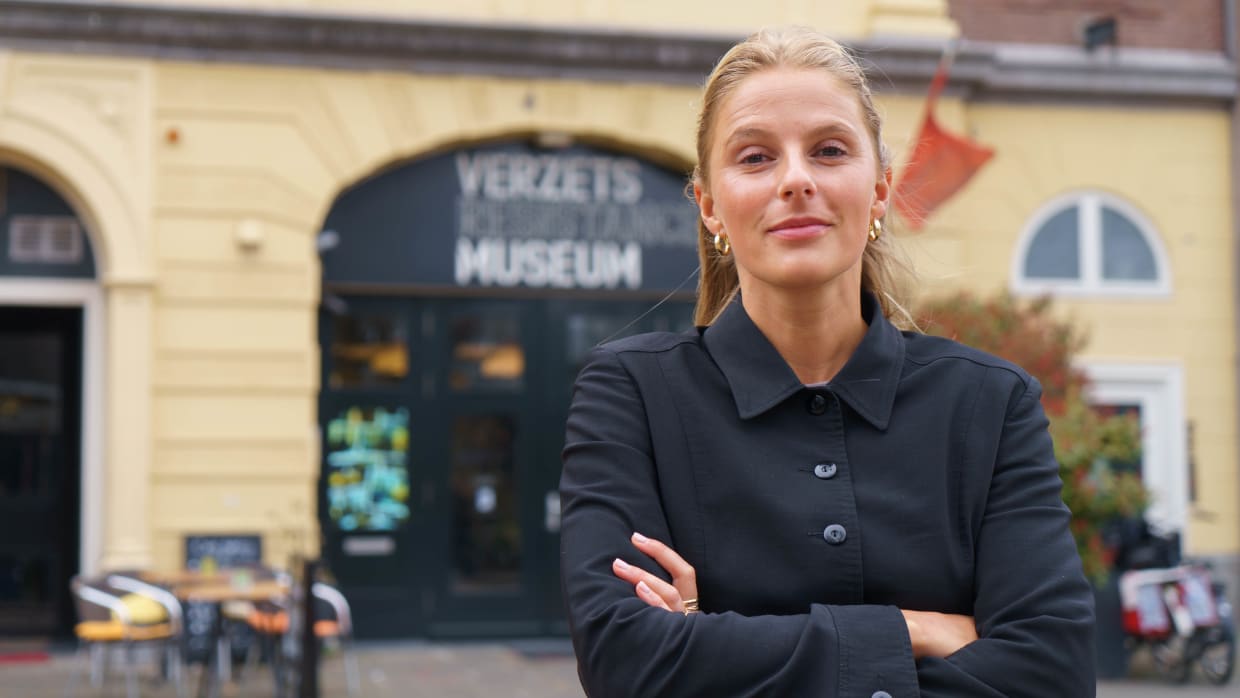
The Resistance Museum is currently hosting an exhibition on the Iranian women’s resistance movement. Lou Steiner (28), a Master’s student in Public History at the University of Amsterdam, was the project leader for the exhibition and talks about the importance of their stories and when current events catch up with you.
Nika Shakarami from Iran was 16 when she joined a protest on the street and set her hijab on fire. Later that day, she sent a message to a friend saying that the security forces were after her, and then she disappeared. Nine days later, she was found at the foot of a building. Murdered by the Iranian regime, although the regime claims it was suicide. Dozens of people gather at her grave to protest and sing.
It is one of the stories from the exhibition ‘Woman, Life, Freedom – Iranian Women’s Resistance’ that made the greatest impression on Lou Steiner, a master’s student in public history and junior exhibition curator. She started working on the exhibition as an intern. “This was one of the first stories I researched and recorded. Nika was so young. I’ve also seen videos of her with her friends, singing songs. These are just girls like you and me.”
Freedom of choice and equality
The exhibition at the Resistance Museum focuses on the Iranian women’s resistance movement, which has a long history dating back to the 19th century. The focal point is September 2022. In that year, Mahsa Amini, aged 22, was beaten to death by the Morality Police for allegedly not wearing her headscarf properly. For the people of Iran, this was the straw that broke the camel’s back, sparking a massive wave of protests. Under the Persian slogan Zan, Zendegī, Āzādī – meaning ‘woman, life, freedom’ in English – women as well as men, and other oppressed groups, took to the streets to protest and make their voices heard. They demand freedom of choice – to wear or not to wear a hijab, to be able to have open relationships with people of the same sex, to dance and sing in public. They demand equality – between men and women, but also for ethnic minorities and different social classes. “Basic things, but they can be arrested and even executed for them,” explains Lou. Iran is the country with the highest execution rate. “The people taking to the streets know there is a high chance they will never return home. Some have their wills in their pockets during the current protests, just in case. That is how great the anger and despair are.”
Freedom of choice and equality
The exhibition at the Resistance Museum focuses on the Iranian women’s resistance movement, which has a long history dating back to the 19th century. The focal point is September 2022. In that year, Mahsa Amini, aged 22, was beaten to death by the Morality Police for allegedly not wearing her headscarf properly. For the people of Iran, this was the straw that broke the camel’s back, sparking a massive wave of protests. Under the Persian slogan Zan, Zendegī, Āzādī – meaning ‘woman, life, freedom’ in English – women as well as men, and other oppressed groups, took to the streets to protest and make their voices heard. They demand freedom of choice – to wear or not to wear a hijab, to be able to have open relationships with people of the same sex, to dance and sing in public. They demand equality – between men and women, but also for ethnic minorities and different social classes. “Basic things, but they can be arrested and even executed for them,” explains Lou. Iran is the country with the highest execution rate. “The people taking to the streets know there is a high chance they will never return home. Some have their wills in their pockets during the current protests, just in case. That is how great the anger and despair are.”
In conjunction with the exhibition on the Woman, Life, Freedom movement in Iran, the Petals Film Festival will be held at Kriterion on 10, 11 and 12 April. Spread over the three days, the festival will screen films which, like the exhibition, highlight the resilience of women in Iran. The programme features a mix of old and new films, spanning from the 1960s to the present day.
Blue Girl
Lou joined the exhibition as an intern whilst studying for her MA in Public History, and subsequently became junior curator and project leader for this exhibition. She has been involved in virtually the entire process. Her work included collecting, selecting and recording the individual stories. “You really immerse yourself in a story like that; you get to know someone. That really moved me.”
She mentions the story of Sahar Khodayari, also known as the Blue Girl. In 2019, Sahar was arrested when, dressed as a man, she tried to go to a match of her favourite football club. Women are not allowed in the football stadium. After the trial, where she was sentenced to six months in prison, she set herself on fire outside the courthouse and died. “They’ve had enough of oppression; the stories you read are horrific. At the same time, these women aren’t pitiable,” Lou emphasises. “During the process, I instead tried to connect with their courage.”
The Master’s in Public History focuses on the everyday engagement with the past and the many ways in which history is presented to a broad audience. Stories have many different perspectives. At Woman Life Freedom, conscious choices have been made in this regard. “History is often told from the perspective of those in power,” explains Lou. “That’s why you see little about the Ayatollah in the exhibition; we focus instead on the women and other oppressed groups.”
Long arm
Crucial to the creation of the exhibition was the advisory group comprising women from the Iranian diaspora: “a group full of powerful women.” Except for two women – journalist and women’s rights activist Mansoureh Shojaee and PhD candidate at Utrecht University Nilou Yekta – the group has remained anonymous for their safety. “I had underestimated beforehand just how far the long arm of the Iranian regime reaches,” says Lou. “For them, and for their families still in Iran. Associating yourself with an exhibition bearing this name is so risky, but it is so important to tell this story.”
Collaboration with Amnesty
Sometimes current events overtake you. In February, around the time of the exhibition’s opening, Israel and the US attacked Iran and Ayatollah Khamenei was killed. Protests this year were cracked down on more harshly than ever. One of the artists in the exhibition was arrested during the recent protests. “She is also a good friend of a woman from the advisory group; she was taken from her home in the night. We’ve fortunately heard that she’s now free, but that’s still very intense.”
These things had to be taken in consideration, but then again, “the exhibition is already up.” Ultimately, the decision was made to add a clip to the video at the start of the exhibition, with an explanation – should major developments occur, things can be adapted or added there. The exhibition ends with a noticeboard, where they pin up new newspaper articles and social media posts every day. “We also have a wonderful partnership with Amnesty. At the end of the exhibition, you can sign a petition, and they keep us informed about new arrests in Iran, as well as Amnesty’s campaigns and petitions, so that together we can continue to stand up for the people of Iran.”
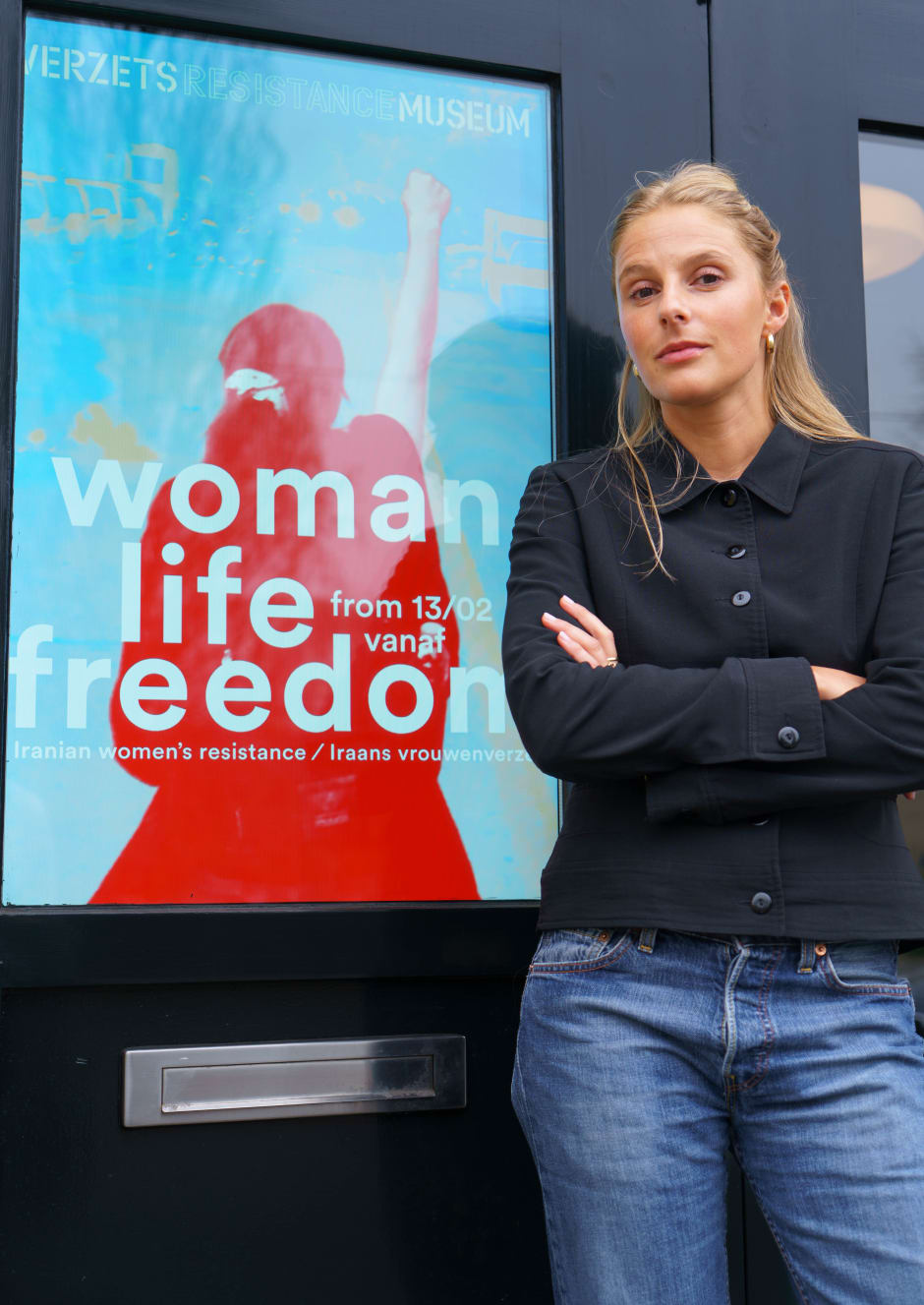
The exhibition ‘Woman, Life, Freedom – Iranian Women’s Resistance’ is on display at the Resistance Museum until 26 August 2026.