Kohstamm lecture | “Big Tech is increasingly dictating how we teach and learn”

The 26th Kohnstamm Lecture was delivered this afternoon by José van Dijck, professor of media and digital society at Utrecht University. In her talk, she warns about the dangers of the growing power of Big Tech in education: “Educational institutions must safeguard their autonomy.”
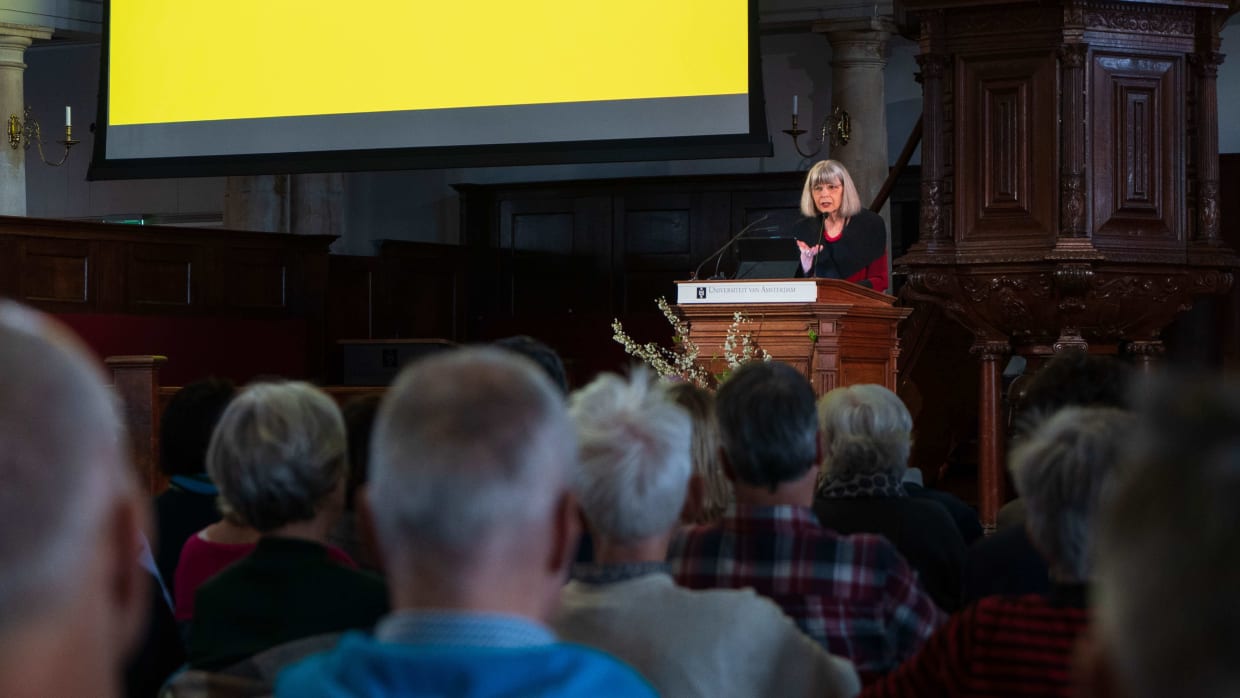
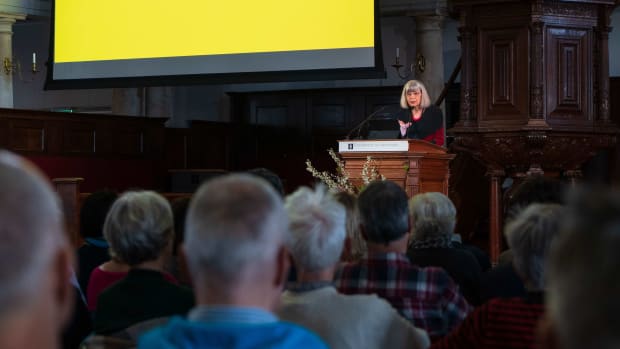
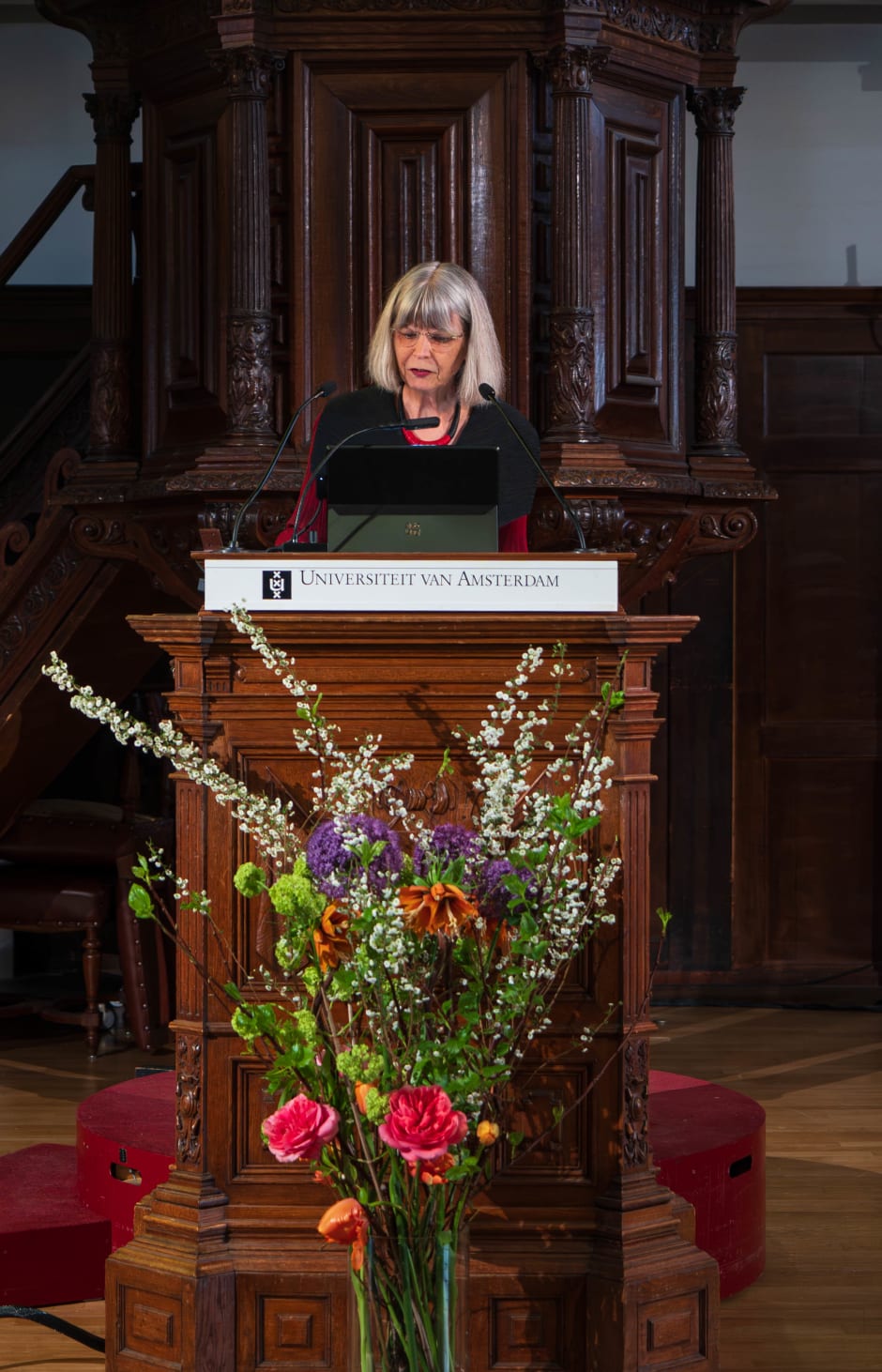
A “gross lack of resources available to education” – that was the complaint of physicist, philosopher, and educator Philip Kohnstamm in 1940. Nearly a century later, the 26th edition of the annual lecture named after him focuses precisely on the opposite problem. As speaker José van Dijck put it on Friday in the Aula of the University of Amsterdam: “Education now seems to be inundated with information and communication technologies.”
Van Dijck is referring to all kinds of programs: Google Classroom, online student tracking systems, learning management systems, and – one of the most recent developments – generative AI such as ChatGPT and Copilot. “Digital technologies have penetrated the very fabric of our society and are leaving an increasingly heavy mark on the education sector. Hardware and software, produced by large companies with enormous economic interests, are increasingly dictating schools’ pedagogical and didactic methods and students’ habits.”
Ban on AI
The Utrecht University professor opens her lecture with the heartfelt plea of fourteen-year-old Charlotte. The student is appalled by the “meaningless speeches” and “flat Sinterklaas poems” that her classmates now produce with a single click using ChatGPT. In a letter to NRC, she made a radical proposal: ban AI for everyone under eighteen, so that young people can learn to think independently again.
That wish is “entirely understandable,” according to Van Dijck, especially from a desire for individual autonomy. However, it is not very realistic: “You can keep AI bots out of the classroom, but students will also need to be digitally resilient outside of school. And teaching that resilience is also the responsibility of the school.” For this reason, Van Dijck focuses on another question: how can students, teachers, and schools remain digitally autonomous in the era of artificial intelligence and Big Tech?
Autonomy
Van Dijck distinguishes between different levels of autonomy that have come under pressure due to the rise of Big Tech. First, she warns of the erosion of students’ individual autonomy: their ability to independently evaluate information and process knowledge. “That process is not so much about producing good outcomes, but about learning itself: it’s about making mistakes, trying again, thinking better, writing better.” When a chatbot takes over the thinking, the essence of education disappears: the trial and error.
José van Dijck (1960) is professor of media and digital society at Utrecht University. She conducts research on social media, the impact of media technologies, and tech companies on digital culture.
Van Dijck served as president of the Royal Netherlands Academy of Arts and Sciences (KNAW) from 2015 to 2018. In 2021, she received the prestigious Spinoza Prize from the Netherlands Organization for Scientific Research (NWO). Between 2001 and 2016, Van Dijck was professor of comparative media studies at the University of Amsterdam.
According to Van Dijck, the professional autonomy of teachers is also at stake. As algorithms increasingly determine how students progress – or even take over grading – the expertise of the teacher risks being reduced to managing a machine. She cites a teacher who told De Correspondent that educators are now in a “fucked-up situation”: “We think we are assessing the quality of a product, but in reality, we are assessing how well someone can handle AI.”
Push from the industry
Moreover, it is not only the teacher but the school as a whole that seems to be losing control to Big Tech, Van Dijck warns. “Schools face a push from tech companies to implement ‘their’ software as quickly as possible. The AI-driven software from Microsoft and Google is being rapidly integrated into the platform systems that schools rely on, making it unavoidable.”
This carries risks: “I recently heard a computer science teacher in vocational education remark that he felt his students were increasingly being trained to become Microsoft service technicians.” According to Van Dijck, it is crucial that schools do not bend too much to tech companies that have a vested interest in promoting their own hardware and software. After all: “Once tools are embedded in the deepest layers of digital ecosystems, how autonomous can you really be?”
Making your own choices
This brings Van Dijck to the issue of infrastructural autonomy, a topic close to her heart, on which she recently sent an open letter to university administrators. At its core is the fundamental question of who controls the digital systems that underpin our research and education. Van Dijck points out that companies like OpenAI in the United States are already signing contracts with entire campuses to roll out their systems to students.
According to the professor, such a development runs counter to the public mission of the university. She therefore advocates restoring the “ability of educational and research institutions to make their own choices in the digital domain.” In practice, this means that universities must reclaim full control over their own systems and maintain oversight of “where data is stored and who has access to it at what cost.” Initiatives such as GPT-NL (a Dutch AI language model) or the UvA AI Chat are, in her view, the first “small steps toward the larger ideal of an independent digital infrastructure.”
Ultimately, Van Dijck brings the discussion back to the essence of education. Whereas Kohnstamm in 1940 longed for more resources, she warns that in 2026 we may be addressing the wrong scarcity. The problem is no longer a lack of tools or information, but the loss of focus: “What is becoming scarce are human minds capable of concentrated attention. So let us invest above all in that: critical thinkers and passionate teachers.”