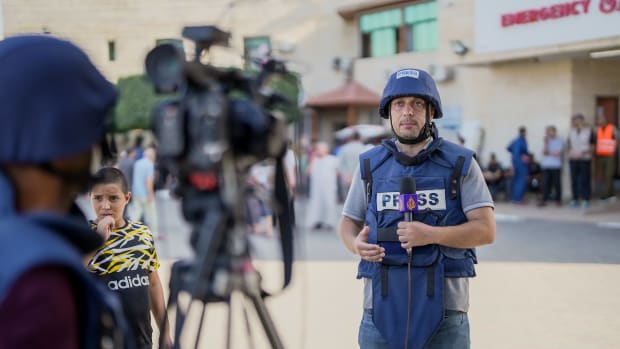
Palestinian journalist Hisham Zaqout: “We are the only voice of Gaza”
What does it mean to work as a journalist in a war zone? Palestinian Al Jazeera journalist Hisham Zaqout recently began a fellowship at Nias to investigate the survival strategies of Palestinian journalists. He himself has just returned from Gaza. He tells his story for the first time to Folia. “What is happening in Gaza goes beyond all previous strategies for ensuring the safety of journalists.”
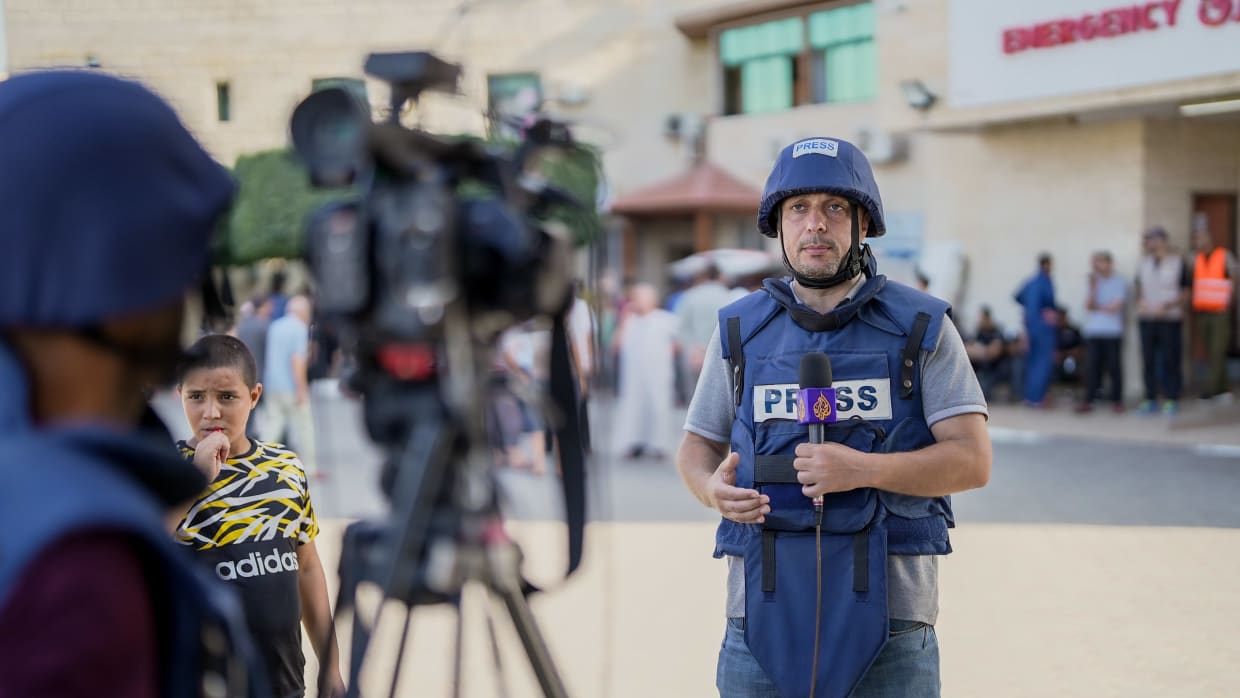
Palestinian Al Jazeera journalist Hisham Zaqout saw his beloved home turn into a war zone. Houses are reduced to rubble and his neighbours, colleagues, family and friends have become targets. Safety for journalists can no longer be guaranteed. On the contrary, practising journalism now entails additional risks. Whatever happens, Zaqout and his colleagues continue to document in order to bring the story of the people in Gaza to the outside world.
Last February, Zaqout came to Amsterdam for a research placement at the Netherlands Institute for Social Sciences and Humanities (Nias). Through the Safe Haven fellowship, he is researching how journalists in Gaza carry on broadcasting and survive. For a while, it was uncertain whether Zaqout would be able to come to the Netherlands. Although he was granted a visa by the Dutch government, he was unable to go to Jordan to collect it. To leave the country, he needed the help of a foreign minister and permission from the Israeli court, according to Zaqout. Eventually, he did receive this permission and managed to travel to the Netherlands via Jordan.
Over the span of five months, Zaqout is conducting research at Nias. He has been awarded the Safe Haven fellowship, a grant awarded to five researchers, artists and journalists from war and conflict zones. Two of the places are funded by the UvA. Zaqout is researching the survival strategies of Palestinian journalists and how they continue to get the story out despite efforts to silence them. It is intended to become a guidebook for journalists on how to survive under extreme conditions, based on his own experiences and the stories of his colleagues.
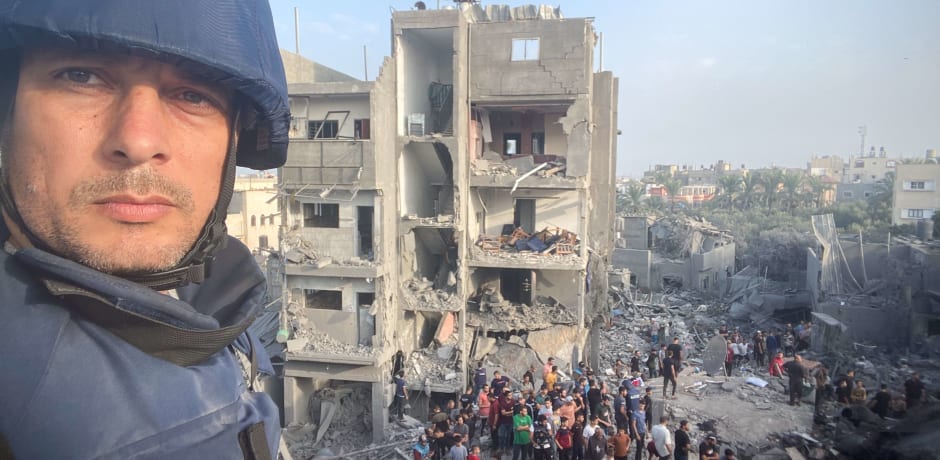
The conditions in Gaza are unprecedented for a modern war, says Zaqout. He has been working as a journalist for over 20 years and has taught young students about the safety of journalists in war zones. But what is happening in Gaza goes beyond all previous strategies for ensuring the safety of journalists. Zaqout: “The bombs are everywhere. It is also because, for the first time in a modern war, the occupying forces are denying access to safety equipment (helmets and vests) and basic necessities (food and water). Survival becomes a matter of good instinct and sheer luck.”
I’m glad you were able to come to the Netherlands after all. What was it like for you to leave Gaza?
“It’s the hardest decision a person can make. It felt as though I’d had part of my arm amputated. I had to leave my family, colleagues and a life full of memories behind. My body is safe here in Amsterdam now, but my mind and soul are with the bombs in Gaza.
I left Gaza with absolutely nothing. You’re only allowed to take the clothes you’re wearing; that’s it. I wasn’t allowed to go back to my old flat to search through the rubble for any remaining personal belongings. So when you arrive in a new place – for me, Amsterdam – you have to start all over again.”
What was it like for you to have to live and work in a war zone?
“You have no choice. It’s all about survival. That’s the second war you are fighting. It’s not just unsafe, but there’s barely any access to basic necessities like food, water and medicine. As a journalist, suddenly the most important thing is that you learn to survive.
I agreed with my colleagues that we would move around as much as possible in small groups of two. That way, if we were attacked, other groups could continue. We agreed that if someone got hit, you had to keep reporting. That’s very difficult. To keep covering and talk about your friends and colleagues being murdered right before your eyes.
If we wanted to be safe, at one point Israel told us we had to be in the centre or south of Gaza. Yet my manager at Al Jazeera’s house, which was in the centre of the Gaza Strip, was attacked.
I was in the hospital reporting at the time and saw his injured family being brought in. He was in the city centre and I called him straight away. I expected there to be people still under the rubble, so he went there immediately to search. He found his two sons there, who survived. But his brothers, daughters, grandson and wife were killed. When he arrived at the hospital, I could see he was crying. “We can’t cry,” he said. “We have to stay alive to tell the story.” This is the first time I’ve spoken about this. It’s hard to remember and think about it.”
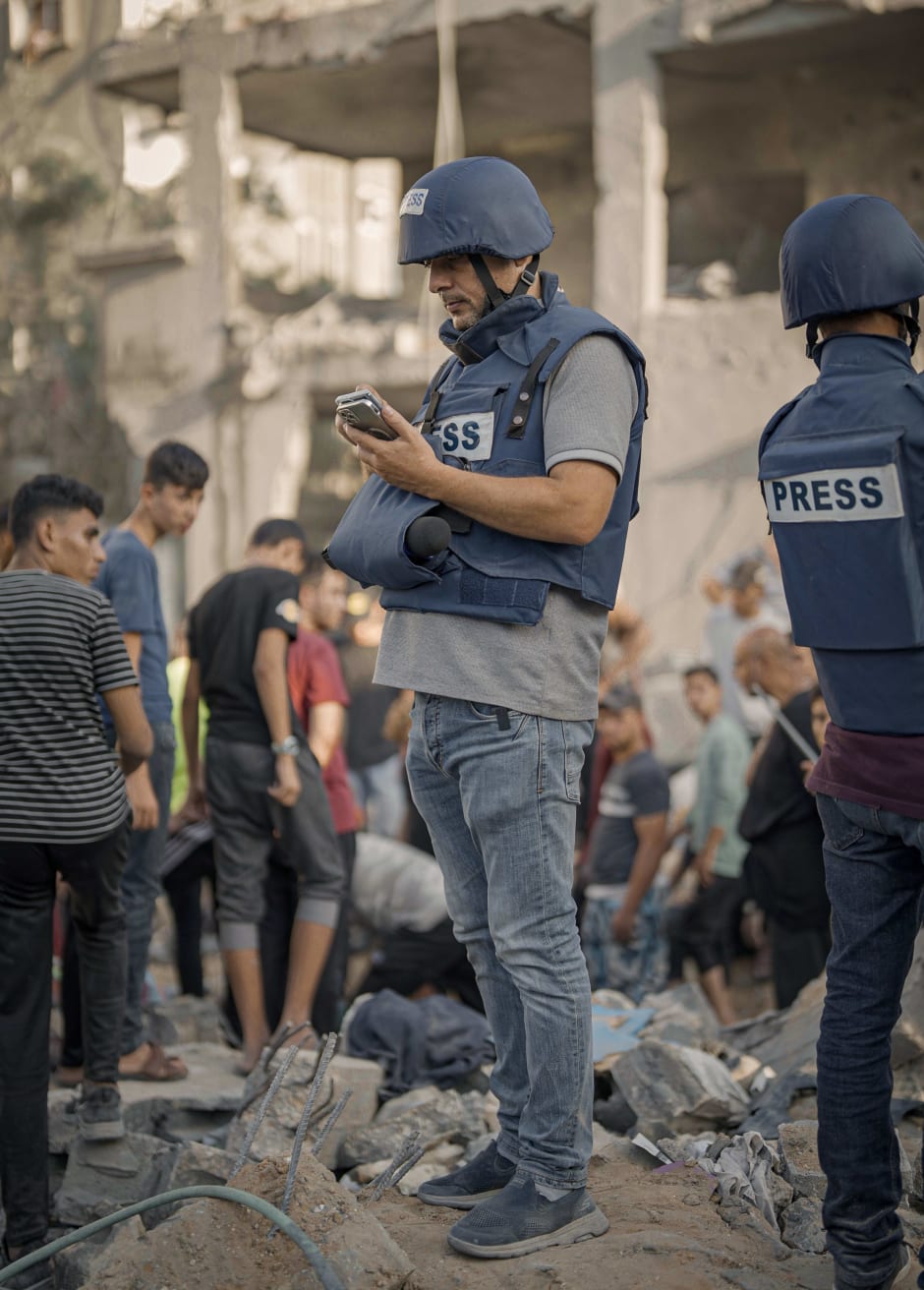
I can see it’s affecting you. What is it like to have to continue your journalistic work in such a situation?
“But it’s very difficult to carry on as a journalist. You’re a deliberate target in the war; it’s life-threatening. On top of that, you have no food and barely any means of communication. The longest we went without access to food was eight months. I normally weigh 75 kilos; when I was in Gaza, I weighed 60 kilos. We sometimes drive around in an SNGSatellite news gathering, a car fitted with a satellite. That way, we can bypass the communication blockades if we come under attack.
We get the news directly from the people – from the paramedics, the firemen and people on the street. We have to go on, every victim has the right to have their story told.”
How are journalists in Gaza silenced?
“In Gaza, we have to fight for press freedom every day under fire. It is not a guaranteed right. The Israeli government not only isolates us but deliberately targets us and our families. The Israeli army has bombed our offices, our makeshift media tents and our cars. They kept taking it further. The internet and means of communication are cut off, and even access to food and water is blocked. This is how they try to suppress us. It is a comprehensive war to erase the truth.
We have no other choice. We are the only voice in Gaza. Foreign journalists are not allowed into Gaza. On some days, I was the only one who could reach the outside world because my satellite transmission equipment wasn’t affected by the communication blackouts.
More than 260 journalists have already died in this war. If, at a crucial moment, you manage to find a brief internet connection allowing you to publish a single photo, that is the highest form of freedom of expression.”
If it is so dangerous to be a journalist and you are a target, why do you still wear a visible press vest?
“Whether you wear the press vest or not, you’ll be attacked anyway. That uniform is designed to be a shield. It’s tragic that the Israeli occupiers have turned it into a target. But in reality they target everyone. If you take off the press vest, they can use it as an excuse that they didn’t know you were a journalist.
We keep wearing it because it’s our way of telling the world: I am a witness, I am doing my job properly. If we are killed, the world will see that the Israeli government did it deliberately.”
What stories are important for you to share about Gaza?
“Of course, we report on the harsh conditions of the war, but I mainly want to show life amidst the rubble: the doctors saving lives without electricity or medicines, the children finding a moment to play amidst the ruins of their homes. War brings out the worst in people, but among the Palestinians in Gaza, it brings out the very best.”
How do you find that humanity in a war?
“In the smallest details. I have seen journalists whose families were brutally murdered. They buried their loved ones and then immediately resumed reporting. I have seen doctors who were arrested, attacked and injured. Yet they returned to the hospital as quickly as possible. That resilience and care for one another is the highest form of humanity.”
Can you remain objective?
“In Western journalism, objectivity is often confused with neutrality. But when your city is being destroyed and your colleagues are being murdered right in front of you, neutrality is impossible. For me, objectivity does not mean abandoning my humanity. For me, it means complete loyalty to the truth. If I cry in front of the camera, that doesn’t make me any less objective. It shows that I am a human being telling the truth.
At Al Jazeera, we focus primarily on live broadcasting. That cannot be manipulated or edited.”
Do you think you will return to Gaza?
“My wife and children are now in Belgium, but the rest of my family is still in Gaza. To return to Gaza, I would need permission from the Israeli authorities, and I probably won’t be granted permission to leave the country again.
But I definitely want to return one day. It is my home, my identity and my reason for carrying on. By being here in the Netherlands, I want to ensure our voices are heard, but the aim is to eventually return. There are still thousands of stories waiting to be told.”