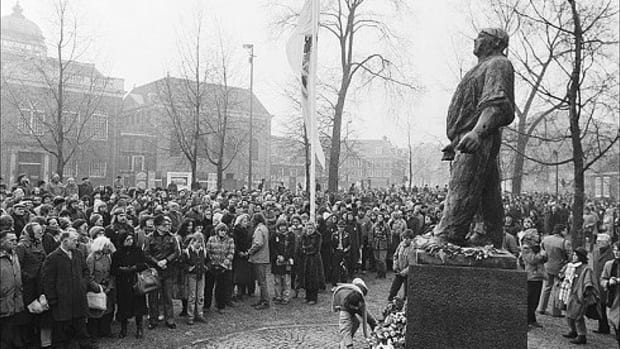
“The February Strike of 1941 is too often presented as a spontaneous popular uprising”

The February Strike of 1941 was a large-scale protest in Amsterdam against the persecution of Jews by the Nazis. Today, 25 February, marks exactly 85 years since the strike. The UvA branch of the Communist Youth Movement is organising a commemoration. Five questions for UvA communist and PhD candidate Martijn.
Martijn, help us out here. The February Strike of 1941. What was that all about?
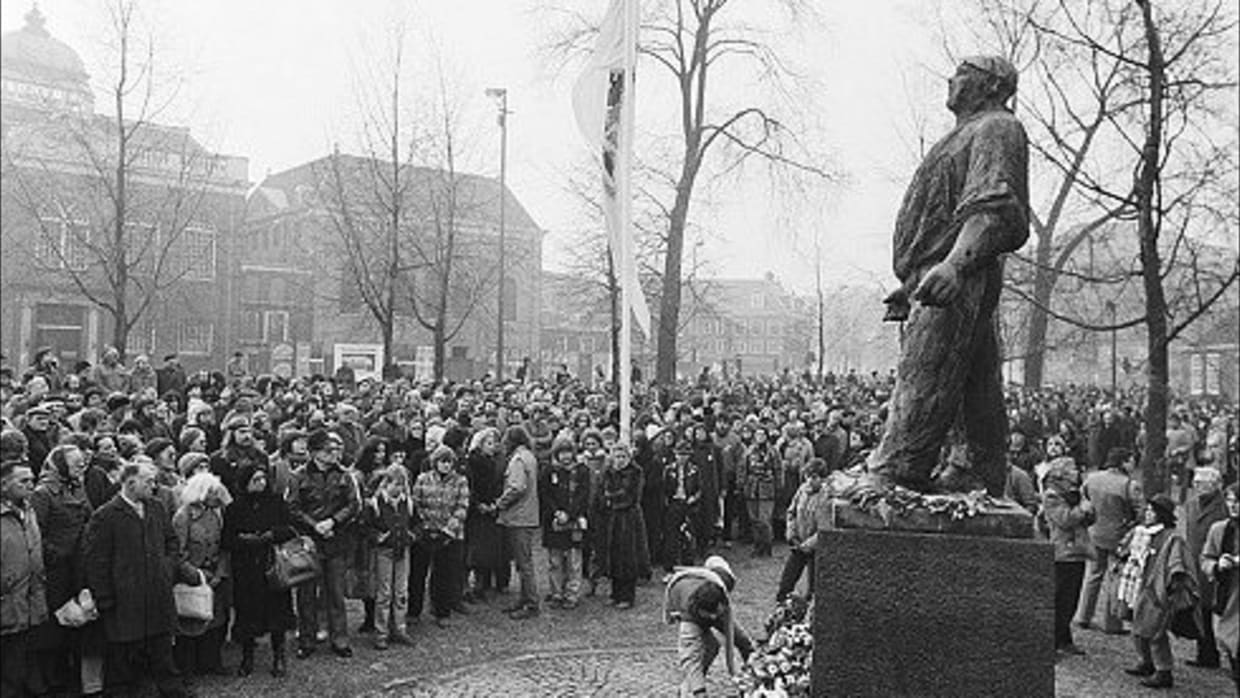
“At that time, the Netherlands had been occupied by the Nazis for almost a year, which meant, among other things, increasing exclusion of Jews from public life and raids, but also (factory) workers who were increasingly worse off and had to perform forced labour in Germany. The immediate cause of the strike was the raids on 22 and 23 February 1941, during which 425 Jewish men were arrested on and around Jonas Daniël Meijerplein in Amsterdam and taken to concentration camps. The strike also spread to the rest of the Netherlands, where fights broke out with the NSB’s security forces. Ultimately, hundreds of thousands of people took part.”
The strike seems to have had little effect, doesn't it? After that, the raids and deportations really started.
“That’s true, but a major consequence of the strike was that it created an atmosphere of ‘We won’t accept this occupation’. It was also about making the political point that the Netherlands did not want to cooperate with the Nazis. The strike was actually the starting point for the (underground) resistance.”
Why do you, as young communists, think it is important to draw attention to this?
“The strike was called and organised by the (then) illegal Communist Party of the Netherlands (CPN). The strike is often presented as a spontaneous popular uprising against the Nazis, but it was much more than that. Capitalism played an important role in the rise of fascism and also facilitated it: big business and industry saw fascism as a means of protecting their financial interests. We want to learn lessons from this, even today. Because we are taking a broader view than just the February strike, we are also organising a separate commemoration, separate from the commemoration organised by the municipality today.”
How do you view today’s communist regimes? I mention Cuba, which is in deep poverty.
“Cuba is indeed in a bad way, but that is mainly due to American policy, which wants to destroy Cuban communism and organises sanctions and blockades. The idea of communism, as you saw it in the former Soviet Union, certainly has advantages over capitalism, which focuses only on short-term profit. The communist system looks at what people need in their lives – such as good education for everyone – and makes a plan for that.”
On Saturday, you will be holding a commemoration. What can we expect there?
“A panel discussion on trade union work with FNV, Asva, SRVU and the Business and Trade Union Work Committee of the New Communist Party of the Netherlands. In addition, there will be contributions from the Communist Party of Sudan and the Cuban Embassy in the Netherlands, among others.”
The commemoration of the February Strike, organised by the Communist Youth Movement, will take place this Saturday, 28 February, from 1 p.m. to 4 p.m. in the Zuiderkerk, Zuiderkerkhof 72.
At his request, the editors have only used his first name, Martijn, due to fears of doxing. His surname and his PhD position at the University of Amsterdam are known to the editors and have been verified.