75 years of Esperanto at the UvA: a language of peace “that is more relevant than ever”

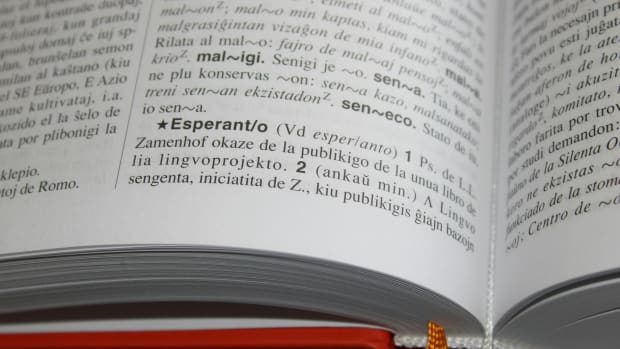
Nowhere else in Europe is Esperanto as popular as at the UvA. The language was originally devised to promote peace and break down borders. In the current climate, marked by geopolitical tensions and growing nationalism, the language is therefore more relevant than ever, says Federico Gobbo, Professor by Special Appointment of Esperanto on the occasion of the 75th anniversary of Espernto at the UvA.

For twelve years now, the Italian Federico Gobbo has held a position at the UvA that is unique in Europe: he is the only professor devoted exclusively to Esperanto. The artificially created language was developed at the end of the nineteenth century by the Polish-Jewish ophthalmologist and philologist Ludwik Lejzer Zamenhof, and was intended to become an easy-to-learn, politically neutral world language. Today, around 63,000 people worldwide are fully proficient in the language.
Gobbo is one of them, and in the twelve years he has been working in Amsterdam, he has seen how global developments are continually reflected in the students who enrol in the course he teaches at the UvA. “I always ask my students about their motivation, and increasingly I hear that they no longer want to go along with the narrative of growing nationalism worldwide. In that respect, Gen Z is far more ideologically driven than the beginner Esperanto speakers of my time.”
So what exactly does Esperanto have to offer them?
“I could fill entire books with that, but I’ll try to keep it brief. We live in an era in which extremely nationalistic and xenophobic ideas are becoming increasingly normalised. Esperanto offers an alternative to that, and is by definition an anti-nationalist movement. Because the language has no native speakers, everyone always interacts on an equal footing. Reducing someone to their background or nationality is therefore impossible. That level of connection between Esperantists makes the language unique and fosters an open outlook on international cooperation. Compared with xenophobia, this is the complete opposite end of the spectrum.”
So, the language of peace?
“Exactly, that is the role Esperanto has always played. As early as the Stalin era, Esperantists were executed because the language was seen as a threat to the regime and potentially capable of inciting rebellion. At the time, it functioned as a kind of safe, secret language for dissenters, and therefore stood in the way of the idea of a single unified nation.”
How does that manifest itself today?
“In today’s world, Esperanto is more relevant than ever because it forms a large but informal network that can help keep contacts alive in countries where people are at risk. I myself have a number of contacts in Russia, among other countries, for example, on a personal basis. The local Esperanto organisation is being isolated by Putin and has to operate very cautiously, but through the language, people are still able to maintain a network.”
“But the relevance of Esperanto goes beyond geopolitical unrest. Major global problems, such as climate change, require global solutions, and here we see that Gen Z in particular strongly connects with the international character of the field.”
How does that become apparent?
“Take Russia’s invasion of Ukraine. Shortly afterwards, we saw a huge increase in the number of students enrolling in the course. That year we had twenty-five students, which is truly unprecedented. Students see Esperanto as a language of peace, brotherhood and international understanding. They feel a need for that counter-movement.”
Twenty-five students, that’s a lot, then?
“It was an outlier – normally student numbers fluctuate more around ten to fifteen – but even then there is no university in Europe that comes close. Take Seville or Liverpool, other universities that play a relatively significant role in Esperanto education in Europe: they rarely have a lot more than five students.”
How has the UvA come to play such a leading role in Esperanto education in Europe?
“First of all, we have an exceptionally long history in the field. Last December, we celebrated seventy-five years of Esperanto at the UvA, which is unique. As early as the 1960s, there were several Esperanto clubs in Amsterdam, so the language has genuinely been part of the city for a very long time. As a student, you also don’t come here unless you have an intrinsic interest in people from different countries and cultures. That is simply the spirit of the city of Amsterdam.”
“The fact that we have a dedicated chair in Esperanto here is also truly unique. This coming summer, an Erasmus programme will be organised for the first time, bringing together students from all over Europe to take a course and spend a week in France learning Esperanto. One third of the students taking part will be from the UvA. That really illustrates how popular the field is here. Most small languages are struggling, but Esperanto continues to thrive at the UvA.”