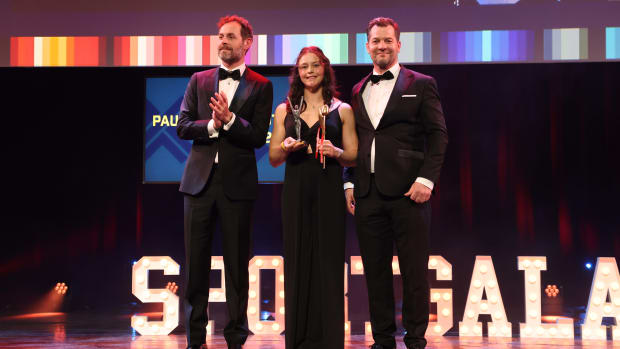
UvA graduate and gymnast Elze Geurts wins Paulien van Deutekom Prize
Sport often revolves around that one goal, but last year UvA student and gymnast Elze Geurts (30) learned betting on both sides. This week, Geurts won the Paulien van Deutekom Prize for personal growth at the Amsterdam Sports Gala. “In order to secure my gymnastics career, I had to choose my career as a doctor.”
Did the award come as a surprise?
“Well, I initially told my coach that I wasn’t going to the sports gala because I’m busy with my work as a doctor. When he started to protest, and when my boyfriend later showed an above-average interest in what I was going to wear, I began to suspect something...”
And how did it feel to receive the award?
“It was great fun. It’s a very honourable award, perhaps even more so than a Fanny (see box) because of the personal story of Pauline van Deutekom (the speed skater who died of lung cancer at the age of 37, ed.). Van Deutekom was a great sportswoman who was also committed to helping other people.”
How does it feel to win an award for personal growth as an athlete?
“Good. I think that the better you develop as a person, the better you perform as a top athlete. It teaches you how to deal with setbacks.”
“Elze Geurts is the epitome of perseverance in all kinds of areas. Despite serious setbacks – including two Achilles tendon ruptures, an anterior cruciate ligament injury and a hamstring injury – she continues to perform at the highest level. Within the TURNZ gymnastics club, she is not only a gymnast, but also a mentor and inspiration. Her motivation to continue gymnastics at the age of thirty lies in the unique physical and mental challenge of the sport and the ongoing process of continuing to learn how to move.”
What was a setback for you?
“In the summer of 2024, I narrowly missed out on the Olympic Games due to a hamstring injury. That was tough for me. After that, I started my residency in rehabilitation medicine and began caring for people who had just suffered a spinal cord injury. That put things into perspective.”
What did you learn from that?
“That you’re much more resilient than you think. And also that, as a top athlete, you’re in a very privileged position. On a personal level, I’ve become more confident in what I can do. I can make better choices about what I can handle. In the past, I always wanted to be in top shape. Now I know that periods when you’re less fit are also part of it.”
How do you look back on the past year?
“Mixed feelings. I’ve been constantly busy. There was the European Gymnastics Championships in May – where I came fifth on the vault, my best performance ever – and I was doing the toughest internship of my course to complete my studies. And then there were the preparations for the World Gymnastics Championships in Jakarta in October, where I was ultimately not selected and lost my elite athlete status, which also means you lose your salary as an elite athlete. On 1 November, I became a research doctor in orthopaedics and sports medicine at Amsterdam UMC.”
UvA student and para-athlete Fleur Jong received the Fanny Award for Sportswoman of the Year on Wednesday evening. “It is a tremendous honour to receive this award,” Jong said when asked. “It’s an award that you hope to win as an athlete, precisely because it is named after Fanny Blankers-Koen, an absolute legend in athletics. Amsterdam is where the success of Team Para Athletics and my own sporting career began, which makes this recognition even more special and valuable.”
Other UvA nominees included sprinter Elvis Afrifa, rowers from the Holland Eight Jan van der Bij, Wibout Rustenburg and Mick Makker, and Guido Bonsen, coach of Jong and Afrifa.
“You might wonder whether I should have completed my internship this year, because it may have been at the expense of my performance at the World Championships. But I do think that I ultimately made the right choices. Otherwise, I could have ended up in a situation where I was not yet a doctor and had to manage without a top athlete’s salary. And six months of top-level sport without an income is also very expensive. So, in order to secure my gymnastics career, I had to choose my career as a doctor.”
Do you think that foresight is also a quality that top athletes need to have?
“I think so, because the climate at the NOC*NSF sports umbrella organisation has become increasingly performance-oriented. The Dutch women’s team used to have six or seven gymnasts with top athlete salaries, now there are only two. That’s a change in policy, and as an athlete you have to be able to deal with that and anticipate it.”
What are you most proud of yourself?
“That’s a difficult question. I do a lot, but I don’t often reflect on everything I do. Last year, I did achieve a really big milestone. I became a doctor, which is no mean feat when combined with top-level sport. This award is a moment for me to reflect on that.”