More study associations at UvA are unable to find board members


Many study associations at the UvA are struggling to find board members. In order to persuade students to join, other structures are being devised. One example is a part-time board, in which tasks are rotated.
Study associations are finding it increasingly difficult to recruit board members. Every year, they have to pull out all the stops to find a solution that will keep the associations running. Folia spoke to six associations from five faculties. All but one of the study associations interviewed indicated that they were having difficulty recruiting new board members.
The SEFA study association appears to be an exception to this rule. As the umbrella organization for the Faculty of Economics and Business, SEFA attracts a relatively large number of interested parties. According to the SEFA board, students see a board position as an opportunity to develop themselves and extend their student life by a year. And let’s not forget: students can put such a board year on their CV. For employers, a board year is sometimes seen as proof of managing qualities.
While SEFA has a luxury problem, other study associations are having more difficulty finding candidates for the board. They say they are actively looking for solutions to the shortage of candidates.
CONGO
Biology, biomedical sciences, and psychobiology
Due to a lack of interest, Congo decided to take drastic measures: a part-time board. Over the past two years, they were unable to find six board members and had to make do with five. Treasurer Cas Wieken points to COVID-19 as the main cause of this trend. “Because students couldn’t leave their homes, they also stopped coming to the faculty,” he says. “I think that also makes them feel less connected to the association.”
For many students, study associations form the social and organizational heart of their studies. They organize lectures, career events, and social gatherings, and rely on the efforts of student boards. Board members often take a gap year for this purpose, during which they temporarily interrupt their studies.
Board members of study associations receive a grant from the UvA. The university pays a monthly amount of €327 per board member, which the board members are free to divide among themselves. The amount of this grant is reviewed every three years on the basis of a points system.
But that’s not all, according to Wieken. The lack of affordable rooms in Amsterdam makes it almost impossible for some students to serve on a board. “Board members often have to be present on campus,” says Wieken. The threat of a penalty for studying too long, which was to be introduced in 2026-2027, didn’t help either. That penalty didn’t happen in the end, but it did make students wary of taking longer to complete their studies. In addition, Congo’s board grant was recently reduced, which also creates a barrier. “For the next three years, we will receive 61 months of funding instead of 88. Because board members must remain enrolled in their studies, they pay tuition fees that are no longer fully covered by the subsidy.”
To solve the latter problem, among others, Congo has decided to recruit more board members for part-time positions. “Instead of the usual six board members, we have now recruited eight students,” says Wieken. “This allows them to continue taking courses alongside their board duties.” Initially, this means that positions will be split up so that each board member has fewer tasks. Furthermore, attendance requirements will be less strict. “Board members no longer have to be present at all activities,” says Wieken. “Congo members will notice that the association room on campus is no longer open every day, all day long. Normally, a board member would always have to be present there.” The current board hopes that these relaxations will attract more new members.
Sarphati
Social geography and urban planning
Last year, the Sarphati study association had difficulty forming a full board. There wasn’t much choice. “We only received five applications to form a five-member board,” say the former board members. And they weren’t eager to serve on the board: “We had to be persuaded to join the board.” For the current board, there were six or seven applications.
According to secretary Sam-Ji Woudstra, a former board member, other study associations at FMG are also having difficulty finding board members. He has noticed that many members have become less active in recent years, but that this fluctuates from year to year, he says. He believes that there are fewer active members because student culture in Amsterdam is disappearing. “There is so much more to do in Amsterdam besides just student life.” According to Woudstra, this would be different in other cities such as Nijmegen or Leiden, where study associations are more active.
In order to get enough applications for board positions, the Sarphati study association organizes open evenings, often accompanied by a beer – “an effective tool,” says Woudstra. “If there are more active members, there is a greater chance that more applications will be received for a board position.” However, according to former board members, it is mainly the active encouragement of members throughout the year that yields results: “We regularly asked active members if they would consider a board position. That paid off in finding the current board.”
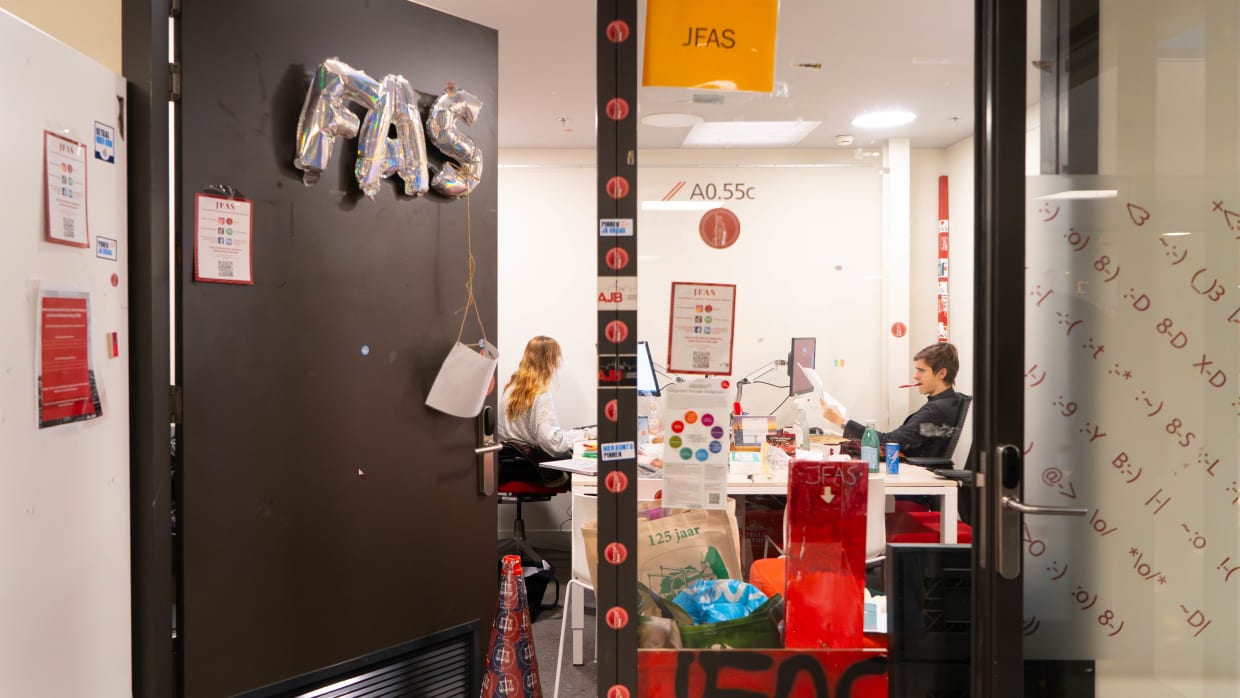
JFAS
The Amsterdam Students’ Law Faculty
The JFAS law association has also had to struggle over the past two years, despite being the largest study association for law students. Although the association usually has seven board members, last year it had to settle for six. Its sister association, NOVAS, is no exception. Because the former secretary was initially unable to find a successor, she was forced to remain in office for an extra month.
When the current board members try to explain this trend, they come up with a number of explanations. First of all, member involvement has declined. “Members are staying active for shorter periods of time,” say board members Ralph Noort and Sepp Spannenburg. This automatically results in fewer motivated candidates for a year on the board. In addition, the compensation that board members receive has been halved since this year. “Previously, each JFAS board member received €327 per month from the UvA for ten months. During the triennial review of all subsidies, our funding was reduced to five months.” According to Noort and Spannenburg, this creates a vicious circle in which it becomes even more difficult to find new board members. For members who are hesitating between an exchange, an internship, or a board year, for example, this can tip the scales in the wrong direction. “Some students are already hesitant to commit to a year, let alone when they don’t get paid for an entire semester,” they say.
Nevertheless, the board members emphasize that a year on the board of the law faculty is not only educational, but also increases the chances of finding a good internship. Despite the challenges, the current board will start recruiting their successors this Thursday.