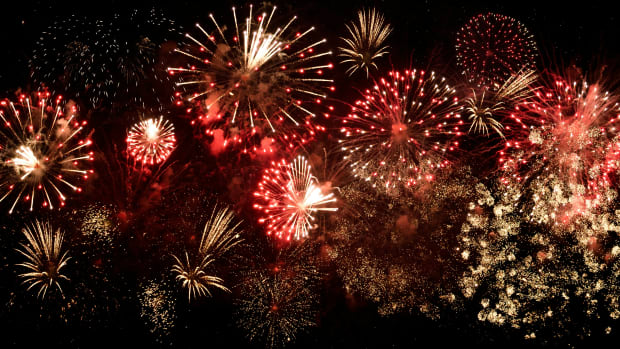
How fireworks in the Netherlands grew into a national tradition

We appear to be heading towards the final New Year’s Eve before a nationwide fireworks ban comes into force. Although the very last firework rocket – legal or otherwise – has certainly not yet been set off for good, this ban does bring an end to a deeply rooted Dutch tradition. But how did that tradition actually come about? Historians from the UvA set out the history of the Dutch fireworks tradition.

Midwinter. The days are short, the nights are bleak, and the sun rarely shows itself. It is therefore hardly surprising that, for centuries, this dark time of year has given rise to a need for rituals centred on the familiar, warming and protective element of fire. According to Professor Peter Jan Margry, who specialises in European cultural anthropology, large fires were already being lit during midwinter celebrations as early as the fourth century AD. “On 21 December, the unconquered sun reaches its lowest point; to lend greater significance to that moment, various rituals emerged at an early stage,” he explains.

Through loud noise, the ringing of bells and large fires, evil spirits were believed to be kept at bay, thus ushering in a prosperous new year. “We already see such Germanic, pagan practices in the early Middle Ages,” Margry notes.
Nobles and landowners
Although at that time we are still far from what could truly be called fireworks, this began to change in the second half of the Middle Ages. “Gunpowder from China reached Europe, and slowly but surely, a forerunner of recreational fireworks developed in the fifteenth century,” the professor explains. “At that stage, however, it was very much an elite affair. Fireworks were mainly used at festivities involving nobles and landowners, or at weddings.”
In the centuries that followed, fireworks became increasingly common, says lecturer in Dutch history Arjan Nobel. “Especially in the seventeenth century, fireworks were set off in the Netherlands on a regular basis during major celebrations. There are beautiful depictions of these events. Fireworks were set off on Dam Square in Amsterdam in 1648, when the end of the Eighty Years’ War was celebrated, and again in 1697, when a large diplomatic delegation arrived.”

Fireworkers
At the time, the work was carried out by specialised men, often soldiers, who were known as fireworkers says Arjan Nobel. “These fireworkers – or pyrotechnicians, as we would call them today – produced the fireworks and set them off themselves. Books were even written for them to use as manuals, describing how different kinds of fireworks could be made. In 1678, for example, a Dutch translation of a book appeared that explained, among other things, how to make a dolphin or porpoise that shot jets of fire from its mouth.”
Such a professional approach was common, yet even then, private individuals occasionally set off fireworks themselves. “We know this because villages and towns regularly issued regulations banning, for instance, the lighting of bangers,” Nobel explains. “City authorities were mainly concerned about the fire hazard associated with private fireworks. Of course, it was far less widespread than today and largely reserved for the elite, but it did happen.”
New Year’s Eve
In the centuries that followed, setting off fireworks became an increasingly prominent part of New Year’s Eve celebrations. “In the second half of the nineteenth century, large numbers of Dutch people in the Dutch East Indies became familiar with Chinese fireworks. Newspapers from that period report that enormous numbers of fireworks were set off there during the turn of the year. That encounter also appears to have influenced the popularity of consumer fireworks back home,” explains Nobel.

At the beginning of the twentieth century, fireworks became increasingly popular, but the real breakthrough came after the Second World War. Prosperity rose sharply, and by the mid-1950s, year after year, newspapers were reporting on the large amounts of fireworks set off at New Year, including nuisance, injuries and fatalities. “In those decades, fireworks became ever more familiar and developed into a national phenomenon in which almost everyone took part,” says Peter Jan Margry.
Collective memory
“And that is precisely where the difficulty lies,” continues the professor of European ethnology. “We have come to associate fireworks so strongly with New Year’s Eve that you cannot simply get rid of them again. In the media, especially over the past few decades, there has been a strong desire to define exactly which traditions exist within society. Things like the cultural heritage of Unesco also contribute to the reaffirmation of that idea. As a result, the fireworks tradition has acquired its own distinct dynamic, operating at a meta level. The eagerness to emphasise it as an important tradition has meant that people have become increasingly attached to it.”
As a result, the entire fireworks debate has weighed heavily on us as a society in recent years. The question, then, is whether the practice will ever truly disappear. “We are dealing with nuisance and victims. Fireworks are becoming ever more powerful and can easily be purchased on a large scale. That is why we have now decided that things cannot continue like this,” Margry says. “At the same time, the practice has existed for an incredibly long time. That ritual transition from the old year to the new is a kind of no-man’s-land, a vacuum in which society is put on pause. That is embedded in the collective memory, and you cannot simply erase it.”