Finnish president Stubb, also called the ‘Trump whisperer,’ visits UvA

During his state visit to the Netherlands, Finnish President Alexander Stubb paid today a heavily guarded visit to the UvA. His visit was overshadowed by the negotiation on a peace agreement between Russia and Ukraine, in which Stubb plays a key role.
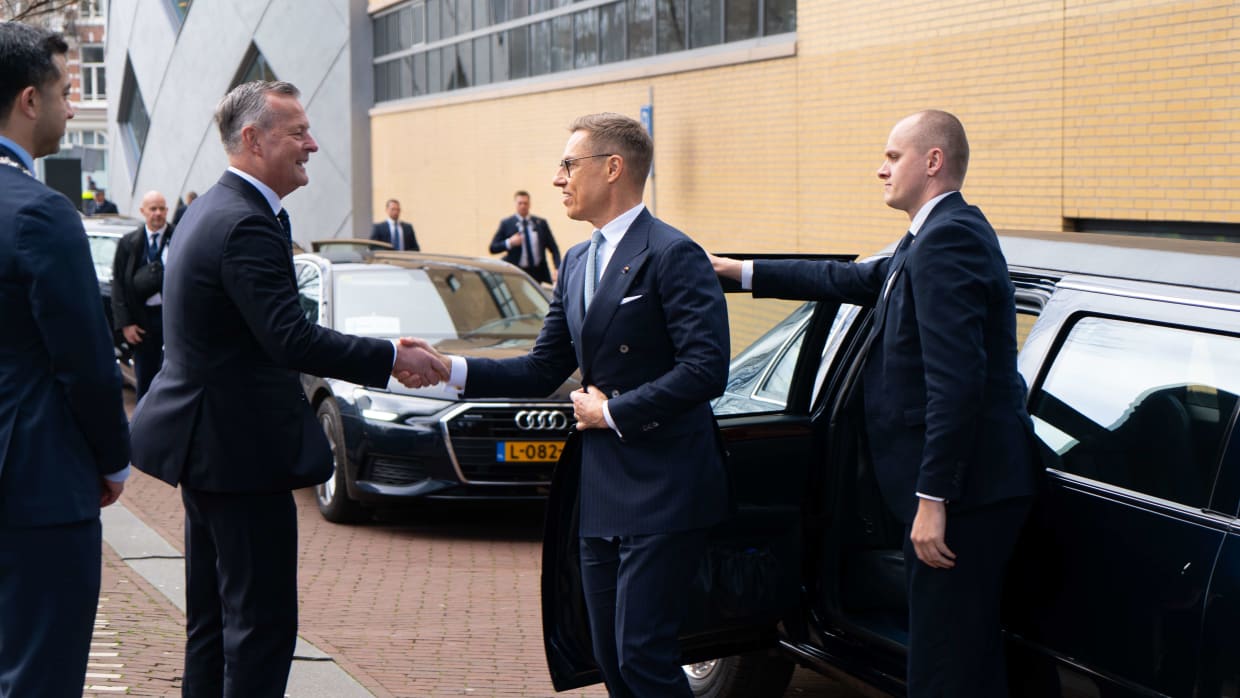
During Finland’s state visit to the Netherlands, Finnish President Alexander Stubb also visited the UvA on Thursday, December 11, to give a lecture on international cooperation. Upon the Finnish delegation’s arrival at the REC, it immediately became clear how heavily guarded President Stubb’s visit was, as befits a state visit.
In the run-up to his reception at the UvA, dozens of police officers and security guards patrolled the campus. Stubb and the rest of his delegation then arrived in a police convoy of about ten cars. Rector Peter-Paul Verbeek welcomed Stubb on the bridge at the main entrance of the REC.
President Stubb was then escorted to a central hall in REC-A. The hall was completely filled with students, Finnish media, and Stubb’s own delegation, which filled the entire first two rows. After the Rector’s opening remarks, Stubb was given the floor for his lecture.
Russian threat
Stubb’s visit is overshadowed by the war between Ukraine and Russia, in which the West is confronted with provocation from Russia. In discussions about a possible peace settlement, reference is sometimes made to Finland, which ceded ten percent of its territory to the Soviet Union in the 1940s in order to maintain its independence.
That history between Russia and Finland may have inspired President Donald Trump’s 28-point plan. In its current form, it states that Ukraine should also cede territory in exchange for peace with Russia.
At the same time, Stubb has become a confidant of Trump this year, according to the NOS. He is even called “Trump’s whisperer.” Stubb earned this nickname partly through informal meetings with Trump, such as joint rounds of golf. In addition, in August, Stubb was part of a high-level European delegation that traveled to Washington to convince Trump to continue supporting Ukraine. Finland stood out as a relatively small country among heavyweights.
Cooperation
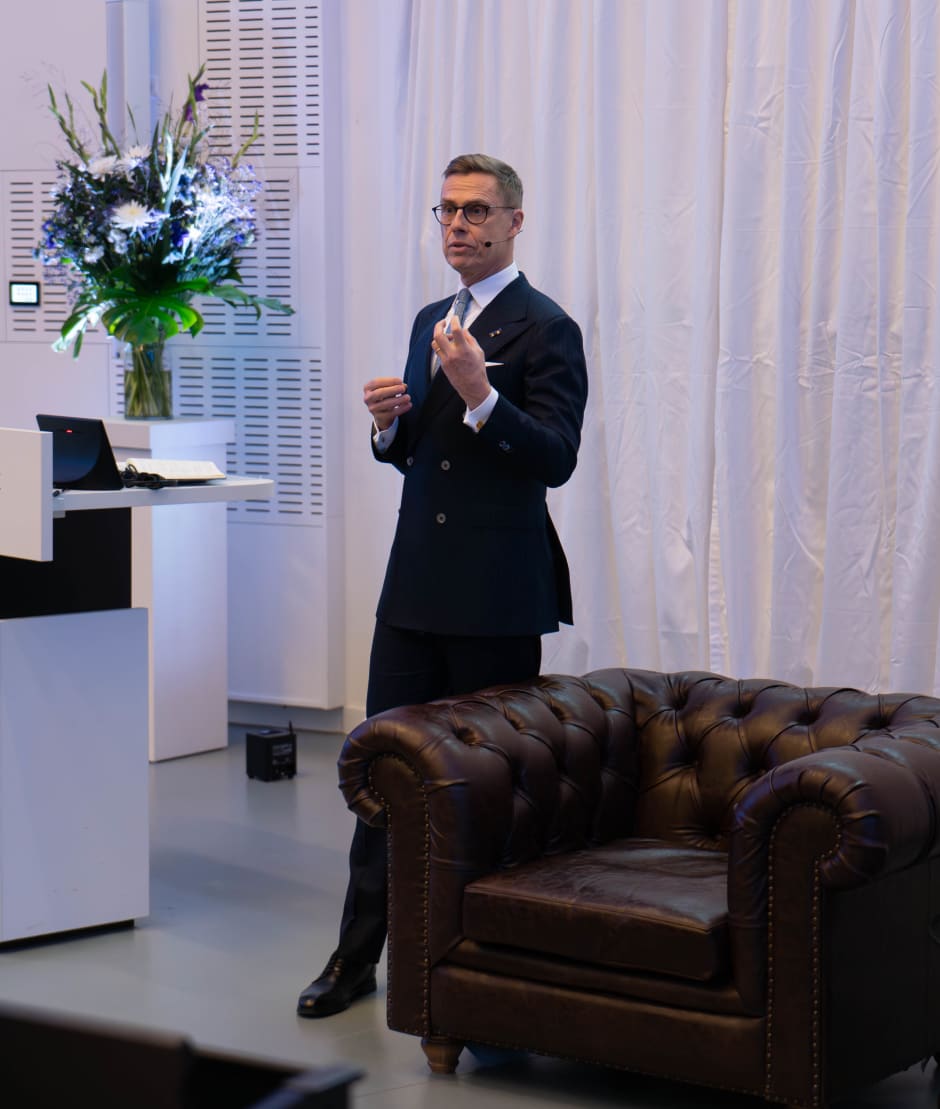
During his lecture, Stubb placed the current war in Ukraine in the context of a broader shift in global power relations. He outlined how the world order is currently shifting from a post-World War II structure in which a few large countries had a lot of influence to a reality in which multiple powers exist. In his lecture, he advocated for a specific type of cooperation: “We must bring back multilateral cooperation, in which multiple countries work together within a system of rules and institutions.” This is similar to how the European Union is structured.
At the same time, regional conflicts have been increasing worldwide in recent years and international rules are increasingly being ignored, Stubb said. Therefore, he argued, the West must be prepared to share power in order to revitalize the multilateral system and prevent the world from sliding further into an unstable order without clear rules.
Jokes with student questions
After the lecture, there was time for questions from UvA students, including Finnish students. This session was moderated by Fleur Launspach, correspondent for the NOS. Amidst the serious topics, Stubb also showed his humorous side. For example, moderator Launspach mentioned that Trump had called Stubb a ‘young and powerful man’. Stubb responded by saying that this phrase was written on a card on his wife’s bedside table.
This joke came after a student asked how Stubb maintains a balance between his personal relationship with Trump and expressing criticism, both publicly and behind closed doors. Stubb says he remains diplomatic in public, but in private there is more room for maneuver. For example, Trump reportedly asked Stubb privately whether Russian President Putin could be trusted, to which Stubb clearly replied “no.” According to Stubb, it’s about building on the points where you agree with each other, so that you can then disagree openly or behind the scenes on other points.
One student also wanted to know how European countries should defend themselves against the recent increase in sabotage and provocations targeting NATO infrastructure from Russia. Stubb is level-headed: “We must remain cool, calm, and collected. These are provocations intended to destabilize Western societies. You need to have your defenses in order, but don't overreact.” When the moderator remarked that this level-headedness sounded very “Finnish,” Stubb smiled: “Yes, that’s right.”
Another student asked what changes Stubb would propose to the 28-point plan that Trump had previously launched. “I have to be very careful here,” said Stubb, because Finland is involved in talks between the Americans and Ukrainians. According to him, the original 28-point plan has now been reduced to 20 points. Stubb disagreed with at least eight of these points and had discussed this with Trump. The rest of the afternoon program of the state visit was partially shortened because Stubb would be participating later that day in consultations of the so-called “coalition of the willing” with countries that support Ukraine, he said.
Red golf cap
At the end of the students’ questions, moderator Launspach pointed out that the lecture was full of serious but topical themes such as war, threats, and a faltering world order. Could Stubb perhaps end on a positive note? He could. He shared that, despite everything, he is hopeful about multilateral cooperation in the future and sees that more and more countries are entering into good partnerships.
To thank Stubb for his visit to the UvA, Launspach presented him with a gift: a red UvA cap. Launspach concluded: “You can wear this when you go golfing with Trump again.”