Dean of Science Susan te Pas: “We need to attract a new type of technical student”
The budget deficit and declining student numbers in the Faculty of Science are high on the list of priorities for new Dean Susan te Pas. She is particularly concerned about the unexpectedly sharp decline in AI and computer science students. That is why she wants to give the university a more technical profile in the coming years.
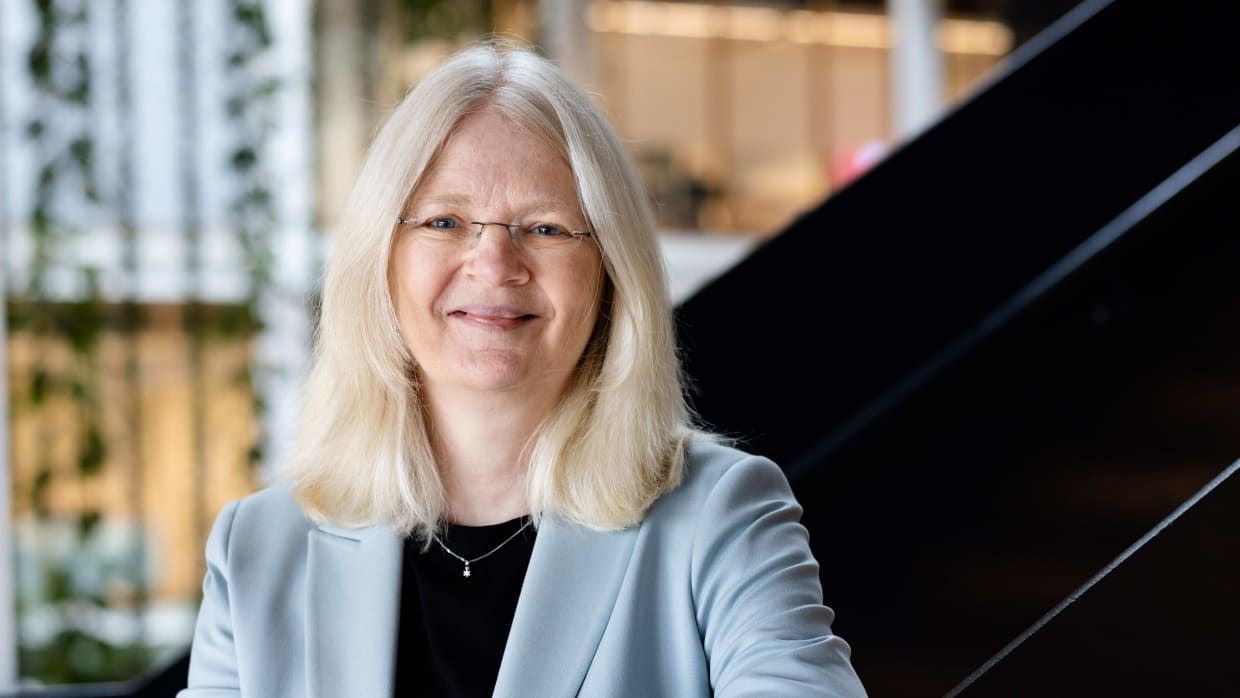
For a moment, Susan te Pas seems untraceable. The new dean of the science faculty appears to take up very little space in the ballroom that she calls her office. Apart from an enormous conference table and two armchairs, her room seems empty. Then she steps into view from behind her desk in the left-hand corner and immediately apologises. “I have a lot of meetings here, but when we move, I’ll ask for a smaller room.”
Modesty is one of the character traits that emerges in an initial conversation with Te Pas. Yes, she has enjoyed her first few months as head of the science faculty. Because working with “opinionated, enthusiastic and also brilliantly creative” people is “always wonderful”. However, she immediately adds that the faculty also faces some financial challenges.
Susan te Pas (Ijsselstein, 1969) studied experimental physics at Utrecht University and obtained her PhD in 1996 in the interdisciplinary field of human physics, which now falls under cognitive science and psychology. During her years as a postdoc in Oxford, Nijmegen and Utrecht, she made the switch to psychology and developed her love for teaching.
Since 2012, she has been Professor of Cognitive Psychology of Higher Education at Utrecht University (UU). In 2021, she became dean of University College Utrecht. Since July 2025, she has returned to the Faculty of Science as successor of the former dean Peter van Tienderen. As deas she was also appointed full professor at the Swammerdam Institute for Life Sciences (SILS).
You have a background in physics but soon made the switch to psychology. How does it feel to be back at a science faculty?
“Like coming home. I was trained as a researcher in the natural science and the research tradition here feels very familiar. You can’t lump all natural scientists together, but there is a shared love for the experimental research method – I always call it algorithmic thinking – and I feel that very strongly here.”
After completing your PhD, you developed a love for teaching. You ignored warnings from colleagues that this would be detrimental to your career. Did you not want to pursue a career?
“No, not necessarily. I’ve always chosen what I found really interesting to do and where I thought I could make a difference. So I chose education, a conscious decision not to become a professor. Later, it turned out that education was actually a career path that was becoming more available in Utrecht at that time. I was the right person in the right place and eventually became a professor after all. That’s how it goes sometimes, and sometimes it doesn’t work out at all.”
You bring a lot of experience from other universities to the UvA. What out-of-the-box ideas have you already contributed to FNWI?
“Ideas they hadn’t thought of yet? To be honest, I don’t think so. I think a lot of people here are aware of what’s happening nationally. I just notice that the boundaries here are sometimes different from what I’m used to. Education and research are very separate here, so you have to work harder to make the connection. Making that connection is something I really enjoy doing. Sometimes I look at those boundaries differently, and that can provide insight or change something.”
These are turbulent times for FNWI. This year, the influx of first-year students at FNWI fell by 13.7 per cent, even more sharply than the national average. Why do you think that is?
“This is partly due to demographic factors that we took into account – there are simply fewer VWO students graduating from secondary schools, and they are less likely to choose a science-based programme. But the decline this year was greater than anticipated.”
“Actually, student numbers are declining in all programmes, but the decline is most pronounced in AI and computer science and interdisciplinary programmes. That’s surprising, because in these times you would expect those programmes to be popular. It’s as if students think the AI revolution is already over, when it’s only just beginning. That worries me, because there is a demand for these people in the labour market and there is room to train them.”
How do you intend to tackle the decline in student numbers?
“I think we need to attract a different type of student than we are currently reaching. Students who want to think more practically. We now have the new Bachelor’s programme in Science, Technology and Innovation for this, but it is not yet attracting as many students as I would like. We need to work on our technology profile and show that, as a faculty, we not only conduct fundamental research but also research into applications. We are much more technical than we sometimes appear to be.”
Won’t that mean the UvA is fishing in the same pond as the technical universities?
“Technical universities do more engineering, which really goes a step further with the design of devices and equipment. At the UvA, we are more focused on applying theory.
For example, we conduct research into cleaner batteries that are less dependent on rare earth metals and build them in the lab. Researchers build their own setups here, which involves a lot of technology. But we don’t have a model factory here. We don’t need one, because we don’t need to become a technical university.”
“On the other hand, we have three technical universities in the Netherlands, but none in North Holland. So we can attract students who want to think more technically to North Holland. I don’t expect this to create competition, because there are enough students in the Netherlands who are interested in a more technical education. And we really do need to train more science graduates in the Netherlands.”
And then there are the budget deficits at the faculty.
“These are not prosperous years. There are major challenges, and they are high on my list of priorities. Not only is education becoming more expensive due to declining student numbers, but square metres have also become more expensive. As a science faculty, we need quite a lot of floor space for laboratories. We receive a budget for this from the UvA, but it hasn’t been indexed for years, while the costs for equipment and lab staff have risen.”
“The biggest problem is the government cuts. We made agreements with the ministry that there would be more permanent positions for research and that they would contribute in the form of starter and incentive grants, among other things. Those grants have now been abolished, but we had counted on them.”
Does that mean fewer staff at the faculty in the long term?
“There will be less room for permanent staff in the first round of government funding. This means that some positions will not simply be filled. The hope is, of course, that the number of staff will remain the same but that they will be financed differently, through research funds that scientists bring in themselves. And the hope is, of course, that the new cabinet will reverse the cuts.”
Do you expect the latter to happen?
“Not for the time being. But it is time for a return to stable policy. I read yesterday that the Netherlands is once again prominently featured as a country of innovation in the negotiation documents. And that talent from abroad is once again welcome.”
Where do you want to be in four years’ time?
“I want to have a healthy budget so that we can invest again. And I want to have built bridges between disciplines, both across the UvA and within the faculty. People often work together within their research group, but I want to connect different disciplines. And ideally, we would also like to have more Bachelor’s students.”