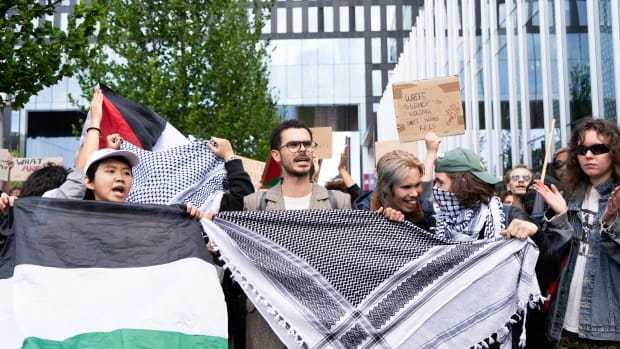
These UvA lecturers will raise the alarm for Gaza on Monday

Under the banner #WijWerkenHierNietAanMee (We won't cooperate with this), an alarm will be sounded for Gaza at various UvA locations at 12 noon on Monday. Dressed entirely in red and making a lot of noise for several minutes with pots, pans and horns, among other things, UvA staff will call on the government to take a stand against Israel. These two UvA lecturers tell their story.
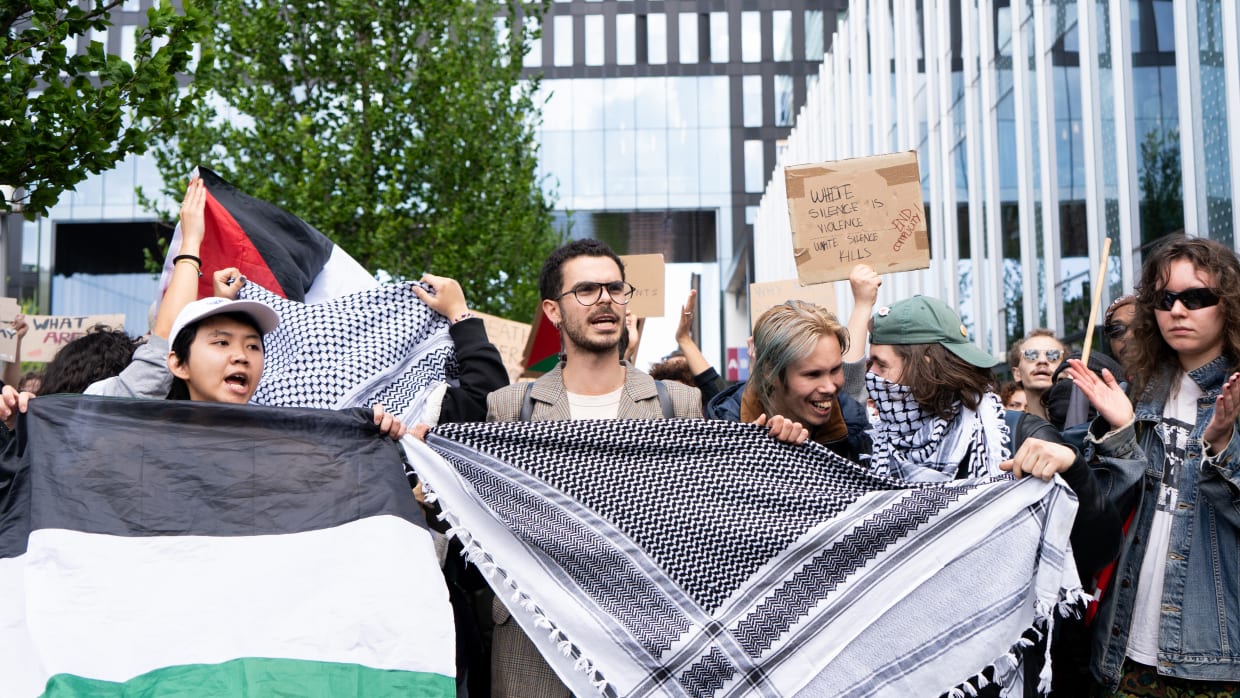
This Monday’s protest is part of a national campaign in which activists are demanding that the government take more decisive action against Israel. As soon as the air raid siren sounds at noon, there will be two minutes of silence, after which a cacophony of noise is supposed to erupt. The Netherlands is sounding the alarm; that is the message. While the academic year is starting in Amsterdam, there will be a moment of reflection on the fact that this is not happening in Gaza. The protest is accompanied by a statement in which UvA lecturers indicate that they no longer wish to bear responsibility for cooperation with Israeli institutions. But who are these lecturers who have been intensively involved in this type of protest for two years?
Sruti Bala (51), associate professor of theatre studies.
Born in India.
Has been working at the UvA since 2007.
Member of UvA staff for Palestine since its founding.
Context and clarity
Associate professor of theatre studies Sruti Bala has been an active member of the protest movement within the UvA for some time now, but that is not how it started. “Initially, it wasn’t a protest, but rather a need for more context and clarity,” she explains. “I was part of a group that started organising teach-ins back in October 2023. We wanted to better understand what was going on, because we quickly realised that this was a serious problem. In order to respond appropriately to the situation, we needed explanation, context and history.”
Bala felt that the terms used by the UvA, among others, did not correspond with reality. “People were talking about “the situation in the Middle East” or “a war between Israel and Gaza.” That wording was not accurate, so I wanted to contribute by providing information. We entered into dialogue with various authorities within the UvA, and only when there was little response did we move on to protest actions.”
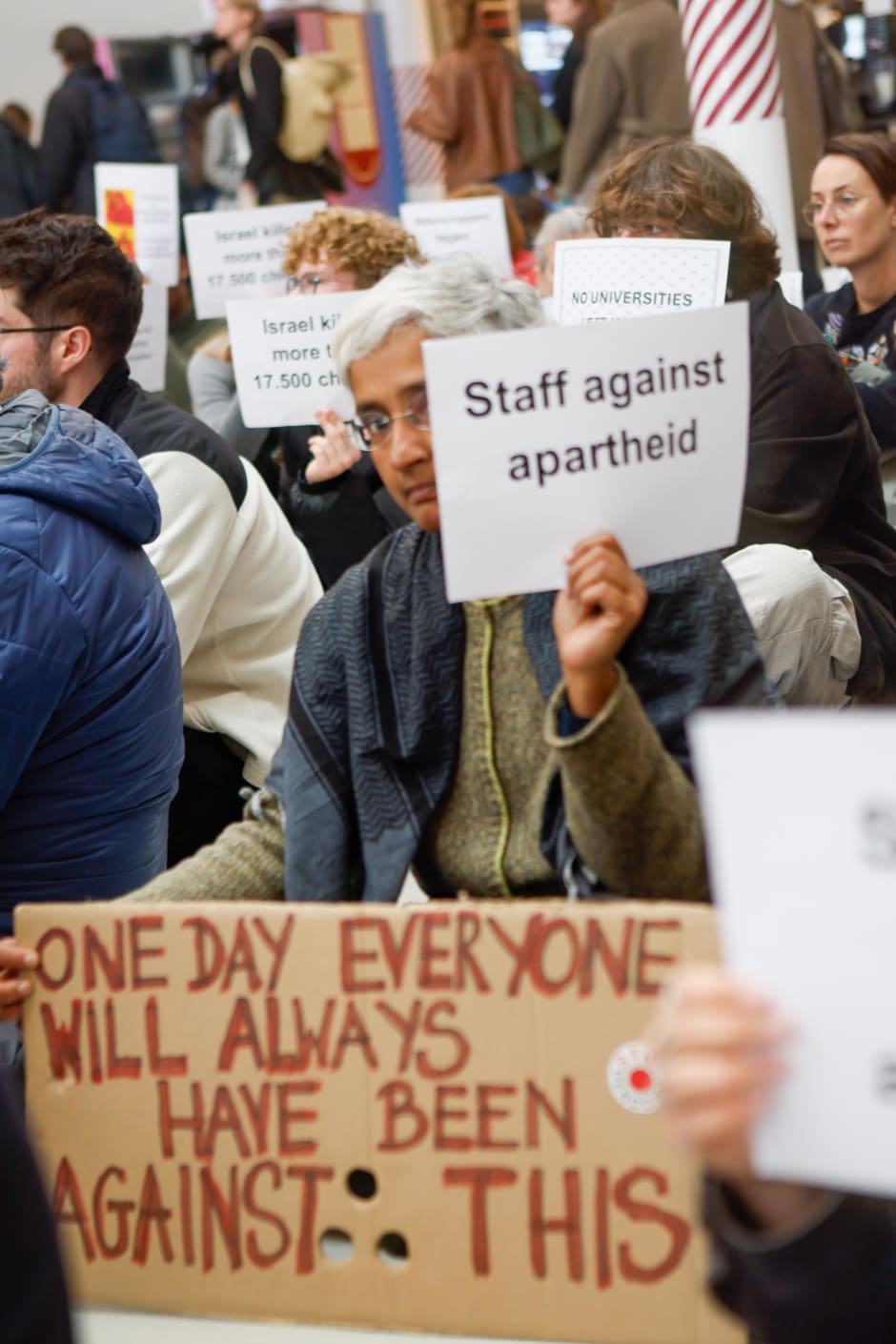
According to Bala, her emergence as a visible activist is a logical consequence of her role as an academic. “The tasks of a scientist do not consist solely of publishing articles from an ivory tower. We must use our privileges to bring about change. Even within my own discipline, theatre studies, I see how important it is to hold up a mirror to society.”
And that mirror seems to be proving its usefulness. Over the past two years, Bala has seen public opinion change significantly. “I think that also has to do with the scale of the violence in Gaza. It is no longer tenable to claim that it is all just because of 7 October. So we are seeing a real change, also within the UvA. People are increasingly recognising that what is happening now is not alright. There is still a long way to go, but in this way we are showing that we do not accept the status quo.”
Sneha Gaddam (38), teacher at Amsterdam School of Economics.
Programme director of BSc Economics and Business Economics
Born in India.
Has been working at the UvA since 2017.
Member of UvA staff for Palestine since its founding.
Deafening silence
Like Bala, Sneha Gaddam, a teacher at the Amsterdam School of Economics, was also involved in the UvA Staff for Palestine organisation from an early stage. “I was part of the teach-ins that were organised from the very beginning, and later also of the protests that followed. At that time, there was still a deafening silence surrounding this topic within the economics faculty. I wanted to become better informed, but above all I wanted to show solidarity with Palestine.”
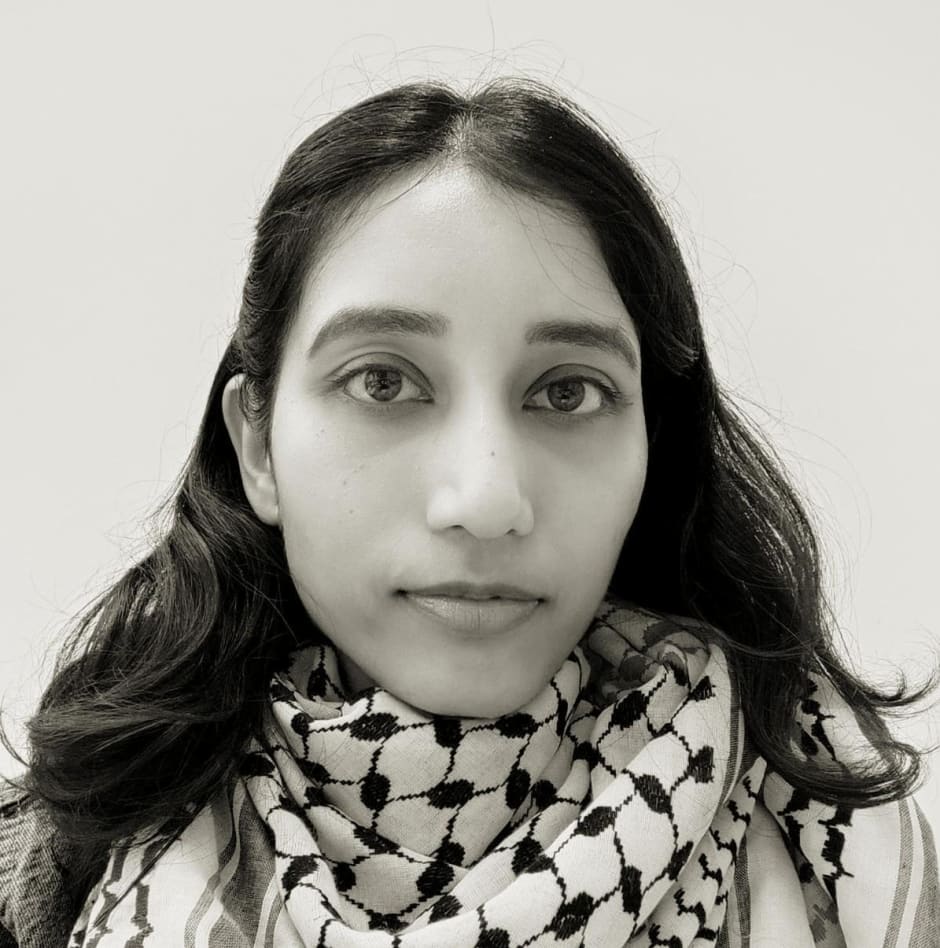
Gaddam is not necessarily a natural protester, but she says she could not ignore the injustice in Gaza. “When I see something so unfair happening, as a fellow citizen I don’t want to be a bystander. That is exactly what the university has trained us to do. We must fight injustice, take action where possible and act according to our responsibilities.”
According to Gaddam, the deafening silence of the early days is disappearing. “I see that more and more people want to be informed about this issue and want to do their part.” Still, she says, it has sometimes been tense to be such a visible part of a protest movement. Gaddam does not want to call it a risk to her career, but as a relatively young faculty member, she sometimes feels vulnerable. “We don’t often see the higher-ranking professors at the protests. When those most powerful colleagues speak out, it gives us even more confidence.”
The protest will take place at 12 o’clock at three different locations: the BG site, the ABC main hall on Roeterseiland and the entrance to the main building of Science Park.
Gaddam hopes that Monday afternoon’s action will succeed in demanding the attention of parliament. “The demands on the cabinet are clear. The arms trade with Israel must stop, as must the import of products from the illegal settlements. We must also ensure that the necessary humanitarian aid can reach Gaza, and the Dutch government must recognise the Palestinian state.” She remains hopeful for a positive outcome: “The very fact that this is now being debated is the result of all those protests and publicity. Politicians can no longer ignore it. Change is slow, but it is possible.”