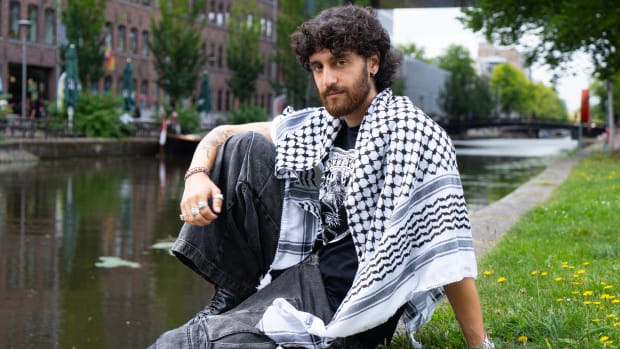
New Asva chair Sahand Mozdbar: “We must not be moralistic leftists”

The new Asva chair Sahand Mozdbar would prefer to see students joining forces on the barricades. Against cooperation with Israel, the scrapping of English-language studies and severe budget cuts. There is room for all political colours, says the outspoken communist Mozdbar.

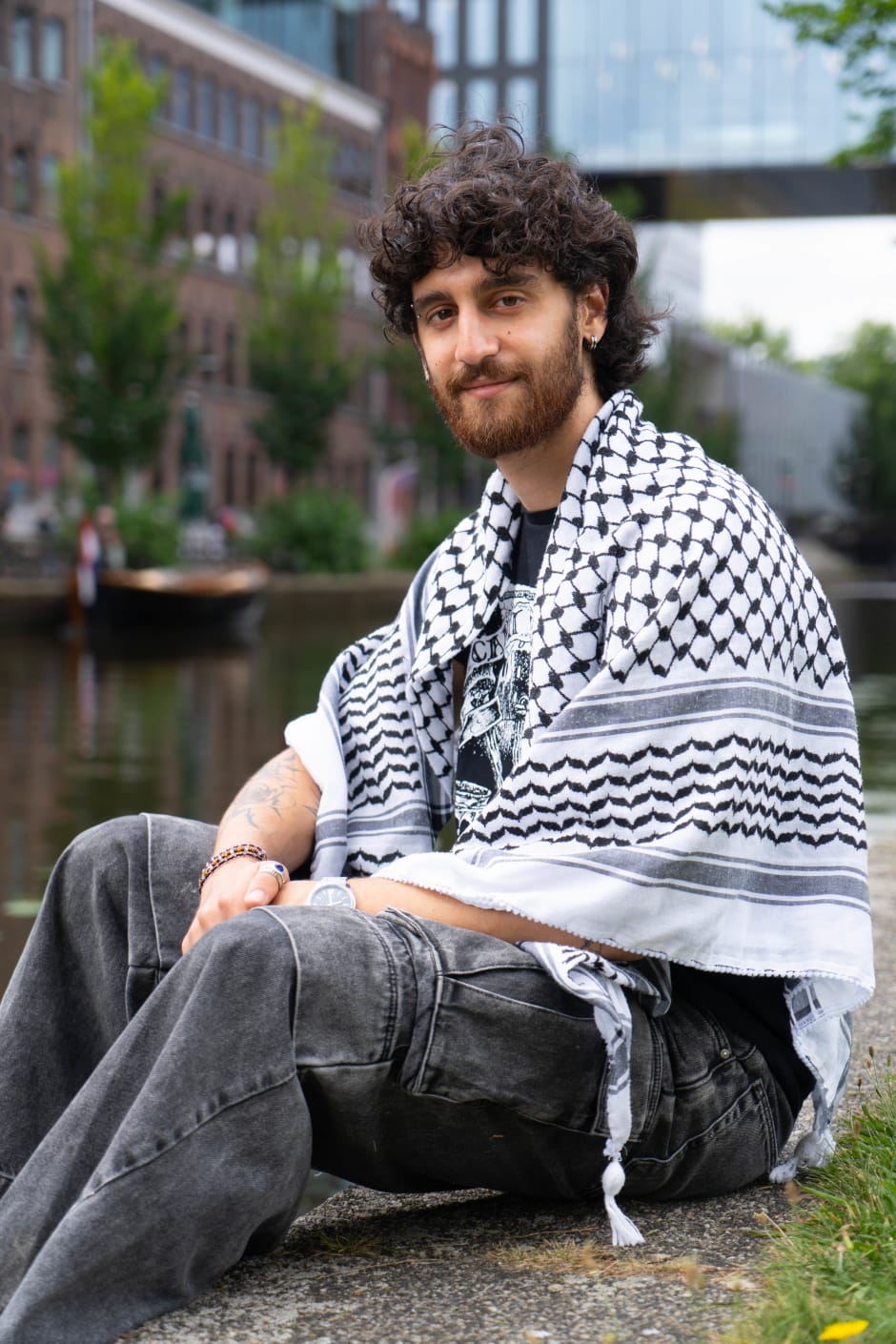
Creating a community is the personal goal of the new chair of the Amsterdam student union (Asva), Sahand Mozdbar (23), this year. He knows how important that is: in secondary school, he was something of an outsider with his piercings, wild hair and T-shirts from bands such as Black Sabbath and Iron Maiden. But thanks to the world of metal music, guitarist and UvA student Mozdbar now understands the importance of togetherness.
In 2025/2026, Mozdbar will form the board of the Asva together with UvA students Marijn Snel, Nina Cortès Niehe and Miko Kok and HvA students Ayrton Anemaet and Rania Ezzimousa. Last year, a striking number of students came to demonstrations organised by the Asva, says philosophy student Mozdbar. He hopes that this increase will help him create “an activist community for all students” this year.
Asva participates in pro-Palestinian UvA occupations, you are an outspoken communist on social media, you wear a keffiyeh and Antifa pins on your bag. Isn’t it a bit naive to think that you can form a community for the entire political spectrum of students?
“Part of being chair is putting your personal preferences aside a little. I try not to look through a left-wing or right-wing lens. Asva represents students” interests in housing, studying, affordable living and the like, which are crucial for every student. People with preconceptions are quick to think, “That’s a left-wing club”. But the housing market, for example, affects everyone, regardless of where you stand politically.”
But solutions for the housing market, for example, are inherently left-wing or right-wing, aren’t they?
“That’s true, whatever your political beliefs, we’re here for you, that’s what I mean. But we can’t avoid having a certain ideological approach. As a board, we complement each other well with our different backgrounds, but I think we agree on those ideas. For example, we don’t believe in market forces in the housing market, but in public housing. So in that sense, we do ultimately have a certain political, perhaps left-wing, leanings on certain issues.”
This left-wing sentiment that seems to prevail within trade unions, student parties and the academic world has been met with a political counter-movement. The new right-wing conservative student party VSP, for example, opposes the “woke ideology” at the UvA. How do you deal with such ideas?
“We are not a political party and we represent all students. That makes it difficult to draw a line. But if there are racist remarks or the exclusion of certain groups, we will have to set boundaries in some way. That is the paradox of tolerance: sometimes, in order to be inclusive, you have to exclude people.”
Speaking of exclusion, are you still in contact with the ASC/AVSV after the violent abuses committed by its Thalia fraternity?
“Asva has ties with most student associations, but no longer with the ASC since previous incidents. Associations are necessary for a sense of community, where, students with the current pressure on their studies, finances and mental well-being can turn to. But there are limits to this if a club crosses the line. I still need to read up on the Thalia case, but depending on each case, we will consider whether we want to work together or continue to work together.”
In the past, Asva has been outspoken in its support for the pro-Palestinian occupations. Will that remain the case now that your major financial backer, the University of Amsterdam, has actively severed ties with the Hebrew University and is investigating its collaboration with Tel Aviv University?
“Asva has a rich history of supporting student demonstrations. I suspect that support for protests will not change in the future, also given the views of the rest of my board. The UvA still has ties with Israel through the Horizon Europe fund. Meanwhile, the famine in Gaza has become critical: some people are so starved that they cannot even be saved. This is an issue among students, so we also have a role to play. The activist line taken by previous boards in the protests will therefore not change.”
Added to this are the seemingly inevitable cuts to higher education by the previous government: 1.6 billion euros. Asva itself already had a deficit last year.
“Our finances are fine at the moment. We do not expect any further cuts. And we will do everything we can to stop the cuts. Ultimately, we do not make decisions about where and how cuts will be made, but we can demonstrate as much as possible with national organisations such as the National Student Union to stop the cuts in the new cabinet. This also applies to international students, such as the scrapping of English-language bachelor’s programmes in psychology.”
Student clubs are finding it increasingly difficult to find board members. Why did you decide to devote a year of your life to a student union?
“I am extremely aware of the privilege of being able to study. I am the first person in my family to have this opportunity. My father fled after the 1979 revolution in Iran and my mother later joined him in the Netherlands. My family were left-wing activists in Iran, which meant they were no longer safe there. I inherited their activist nature.”
“Last year, I founded Het Vredescomité (The Peace Committee), a movement that offers a countervoice to the militarisation of education. For example, we believed that the Ministry of Defence had a plan to collaborate with university researchers in order to circumvent budget cuts, which we opposed. Because then, as a researcher, you could end up working on war equipment in Israel, for example. As an activist in that committee, I thought: how can I do more of this kind of work before I finish my studies? That’s how I ended up at Asva.”
And how do you envision a community at an advocacy organisation like Asva?
“Communities make life bright and cushion people. Whether that’s a student association, a study association or a student union. As a student union, it is our job to listen to students, and I think that is where our mission lies. We will be present at action groups, visit more Secondary Vocational Education – those students in particular feel that we are not visible enough – and learn what is going on at every event. We should not be left-wing moralists, but rather offer a listening ear to all students.”