The similarities between Rembrandt and Gen Z: “He would have been a fan of vaping”

Rembrandt as a pioneer of Gen Z? In his book Sex, Drugs and Rock ‘n’ Roll in Rembrandt’s Time, UvA historian Benjamin B. Roberts paints a picture of the early seventeenth century, when Rembrandt and his contemporaries wore earrings and mullets, dressed in gender-neutral clothing, and experimented with drugs.
Would Rembrandt have identified as queer if he were alive today? Historian and writer Benjamin B. Roberts opens his book with this provocative question. One of the first pages shows a self-portrait of the young painter with a luxurious head of hair and a striking earring. “That was completely out of fashion for the generations before him,” Roberts explains. “Certain stylistic characteristics we see in him are reminiscent of those of today’s Gen Z. What it means to be a man is strongly culturally determined, and we see that blurring with Gen Z, just as it did with Rembrandt’s generation.”

And so, according to the historian, Rembrandt – with his penchant for jewellery and wide trousers – would not look out of place walking down the street in Amsterdam today or visiting a trendy club such as the Skatecafé. “The term queer didn’t exist back then, but I definitely think Rembrandt would have identified with it. He played with what it meant to be a man and dressed in a very gender-neutral way. Experimenting with sexuality is part of youth. Even in the seventeenth century, all sorts of things happened in the woods or in the dunes,” says Roberts.
Binge drinking
It turns out that there were many facets to the painter’s life that, according to Roberts, bear similarities to the life of a contemporary student. Excessive drinking, a liberal sexual morality, it all happened. “Students drank a lot back then too. I wouldn’t be surprised if the drinking habits of today’s generation pale in comparison to those of the seventeenth century. Drinking water was unreliable, so beer was safer, and students were also exempt from alcohol tax. Phenomena such as binge drinking and drinking games already existed back then.”
All that alcohol consumption went hand in hand with a lot of sexual escapades, which is also reminiscent of student life today. In that sense, not much has changed in the last four hundred years, argues the historian. “In Leiden, where Rembrandt studied, prostitutes lived close to the lecture halls. After class, students would have a drink together and then visit the brothels. This was also reflected in Rembrandt’s work; for example, he made a drawing showing a couple making love. A woman with her legs up and a man lying on top of her. It indicates that he saw this as normal. Not many artists captured such things at that time.”
Lowlands
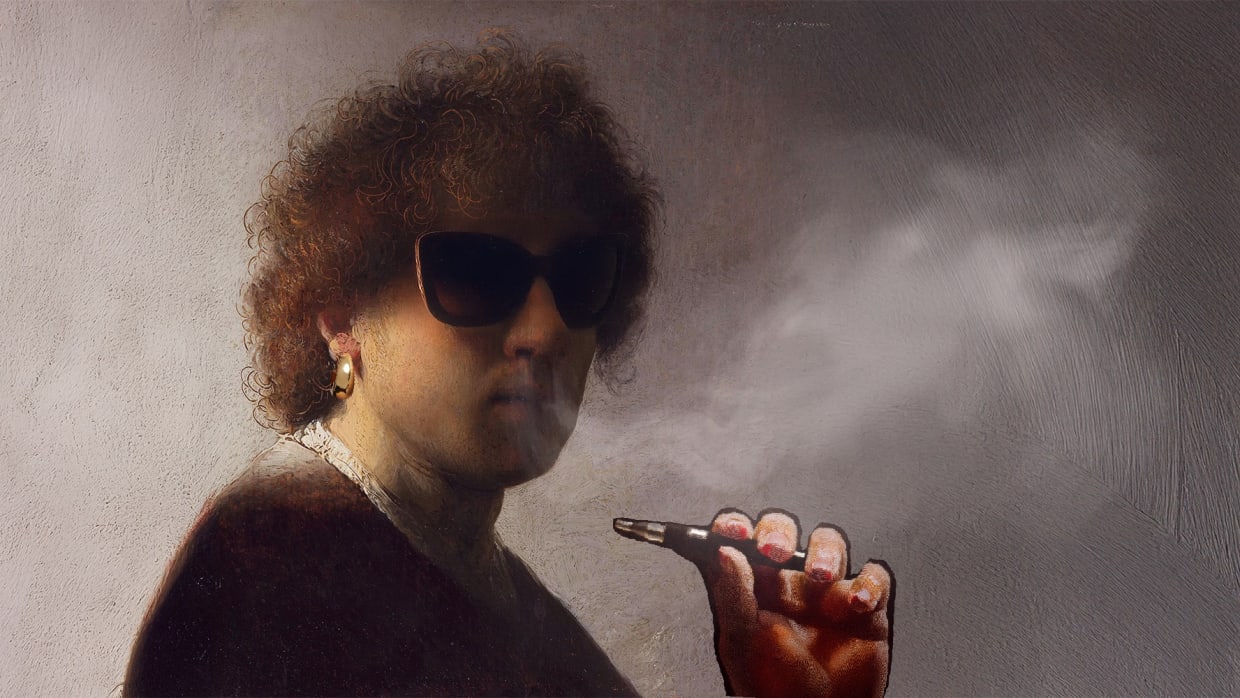
But while drunkenness and sexual experimentation could be interpreted as timeless human needs, the connection between Rembrandt and Gen Z becomes truly irrefutable when Roberts talks about drug use at the time. Until the early seventeenth century, smoking was virtually unknown in Europe. This changed around 1620 when tobacco was experimented with in the botanical garden in Leiden, because it was believed that smoking would help against the plague. Of course, this did not work, but it did give people a strong nicotine kick, and so smoking became increasingly popular; not only tobacco, but also cannabis. Conclusion? “I think Rembrandt would have been a fan of vaping. He was a young man of his generation and just went along with everything. Expanding his mind, mixing drops of certain substances into his beer, people were experimenting with all kinds of things,” says Roberts.
At a festival like Lowlands, where the use of narcotics is the norm, the young painter would have felt right at home, Roberts suspects. “And not just because of the drugs. Rembrandt’s generation sought entertainment in music as well; that was really the hype of the time. Young people would get together to sing. One would bring a lute, another a flute, and then it was party time. Just like young people today still love to sing, dance and go out. If Rembrandt were alive today, he would definitely be going to Lowlands.”
When Rembrandt’s wild youth, full of sex, drugs and rock “n” roll, as the title of the book suggests, comes to an end, Roberts draws one last poignant parallel with Gen Z. “Just as today’s baby boomers have a lot to say about Gen Z, Rembrandt’s generation was blamed for all the problems in the world. Complaining about young people by older moralists is therefore timeless. Young generations change society, bring about innovation and disruption, which is not always welcome by older people.”