UvA University Library employee writes feminist novel about toxic relationship

The fifth novel by Diana Tjin (63) – an employee at the UvA University Library – is centred on women’s emancipation. With Scènes uit een giftige relatie (Scenes from a Toxic Relationship) she aims to express her concerns about women who are oppressed by their partners. “I have used my own relationship from the 1980s as an example.”
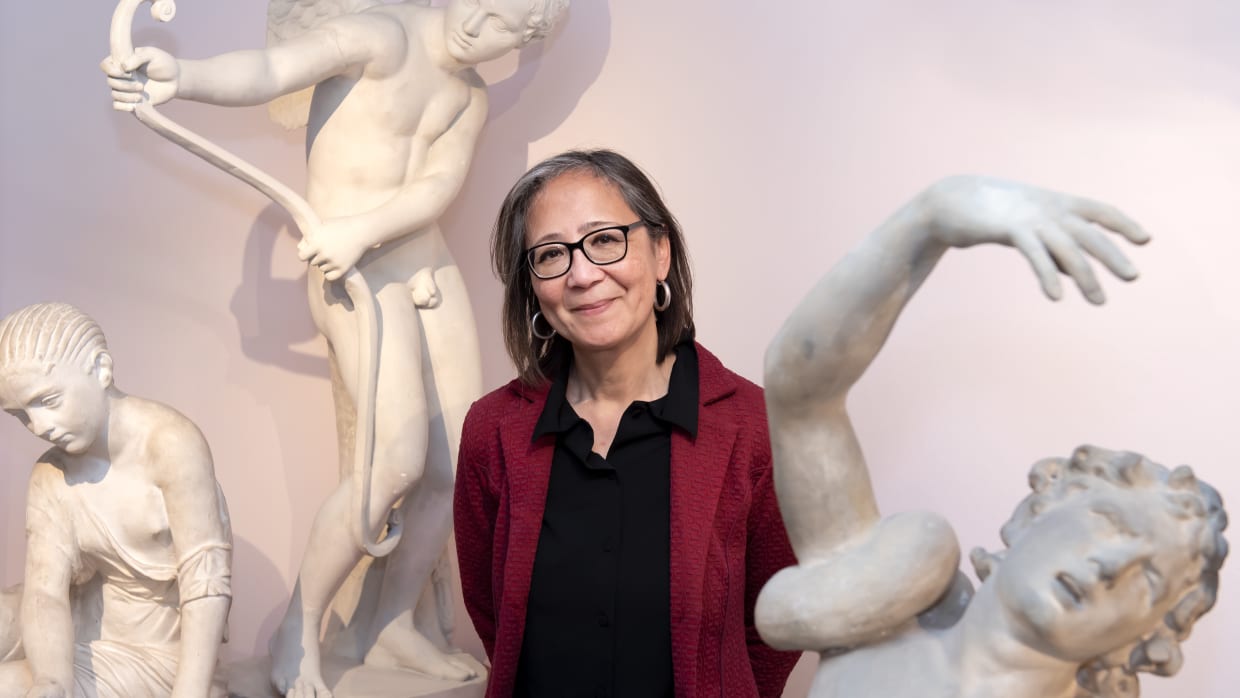
Diana Tjin previously wrote four other books alongside her work as a university library assistant. Her latest novel, released in April, centres on seventeen‑year‑old Hermine. She falls in love with Berend, a student who is five years older. He is the love of her life—at least that’s what she thinks. When they move in together, his true nature is revealed: a narcissist who belittles her with verbal abuse. He dismisses her academic pursuits and confines her to a traditional women’s role, leaving the shopping and cooking largely to her. Once entangled in a toxic relationship, it becomes difficult for Hermine to break away from him.
The book is called Scenes from a toxic relationship. Why?
“The title is based on the film Scenes from a marriage, by the renowned Swedish director Ingmar Bergman, about a married couple who grow apart over a long period. Readers should understand what my book is about from the title alone.”
“Furthermore, the protagonist Hermine sometimes feels like a film character in a life she didn’t write. She has lost touch with reality because she is under psychological pressure. That is also why I included theatrical scenes in some chapters. In those I describe ‘characters’, ‘scenery’ and a ‘action’ to show how estranged Hermine has become from her own life. She never imagined she would end up in such a situation.”
Hermine is forced into a traditional women’s role. Why did you choose women’s emancipation as your theme?
“I am Surinamese, so a born feminist. In Suriname it has always been perfectly normal for women to earn their own living and hold their own. Strong, self‑assured women are highly valued there. For my generation, women’s emancipation in the Netherlands was still exceptional. When I first came to the Netherlands and grew up here, it was expected that women would become housewives, regardless of whether they had studied. In my Dutch environment people raised their eyebrows at my decision to continue working after having children. I was even reprimanded by my son’s primary‑school teacher for alleged child neglect. I am shocked that girls of this generation – now the same age as I was when I had young children – still face the same. There is always some reason to keep women down. Sometimes I wonder why we haven’t made more progress. Then I think: have we really achieved nothing?”
“I used my own relationship from the 1980s as an example for my book. I also based the toxic dynamic between Hermine and Berend on troubling relationships among couples, colleagues, parents and children, and friends in my circle. I wrote this book from a feminist perspective, but more broadly it is about distorted relationships – about how people can entrap one another and how immense the consequences can be.”
Why doesn’t Hermine simply leave Berend?
“It is one of the greatest mysteries why women who endure verbal or physical abuse remain with their partner. But it’s very complex. Sometimes there are children involved, or the financial situation makes it impossible to walk away. In Hermine’s case it comes down to pure insecurity. Without Berend, she doesn’t feel like a fully fledged person. Gradually she begins to realise that she needn’t continue thinking that way about herself. That is the moment she leaves him.”
What do you want to convey to the reader?
“I wrote this book to offer encouragement to anyone trapped in a toxic relationship. It isn’t easy, but you always have the choice to leave. Hopefully it will be an eye‑opener for those who recognise themselves in the story and give them the courage not to tolerate such behaviour any longer. You must take yourself seriously – that’s where it starts.”
How can you help someone in a toxic relationship?
“My acknowledgements are addressed, among others, to everyone who didn’t look away during my toxic relationship. Whether it concerns child abuse, physical violence or verbal abuse in a romantic relationship, it is essential that bystanders don’t claim it’s just part of the deal or that someone is overreacting. At the same time, as a friend you need to be careful not to intervene directly – an abusive partner often sees such friendships as a threat and may even forbid them, which only isolates the victim further. If you sense that something is wrong, you don’t have to confront it head‑on; simply tell them you’re there for them and that they can always turn to you. Someone in desperation usually recognises that helping hand.”
How does this book differ from your other books?
“In my previous books I expressed my concerns about how society treats people from different backgrounds – racist remarks are still made all too often. I am Surinamese, and although my heritage and experiences of discrimination reappear in this book, they are not its focus. My primary concern here is the position of women, and I wrote this novel to support them.”